Teaching tips · Vietlingo
Teaching kids online: short activities, attention, and parents
0How to keep young learners engaged with short activities, and the important role of parents in online lessons.

Hello,
Teaching Vietnamese to children online requires a lot of energy, creativity, and careful preparation. Children naturally have shorter attention spans than adults and need constant, engaging interaction so they do not get bored.
Change activities often
The rhythm of a lesson for children needs to be faster than normal. You should change the activity every 5 to 7 minutes to maintain the child's attention. Try combining these methods:
- Use visual picture cards.
- Bring physical movement and fun songs into the classroom.
- Play simple games like guessing or "show-and-tell".
- Use TPR (Total Physical Response): give a very simple Vietnamese command and show it, for example "Con chạm vào mũi nào!" (touch your nose), so the child listens and does it.

Screen interaction and routines
A child's attention is usually focused on what is happening on the screen. Use the whiteboard to draw pictures together with the child, or share your screen to do an activity such as matching or sentence ordering from a Vietlingo course together. Remember to always praise the child's effort, rather than just the result. In addition, create familiar routines, for example, always sing the same hello song at the start and a goodbye song at the end.
Heritage kids
One group you may meet is heritage kids living abroad. They can often understand Vietnamese very well but are used to answering the tutor in English. In this case, patiently encourage them to repeat their answers in Vietnamese. Create a comfortable, low-pressure environment so they are not afraid of making mistakes when speaking, and praise them whenever they try to use Vietnamese.
Talking with parents
Parents play a very important role when children learn online. In the first lesson, agree on the learning goals with the parents. At the end of every lesson, you should spend 2 minutes giving a quick update on the child's progress. Give simple homework that parents can help the child review for 5 minutes a day.
Example sentence you can say to parents in English:
"Today she did a great job learning fruit words. For homework, please ask her to name fruits in Vietnamese for 5 minutes during dinner."
Vietnamese meaning:
"Hôm nay bé học từ vựng về trái cây rất tốt. Bài tập về nhà: anh/chị cho bé tập gọi tên các loại trái cây bằng tiếng Việt khoảng 5 phút trong bữa tối nhé."
Safety rules
Children's lessons on Vietlingo follow child-safety rules. The main points:
- The parent books and manages lessons on the parent's own Vietlingo account.
- A parent is present for the first lesson, and at home and reachable during later lessons.
- The child learns in a shared or open room with the camera on, never alone in a closed bedroom.
- All messages go only through the parent's Vietlingo account.
- No recording, audio or screenshots of a child without the parent's written permission.
Read the full rules in "Child safety rules for teaching kids online".
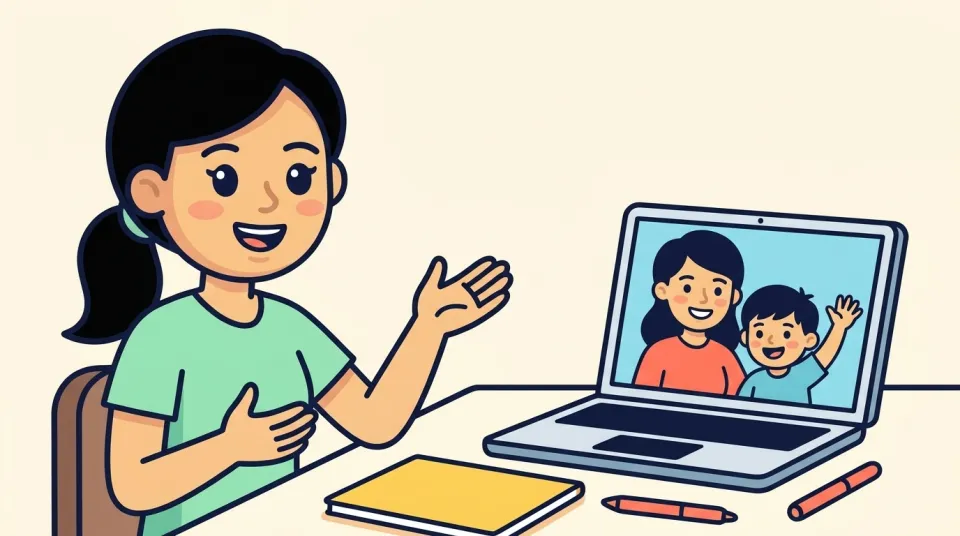
Quick tip
Always have a backup game or song ready to use the moment you see the child starting to lose focus.
Vietlingo