
Key takeaway
Teach overseas Vietnamese kids the dialect they hear most from real family members at home, whether Southern, Northern, or Huế. In mixed-region homes, pick one main speaking model for the first years and treat other family accents as listening practice. Because Vietnamese spelling and all six tone marks are shared nationwide, reading and writing carry across every region.
Teach your child the Vietnamese accent they hear most from family at home, whether Southern, Northern, or Huế. In mixed-region homes, pick one main speaking model for the first years and treat other accents as listening practice. Because Vietnamese spelling and all six tone marks are shared, reading and writing carry across regions.
| Family situation | Start with | Add later | Watch out for |
|---|---|---|---|
| Both parents Southern | Southern (Sài Gòn) | Listening to relatives who use another accent | Keep standard spelling even where spoken endings merge |
| Both parents Northern | Northern (Hà Nội) | Southern everyday words and five-tone listening | Do not frame other regional accents as incorrect |
| A Huế family | Central (Huế) | Northern or Southern listening for wider travel | Teach polite family address; keep intimate pronouns for listening |
| Parents from different regions | The accent the child hears most each day | The second parent’s accent as everyday listening | Avoid correcting a child between Mom’s and Dad’s words |
| Grandparents differ from parents | The caregiver voice heard for the most hours | Shared family and kitchen word pairs | Let grandparents speak naturally in their own voice |
| No relatives speaking Vietnamese nearby | One course model matching family roots or trips | A second accent once core home routines feel steady | Follow one consistent audio model in the beginning |
Which dialect should overseas Vietnamese children learn first?
Start with the accent your child hears from relatives during meals, calls, or other routines. If Vietnamese is part of your family’s time together, use familiar voices to invite short replies: a greeting, a question, or a request for a bowl.
If your household speaks a Southern variety close to Sài Gòn, start there; if the adults speak a Northern variety close to Hà Nội, choose Northern; if your family is from Huế, teach polite everyday Huế speech. Compare these three reference varieties in our overview of Northern, Huế, and Southern Vietnamese dialects, or read our guide to choosing which Vietnamese dialect to learn for adult goals.
If no fluent Vietnamese speakers live nearby, pick one accent tied to your family’s roots or future trips, use structured audio in that single variety, and keep it consistent until basic greetings and mealtime phrases feel steady.
What if the parents come from different regions?
When parents speak different varieties—or when grandparents differ from parents—agree on one primary model for your child’s early speaking and let everyone else speak naturally in their own accent. Anchor speaking in the voice your child hears for the most hours each week, whether that is Mom, Dad, or a grandparent helping after school.
Never ask a relative to imitate an unfamiliar accent, and do not “correct” your child toward another region’s speech. If your child says má after calling Grandma and mẹ with Dad, welcome both words: simply name who uses each one rather than calling either form wrong.
As Bae and Đào’s study of Northern and Southern expressions notes, communication across Northern and Southern Vietnamese is generally manageable for Vietnamese speakers even though regional differences require extra effort from learners, and regional words act as tendencies rather than rigid borders.
Will two accents confuse a child?
There is no child-development study cited here that tests whether hearing two Vietnamese accents confuses a child. As a practical starting point, choose one accent to model when you practice together, and let relatives continue speaking naturally in theirs.
Separate speaking from listening. Practice tones, pronouns, and table words in one main speaking model. For listening, invite your child to notice how a relative from Hà Nội or Sài Gòn says a familiar word, without asking for an immediate imitation.
Brunelle’s tone-perception study found that adult Southern listeners adapted to Northern voice-quality cues when identifying isolated tones. That finding does not establish whether two accents confuse children or how quickly they learn to understand relatives. For home practice, keep one speaking model and introduce other voices through listening.

What if the home accent is not the one in the textbooks?
If a textbook uses words that differ from your family’s, read the standard spelling aloud in your home accent and name your household word too. Every region shares the same alphabet (chữ Quốc ngữ) and core grammar (Thompson’s Vietnamese reference grammar) and marks the same six written tone categories (Vũ’s cross-dialect tone comparison).
Everyone writes ma, mà, má, mả, mã, mạ the same way on paper. In speech, Hà Nội contrasts all six tones with pitch and voice quality (Kirby’s phonetic description of Hà Nội Vietnamese), whereas Huế and Sài Gòn merge hỏi and ngã into five spoken tones (Phạm and McLeod’s dialect review). You can compare how each tone sounds in our guide to Vietnamese tones across Hà Nội, Huế, and Sài Gòn.
| Written form | Hà Nội speech | Huế speech | Sài Gòn speech |
|---|---|---|---|
| Six tone marks (mả / mã) | 6 spoken tones; hỏi and ngã distinct | 5 spoken tones; hỏi and ngã sound the same | 5 spoken tones; hỏi and ngã merged |
| Initial d / gi (gia đình) | Usually z-like | Usually y-like | Usually y-like |
| Initial v (về) | Usually v-like | v-like or y-like by speaker | Often y-like |
| Finals -n / -ng (bàn) | Kept distinct | Can merge after many vowels | Can merge after many vowels |
When reading a picture book aloud, pronounce the text in your home accent while pointing to the standard spelling. If a page prints quả (fruit) and your family says trái, mention your home word casually and keep all six tone marks in writing.
Which words will your child hear from relatives?
Ask relatives which kinship titles and tableware words they use on calls or at meals. The Northern and Southern pairs below follow the SEAlang Vietnamese dictionary and Thompson’s grammar, while the Huế family terms match Visit Huế’s note on mạ and Khám Phá Huế’s overview of ôn, mệ, and o. Because these columns reflect tendencies rather than strict rules, ask relatives which titles they prefer, and see our 50 everyday Northern, Huế, and Southern word comparisons for more.
| Meaning | Hà Nội | Huế | Sài Gòn |
|---|---|---|---|
| Mother | mẹ | mạ | má |
| Father | bố | ba | ba; tía (regional) |
| Grandfather | ông | ôn | ông |
| Grandmother | bà | mệ | bà |
| Paternal aunt | cô | o | cô |
| Small rice bowl | bát | chén | chén |
| Large bowl | bát ô tô | tô | tô |
| Spoon | thìa | muỗng | muỗng |
| Glass / cup | cốc | ly | ly |
| Plate | đĩa | dĩa | dĩa |
Flag one lively table swap early: Northern dĩa commonly means “fork” while đĩa means “plate,” whereas Huế and Southern dĩa means “plate” (Southern “fork” is nĩa). In Huế families, teach polite forms—answering elders with dạ and using con or cháu—and keep intimate pronouns (mi, tau, hắn, bây) for listening only.
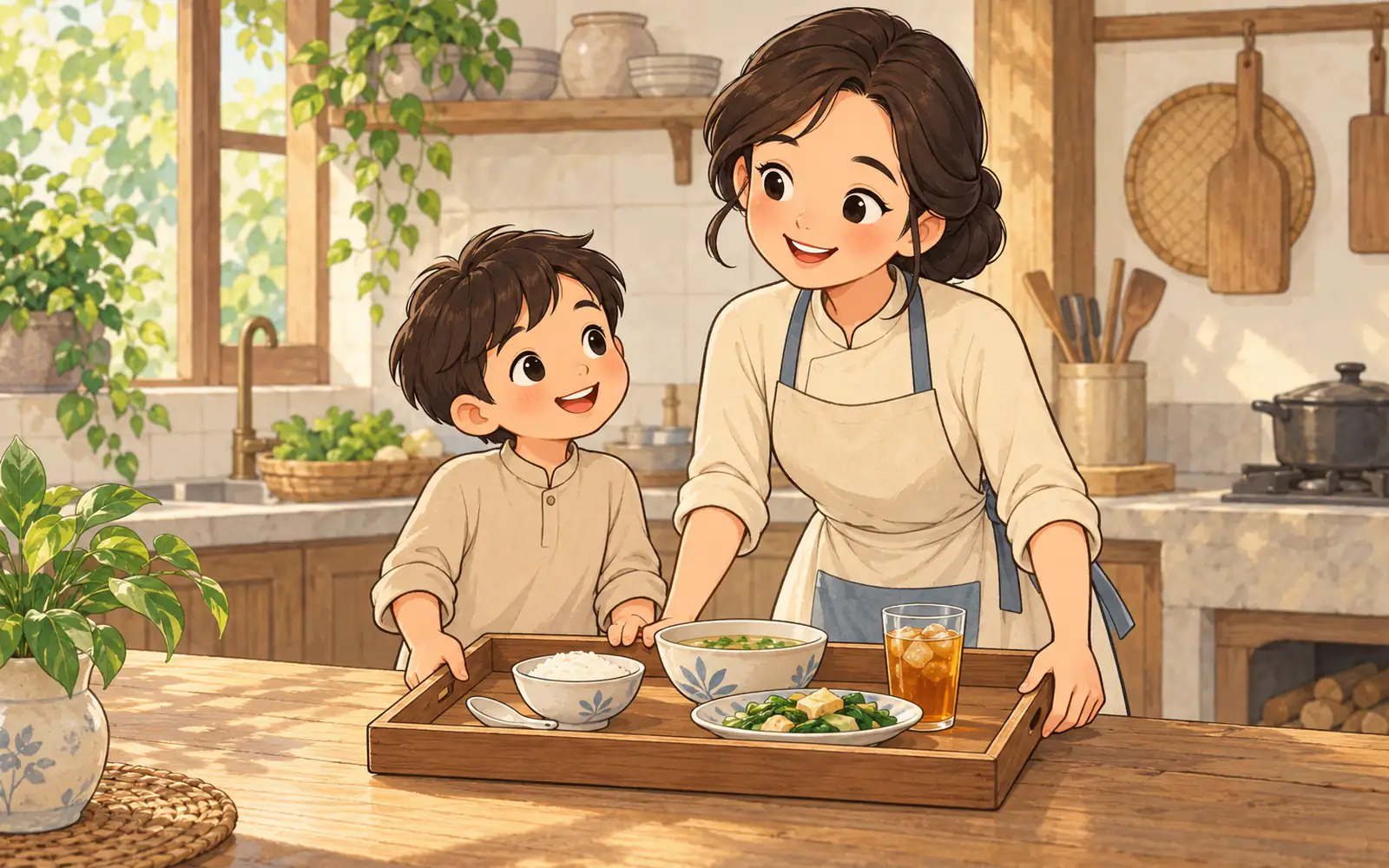
One mealtime exchange in three home accents
Here is the same kitchen moment—a mother calling her child to eat (“Where are you going? Come in and eat with Grandma; this soup is tasty, isn’t it?”) and the child answering (“Yes! Mom, please give me a small bowl and a spoon.”):
- Hà Nội (N): Con đi đâu đấy? Vào ăn cơm với bà đi, canh này ngon nhỉ? — Vâng ạ! Mẹ cho con xin một cái bát và một cái thìa ạ.
- Huế (H): Con đi mô rứa? Vô ăn cơm với mệ đi, canh ni ngon hỉ? — Dạ! Mạ cho con xin một cái chén với một cái muỗng ạ.
- Sài Gòn (S): Con đi đâu vậy? Vô ăn cơm với bà đi, canh này ngon hen? — Dạ! Má cho con xin một cái chén với một cái muỗng nha má.
How can parents add a second accent later?
Wait until your child comfortably understands and answers everyday routines in their home accent. Introduce a second accent as listening recognition first, using our guide to telling Hà Nội, Huế, and Sài Gòn accents apart by ear.
- Pair five familiar words. Connect home words to a relative’s equivalents—such as bát with chén, or mẹ with mạ and má—like family nicknames for the same person or thing.
- Follow one real voice. Let regular calls with one aunt, cousin, or grandparent anchor the second accent instead of switching among many speakers.
- Spot one clue at a time. Notice z-like versus y-like d/gi, or everyday Huế words like mô (where), răng (why), and rứa (so, like that) noted in Alves’s Central vocabulary notes and Khám Phá Huế.
- Measure progress by comprehension. Praise your child when they understand a relative’s question and reply naturally in their own accent.
How can a parent practice too?
If you understand family Vietnamese but hesitate to model full sentences or tone marks, try short mealtime phrases yourself. Pair our speaking plan for adult heritage speakers with your home routines. A parent can learn alongside the child with the course for the accent the household speaks, starting with the first units for Southern, Northern, or Huế.
If your family speaks Southern Vietnamese at home, SVFF, Vietlingo’s partner school for Southern, has a parents’ guide to choosing between Southern and Northern Vietnamese for a child. SVFF teaches mainly Southern Vietnamese, with live lessons from native Southern teachers and self-study Northern and Huế courses, and recommends Vietlingo for live Northern and Huế lessons.

Key takeaways
- Start with real family voices: Teach the accent your child hears most from parents, grandparents, and relatives at home.
- Keep one speaking model early: Let mixed-region relatives speak naturally without correcting your child toward another region’s accent.
- Rely on shared spelling: Every region writes the same standard words and all six tone marks.
- Add other accents through listening: Build recognition gradually once home routines feel steady.
Read next: Vietnamese family words by region and which accent you will hear in Sài Gòn, Hà Nội, or Huế.
To practice alongside your child in the accent your family uses at home, explore Everyday Southern Vietnamese (first unit), Everyday Northern Vietnamese (first unit), or Everyday Huế Vietnamese (first unit).
Prefer to learn from video? Start with the Northern Vietnamese Pronunciation Course or the Southern Complete Vietnamese Course (A1), and train your ear with Slow Vietnamese 01 (Northern) or Slow Vietnamese 01 (Southern).
Frequently asked questions
Should my child learn Northern Vietnamese because it is the national standard?
Only if Northern is the variety your household uses or chooses as its main model. If parents or grandparents speak Southern or Huế at home, you can model their words in everyday conversations and let your child hear that accent regularly.
What should we do if our child mixes Northern and Southern words?
Treat it calmly rather than correcting it as a mistake. Simply name who uses each word—such as Dad’s bát and Grandma’s chén—while continuing to model one consistent primary accent yourself.
Will learning a five-tone home accent hurt my child’s Vietnamese spelling?
A five-tone home accent does not change the written rules: all six tone marks remain in standard spelling. Read aloud in your family’s accent while showing your child the written form, and check the spelling together.
What if only our child’s grandparents speak Vietnamese regularly?
Adopt the grandparents’ accent as your child’s main model, let calls and visits stay in their natural voice, and learn the same variety alongside your child so short daily phrases continue between visits.
Can a parent learn Vietnamese alongside their child?
Yes. Choose the course for the accent your household speaks, practice short mealtime phrases yourself, and bring them into family routines so your child hears you using the same accent every day.




Comments (0)
A new word, a question, or a different perspective? Share it with fellow learners.
Be the first to comment.