Key takeaway
Vietnamese wedding traditions in the North and South share one core sequence: first visit (dạm ngõ), engagement (ăn hỏi or đám hỏi), wedding (vu quy, lễ cưới), and return visit (lại mặt). Regional sources describe differences of detail—such as the candle rite (lễ lên đèn) in the Mekong Delta and family address forms—and customs vary by family, province, and religion.
Vietnamese wedding traditions in the North and South share one core sequence: first visit (dạm ngõ), engagement (ăn hỏi, đám hỏi), fetching the bride for the wedding (vu quy, lễ cưới), and return visit (lại mặt). Reliable sources show differences of detail rather than separate systems, and customs vary by family, province, and religion.
| Stage | What happens | Who takes part |
|---|---|---|
| First visit (dạm ngõ, chạm ngõ) | The groom’s side brings betel and areca (trầu cau) so the couple may court. | Parents, elders, couple. |
| Engagement (ăn hỏi, đám hỏi) | Bearers bring paired gifts; the bride’s side places part on the altar and returns a share (lại quả). | Families, bearers (bê tráp), couple. |
| Fetching the bride and the wedding (xin dâu, rước dâu, vu quy, lễ cưới) | The groom’s party escorts the bride from lễ vu quy to the groom’s home for altar rites (lễ gia tiên) and the banquet. | Representatives, groom’s father, couple, friends. |
| Return visit (lại mặt) | A few days later, the couple bring gifts to thank the bride’s parents and ancestors. | Newlyweds and bride’s parents. |
How the main stages of a Vietnamese wedding fit together
VietnamPlus lists five Northern rituals: dạm ngõ, ăn hỏi, xin dâu, lễ cưới, lại mặt. The Ho Chi Minh City Museum notes six classical rites simplified into chạm ngõ, hỏi, cưới.
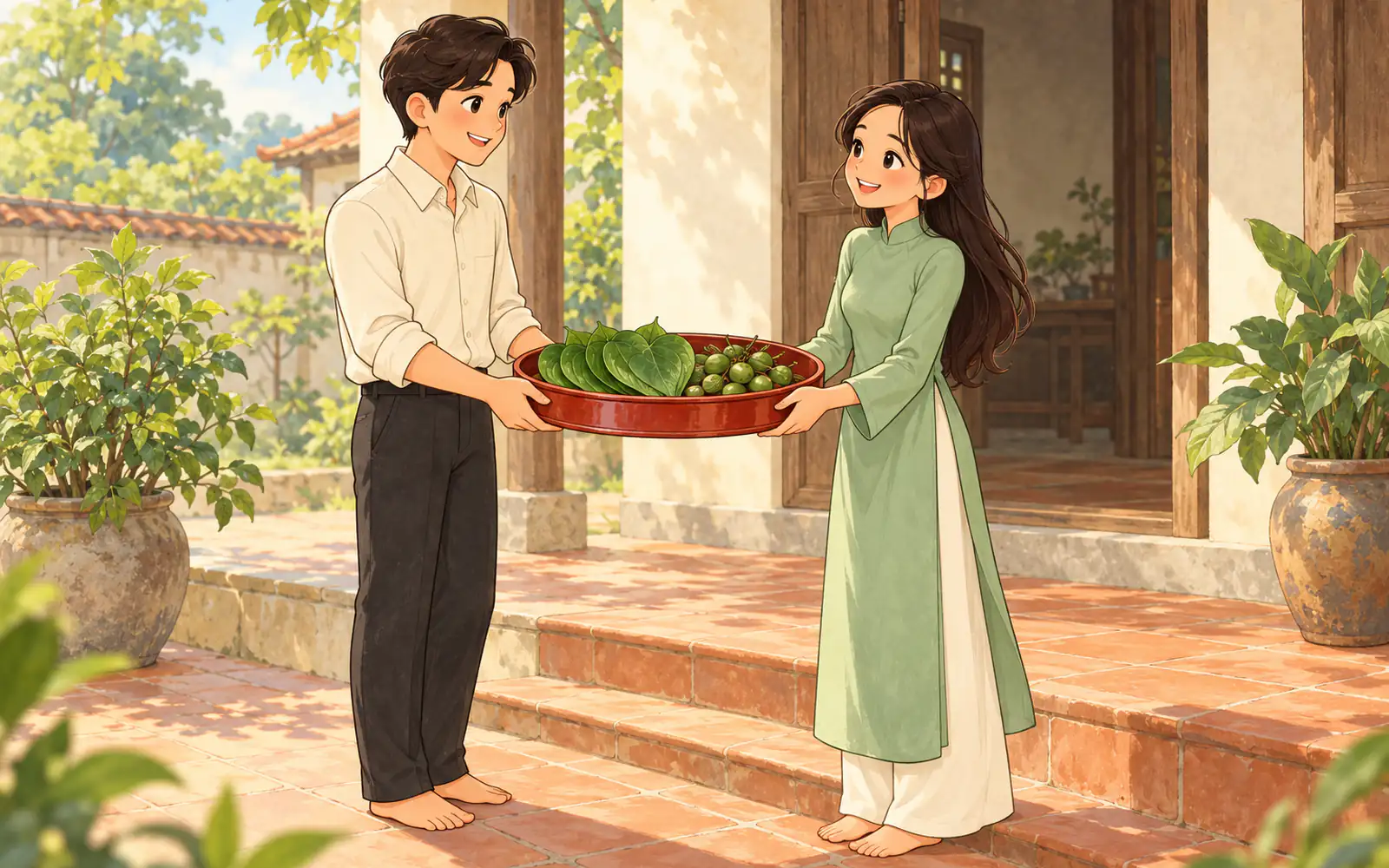
At lễ chạm ngõ (dạm ngõ, xem mặt), the State Committee for Overseas Vietnamese notes the groom’s side brings betel and areca so the couple may court. A betel tray (cơi trầu) accompanies dạm ngõ, ăn hỏi, xin dâu, reflecting “miếng trầu là đầu câu chuyện” (“the betel quid begins the conversation”).
The Vietnam National Museum of History tells a legend about two brothers who looked alike and one brother’s wife: they became a stone, an areca palm, and a betel vine. In the legend, King Hùng had the three chewed together and decreed their use at weddings.
Inside the Vietnamese engagement ceremony (đám hỏi and lễ ăn hỏi)
At lễ ăn hỏi, the Border Guard’s page on engagement customs notes tray bearers (bê tráp) were usually women, and young men can take over now that trays are heavy. Unmarried women in red áo dài receive them in equal number while the bride waits inside until the groom escorts her or her parents call her out.
Many families in both regions use odd trays with even gifts inside. VietnamPlus says Northern weddings often use 7 or 9 trays, the odd number standing for growth, and the Border Guard page describes the same pattern.
A Cần Thơ University journal paper on the Mekong Delta reports 5, 7, or 9 trays in red paper (happiness, joy, abundance) with even gifts, while one speech in a Ho Chi Minh City University of Education study drawing on 19 Southern provinces mentions six trays.
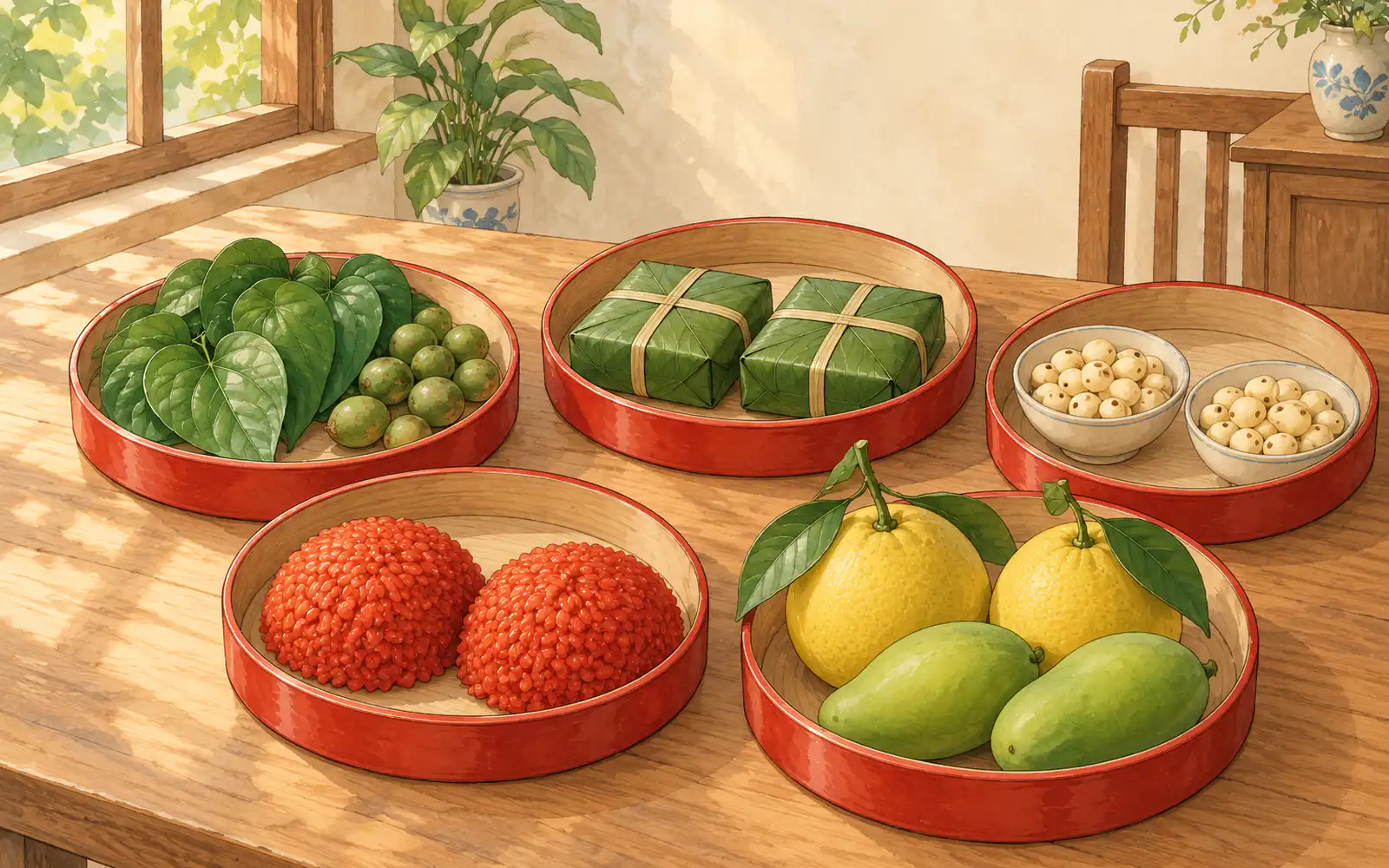
- Northern trays: Betel and areca, tea, wine, green rice cakes (bánh cốm), husband-and-wife cakes (bánh phu thê), lotus, and fruit.
- Paired cakes: Bánh xu xê with bánh cốm, or round bánh dày with square bánh chưng, for yin-yang harmony; some use red sticky rice (xôi gấc) and roast pig (lợn quay).
- Regional gifts: Roast suckling pig (lợn sữa quay) in Hà Nội custom, or a ring, necklace, or earrings in Southern custom.
- Mekong Delta gifts: The Cần Thơ paper calls earrings and rings the most important gifts and also lists pork; it says the groom’s mother traditionally puts on the earrings and the groom the ring, though many families now let the groom put on both.
The bride’s side places part on the altar, shares gifts, and returns a share (lại quả), tearing areca by hand, dividing in even counts of four or more, and leaving lids upturned. The gap before the wedding was once two or three years and is now often much shorter, even a few days.
Where Northern and Southern wedding customs differ
Only rows with a regional source appear below.
| Detail | Northern Vietnam | Southern Vietnam |
|---|---|---|
| Rituals named | Dạm ngõ, ăn hỏi, xin dâu, lễ cưới, lại mặt (VietnamPlus). | Chạm ngõ, hỏi, cưới (HCMC Museum); nhóm họ, xuất giá, vu quy, thành hôn, tân hôn (Southern study). |
| Tray numbers | Often 7 or 9 odd trays (VietnamPlus) with even gifts (Border Guard page). | 5, 7, or 9 trays with even gifts in the Delta (Mekong Delta paper); one Southern study speech mentions 6. |
| Engagement gifts | Roast suckling pig (lợn sữa quay) in Hà Nội custom (Border Guard page). | Ring, necklace, or earrings (Border Guard page); earrings, rings, and pork (Mekong Delta paper). |
| Lễ lên đèn | Not described in the Northern sources here. | Called required in the Delta (Mekong Delta paper); listed as an important rite (Southern study). |
| Men’s headwear | Khăn xếp, named for comparison (Đồng Nai arts page). | Khăn đóng, covering the crown (Đồng Nai arts page). |
The Southern candle-lighting rite (lễ lên đèn)
In lễ lên đèn, the groom’s side brings two dragon-and-phoenix candles (đèn cầy) for the couple, or in some places clan elders, to light on the altar. The Mekong Delta paper calls the rite required there, the Southern study lists it as an important rite, and the Northern sources here do not describe it.
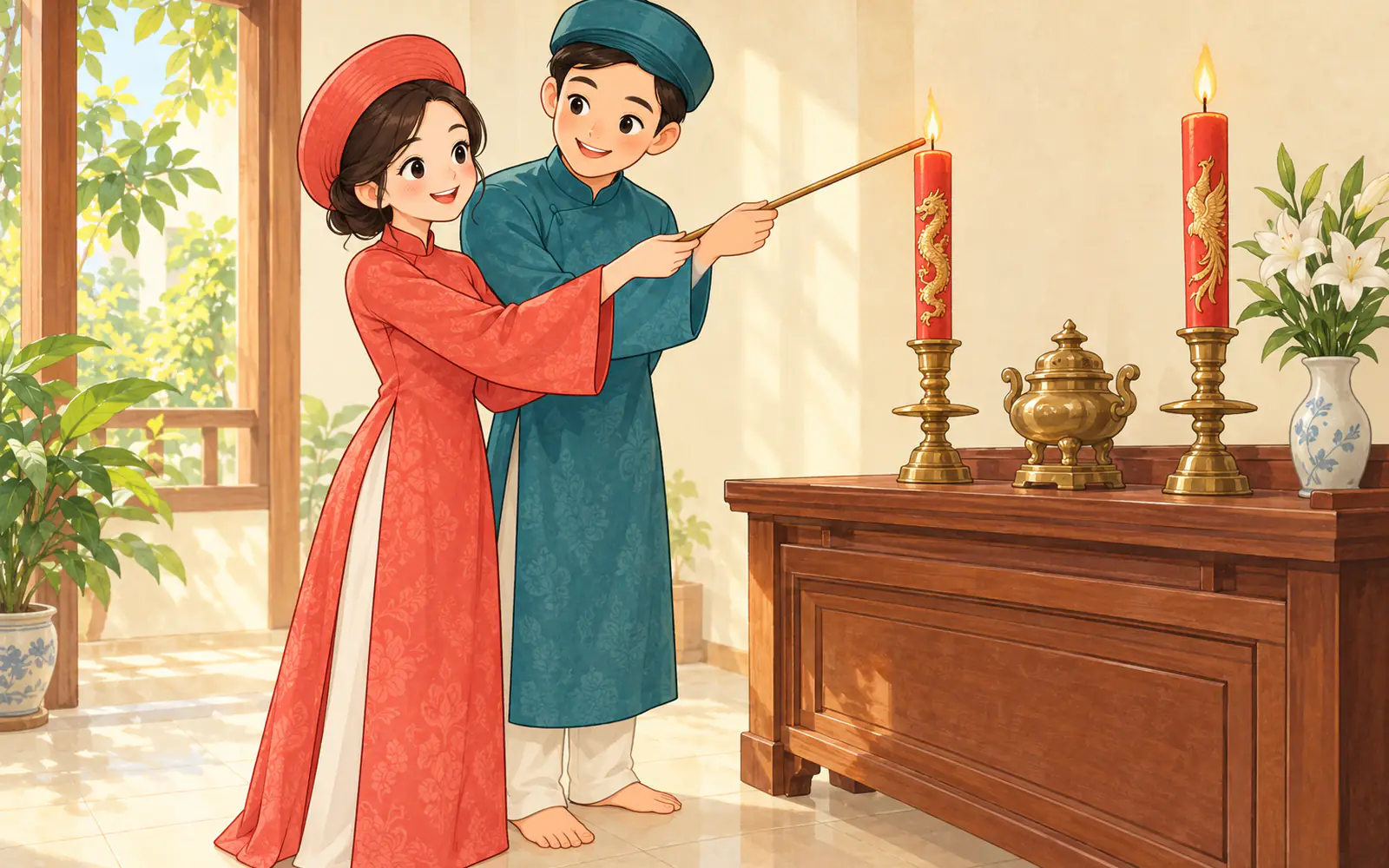
The groom stands by the dragon candle and the bride by the phoenix candle, with fans off and doors closed in some places so both burn evenly. The candles are saved and lit again when the couple have a child, so the baby can see them.
A Đồng Nai account describes a matchmaker (mai dong) lighting both candles and handing the left one to the groom’s side and the right one to the bride’s. In the Ho Chi Minh City Museum’s reconstruction of a Southern home, the rites happen at the main-hall altar, set with bronze vessels, fruit, and candles.
The wedding day: rước dâu, vu quy, and chào bàn
In that Southern study, families hold lễ nhóm họ to present a meal to ancestors and divide tasks, and lễ xuất giá so female elders advise the bride. The bride’s side often holds tiệc vu quy a day before the groom’s banquet, while lễ thành hôn and lễ tân hôn name the groom’s ceremony.
A representative, the groom’s father, the groom, and friends lead lễ rước dâu, while the groom’s mother often does not go to fetch the bride. In Đồng Nai, both processions traditionally go in an even number to avoid loneliness. In the Mekong Delta of the past, the Cần Thơ paper describes simpler customs and processions that went by boat (xuồng, ghe).
After lễ gia tiên at the groom’s house, the bride sits on a bed whose mat was spread by someone chosen by the groom’s family for having been blessed with children. The bride’s mother (in some places both parents) traditionally does not join the procession, and first visits the groom’s family after lễ lại mặt a few days later.
In the Southern study’s account of tiệc vu quy, the bride’s father thanks guests from the stage at a restaurant; at a home reception, her parents or a representative lead the couple from table to table to greet guests (chào bàn). You can wish the couple “Trăm năm hạnh phúc!”.
The Đồng Nai Literature and Arts Association notes Southern men wear a formal silk áo dài, white trousers, and a khăn đóng covering the crown, unlike the Northern khăn xếp. Earlier Southern brides wore layered áo dài, a tasseled hat, and curved slippers, while grooms wore a blue outer robe.
Words and wishes at a Vietnamese wedding
In the Southern study, representatives greet elders—“Dạ, kính thưa ông trưởng tộc, kính thưa họ tộc nhà gái”—and guide the couple: “con mời ngoại ăn trầu, con mời ông dùng rượu, con mời cô dùng trà”.
A Đồng Nai page lists wishes including “Trăm năm hạnh phúc”, “Đầu bạc răng long”, and “Trăm năm tình viên mãn, bạc đầu nghĩa phu thê”. As our Northern vs Southern Vietnamese guide notes, dạ is the everyday polite opener in the South and is heard in the North too, where vâng and a closing ạ are common.
- Polite forms: N: bố mẹ, vâng, closing ạ (dạ also heard) · S: ba má, opening dạ.
What a wedding guest or partner should know
- To the couple, if you are younger than both: N: “Em chúc anh chị trăm năm hạnh phúc ạ!” · S: “Dạ, em chúc anh chị trăm năm hạnh phúc!”.
- To parents you address as bác: N: “Cháu chúc mừng hai bác ạ!” · S: “Dạ, cháu chúc mừng hai bác!”. Change the kinship terms to fit your relationship with them.
- Slow down: N: “Anh nói chậm lại một chút được không ạ?” · S: “Anh nói chậm lại chút giùm em nha.”
Customs vary by family, province, and religion, and Northern and Southern speakers generally understand each other. See learning Vietnamese for your partner’s family and meeting your partner’s Vietnamese family, and compare Hà Nội vs Sài Gòn Vietnamese when choosing a dialect.
Key takeaways
- Shared frame: First visit (dạm ngõ), engagement (ăn hỏi, đám hỏi), wedding (vu quy, lễ cưới), and return visit (lại mặt).
- Trays and gifts: Sources in both regions describe odd tray counts with even gifts inside, though numbers vary. Hà Nội custom often includes roast suckling pig; Southern sources also describe jewelry and pork.
- Rites and speech: One Mekong Delta paper calls lễ lên đèn required there. Guests can wish the couple “Trăm năm hạnh phúc” and choose address words that fit their relationship with the people they greet.
Start learning Vietnamese for family celebrations
Start with Everyday Southern Vietnamese, Level 00, an interactive textbook course following Ben in Sài Gòn across the tones, Southern final consonants, greetings, address words, drinks, numbers 0 to 10, and asking people to speak slowly, or Slow Vietnamese 01 - Southern for beginner video lessons starting slow before normal speed.
For Northern Vietnamese, try Everyday Northern Vietnamese, Level 01 (in Beta, with audio being added), following Lucia in Hà Nội through introductions with anh, chị, em, bác, jobs, time, and café orders, or Slow Vietnamese 01 - Northern, or study with tutors and book a trial lesson.
Frequently asked questions
Do Southern weddings use different tray numbers from Northern ones?
Many families in both regions use odd trays with even gifts: VietnamPlus notes 7 or 9 in the North, the Mekong Delta paper reports 5, 7, or 9, and one Southern study speech mentions 6.
What is the difference between dạm ngõ and đám hỏi?
Lễ dạm ngõ is the first visit with betel and areca so the couple may court; đám hỏi is the engagement with trays of paired gifts.
What is lễ lên đèn in a Southern wedding?
It is a candle rite in which the couple or elders light dragon-and-phoenix candles on the altar. A Mekong Delta paper calls it required there and a study drawing on 19 Southern provinces lists it as important; the Northern sources here do not describe it.
What is the difference between lễ vu quy and lễ thành hôn (or lễ tân hôn)?
In the Southern study, lễ vu quy is held at the bride’s home, whereas lễ thành hôn and lễ tân hôn name the ceremony at the groom’s house.



Comments (0)
A new word, a question, or a different perspective? Share it with fellow learners.
Be the first to comment.