Key takeaway
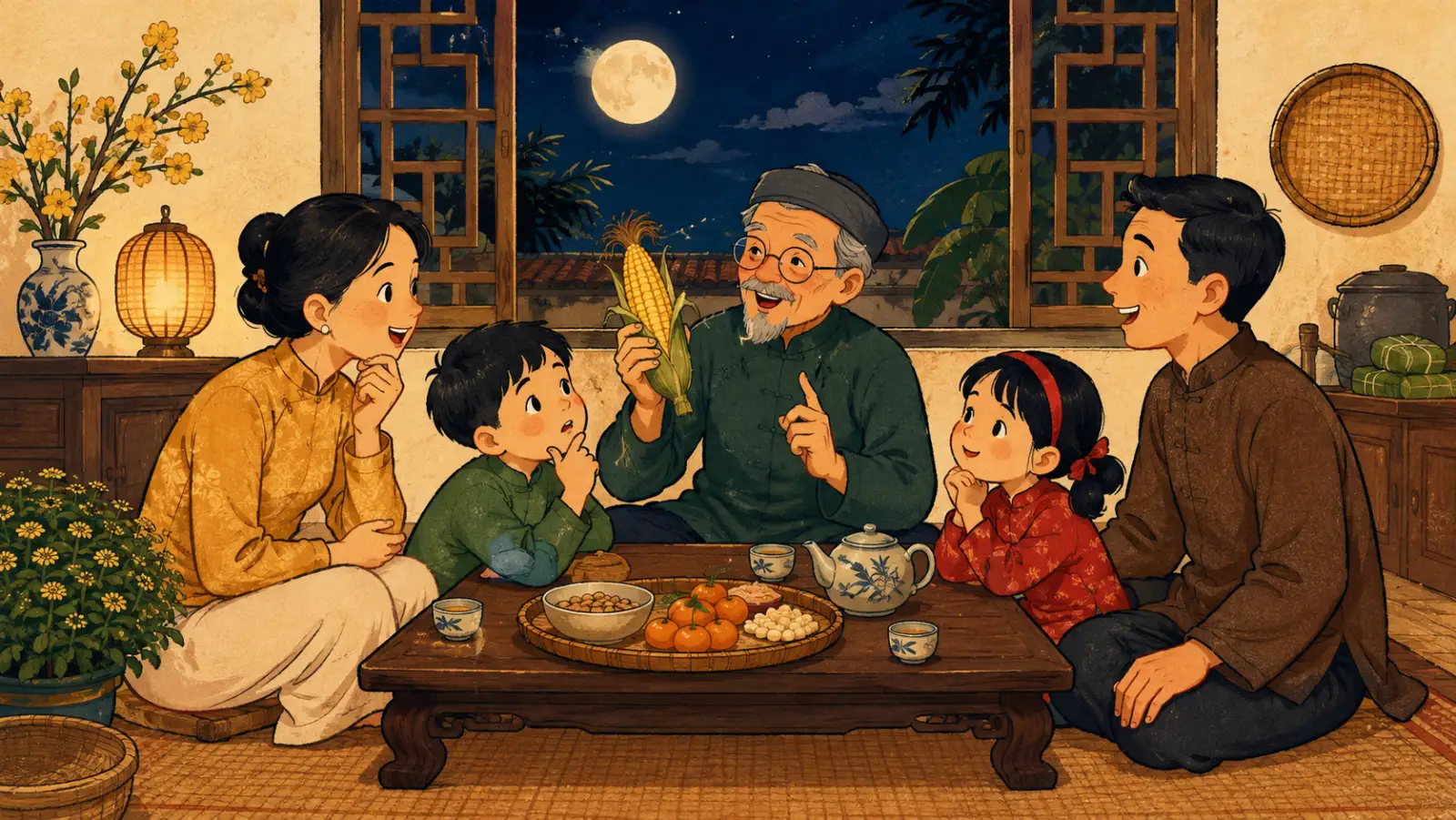
A Vietnamese riddle, or câu đố, describes an everyday thing such as the moon, a foot, or an ear of corn in disguised, poetic language and asks you to guess it. Its guiding idea is nói một đằng hiểu một nẻo, “say one thing, mean another”. This guide gives famous riddles with diacritics, English translations, answers, and a glossary.
Few folk games reveal how Vietnamese people think about the world quite like the riddle, or câu đố. A riddle paints an everyday thing — the moon, your own foot, an ear of corn — in disguised, poetic language, then dares you to guess what it is. The guiding principle is nói một đằng hiểu một nẻo, "say one thing, mean another." In this bilingual guide we explore what makes a Vietnamese riddle tick, work through famous examples with real diacritics and English translations, and show learners and teachers how to turn these tiny poems into living lessons. Try to guess each answer before you read it.
What is a Vietnamese riddle (câu đố)?
A câu đố is a short folk genre that describes an object obliquely — it never names the thing directly. Instead it hides the name behind images, comparisons, and clever turns of phrase, so the listener has to read between the lines and guess. Because the whole point is to nói một đằng hiểu một nẻo ("say one thing, mean another"), a good riddle feels like a small trap built out of words: everything you hear points at one picture while secretly meaning something else.
The purpose is twofold. First, riddles test perception and quick wit — they sharpen your ability to notice shape, colour, and function in ordinary things. Second, they entertain. For centuries, Vietnamese children, farmers, and courting couples traded riddles to pass the time, to show off cleverness, and to bond. As a member of Vietnam's wider folk literature family, the riddle sits beside proverbs and folk song, but it is the most playful of the three.
Đố and Giải: what are the two halves of a riddle?
Structurally, every riddle has two parts. The first is the Đố — the puzzle itself, the disguised description that you hear or read. The second is the Giải — the answer or solution, the moment the hidden object is revealed. The fun lives entirely in the gap between them: the Đố stretches that gap as wide as it can, and the Giải snaps it shut with a satisfying "of course!"
Knowing these two terms also helps you talk about riddles in Vietnamese. If you say "Đố em nhé" ("here's a riddle for you"), you are presenting the Đố; when your friend says "Giải được rồi!" ("I've solved it!"), they are claiming the Giải. For learners, this is a clean, memorable pair of words to anchor a whole lesson around.
What are the three ways a riddle hides its answer?
Folklorists usually describe three main techniques a riddle uses to conceal its subject. Recognising them turns guessing from luck into a skill.
Miêu tả trực tiếp (direct description)
Here the riddle describes the object straightforwardly — by its shape, its colour, or its function — but withholds the name. The crab riddle below is a perfect example: it simply counts legs, claws, shell, and eyes. The challenge is recognition, not decoding.
Miêu tả gián tiếp (indirect description)
This technique works through simile and metaphor (so sánh, ẩn dụ). The thing is dressed up as something else entirely — a hand becomes a five-branched tree, corn becomes a body wrapped in silk. You must translate the metaphor back into reality.
Chơi chữ (word-play)
The trickiest type relies on puns and double meanings (chơi chữ). The answer is buried in a play on sound or sense, so even native speakers can be fooled. The stool riddle near the end of this guide is built on exactly this kind of verbal mischief.
Which riddles describe the sky and animals?
Some of the most beloved riddles take their images from nature — the moon overhead, the rainbow over the rice fields, the crab in the paddy. Read each puzzle, picture it, and guess before you scroll to the answer.
The moon
Thuở bé em có hai sừng
Đến tuổi nửa chừng mặt đẹp như hoa
Ngoài hai mươi tuổi đã già
Quá ba mươi lại mọc ra hai sừng.
English: "As a child I had two horns; in my middle years my face was as lovely as a flower; past twenty I had already grown old; and beyond thirty I sprouted two horns again."
Answer: mặt trăng (the moon). The "child with two horns" is the young crescent; the flower-faced beauty is the full moon around the middle of the lunar month; then it wanes and, by the end of the cycle, the crescent — the "two horns" — returns. The numbers are the days of the lunar month.
The rainbow
Xanh xanh, đỏ đỏ, tím tím, vàng vàng
Bắc cầu thiên lý nằm ngang giữa đồng.
English: "Greens and reds, purples and yellows; a thousand-mile bridge lying across the field."
Answer: cầu vồng (the rainbow). The doubled colour words paint the arc, and cầu thiên lý ("a thousand-mile bridge") is the rainbow stretched over the open countryside.
The crab
Con chi tám cẳng hai càng
Một mai hai mắt rõ ràng con chi?
English: "What creature has eight legs and two claws, one shell and two clear eyes — what creature is it?"
Answer: con cua (the crab). This is a pure miêu tả trực tiếp riddle: it counts the crab's eight legs, two claws, single shell (mai), and two eyes, then asks you to name it.
Which riddles describe the body and everyday things?
Other riddles turn inward, describing parts of your own body, or the humble objects around the house. These reward you for noticing things you usually take for granted.
The foot
Đi thì nằm
Đứng thì nằm
Ngồi cũng nằm
Nằm thì đứng.
English: "When you walk, it lies down; when you stand, it lies down; when you sit, it also lies down; but when you lie down, it stands up."
Answer: bàn chân (the foot). Whenever you walk, stand, or sit, the sole lies flat against the ground; only when you lie down does the foot point upright.
The hand
Cây chi mà có năm cành
Nhúng nước thì héo, để dành thì tươi.
English: "What tree has five branches, withers when dipped in water, yet stays fresh when kept dry?"
Answer: bàn tay (the hand). The "tree with five branches" is the hand with its five fingers; soak it and the skin "wilts" into wrinkles, but leave it dry and it stays smooth and "fresh." This is miêu tả gián tiếp through metaphor.
Corn
Mình vàng mà mặc áo xanh
Một trăm chỉ thắm quấn quanh mình vàng.
English: "A golden body dressed in a green coat; a hundred bright threads wound around that golden body."
Answer: bắp ngô (an ear of corn). The golden body is the cob, the green coat is the husk, and the "hundred bright threads" are the fine corn silks wrapped around it.
The stool (a word-play riddle)
Now for a chơi chữ riddle that depends on a sly double meaning.
Ngửa lưng cho thế gian ngồi
Rồi ra mang tiếng con người bất trung.
English: "It bares its back for the whole world to sit on, and yet ends up branded a disloyal soul."
Answer: a stool or bench (cái ghế đẩu / cái ghế). The humour is in the unfairness: the stool patiently offers its "back" for everyone to sit on, and is still accused of bất trung ("disloyalty") — a pun on the idea of turning your back. The wit lies in the moral language used for a piece of furniture.
Which riddles can you sing? The đối-đáp ca dao
Riddles were not only spoken — young people also sang them back and forth in courtship, a call-and-response game called đối đáp. This overlaps with the world of ca dao folk poetry, where a question sung by one side is answered, line for line, by the other. Here is a famous exchange.
The young man poses the puzzle:
Hỏi anh: cái gì thấp, cái gì cao?
Cái gì sáng tỏ như sao trên trời?
Cái gì em trải anh ngồi?
Cái gì thơ thẩn ra chơi vườn đào? ...
English (gist): "Tell me: what is low and what is high? What shines as bright as a star in the sky? What do you spread out for me to sit on? And what wanders idly into the peach garden?"
The young woman answers, matching each image in turn:
Em ơi! Đất thấp trời cao,
Ngọn đèn sáng tỏ hơn sao trên trời.
Chiếu hoa em trải anh ngồi,
Đêm nằm tơ tưởng ra chơi vườn đào...
English (gist): "Oh my dear! The earth is low and the sky is high; a lamp shines brighter than any star above; a flowered mat is what I spread for you to sit on; and at night, lost in longing, my thoughts wander out to the peach garden..." Each riddle-question is answered with its solution, and the playful test of wit doubles as flirtation. This is folk literature working as romance.
What is a bilingual glossary for talking about riddles?
Keep these key terms handy. They let you discuss riddles in Vietnamese and unlock the examples above.
| Vietnamese | English | Notes |
|---|---|---|
| câu đố | riddle | The folk genre itself; literally "puzzle sentence." |
| đố | to pose a riddle / the puzzle | The first half: the disguised description. |
| giải | the answer / to solve | The second half: the revealed object. |
| nói một đằng hiểu một nẻo | say one thing, mean another | The core principle of every riddle. |
| miêu tả trực tiếp | direct description | Hides the name but states real traits (e.g. the crab). |
| miêu tả gián tiếp | indirect description | Uses simile/metaphor (e.g. the hand as a tree). |
| chơi chữ | word-play / pun | Hides the answer in sound or double meaning. |
| đối đáp | call and response | Sung riddle exchange, often in courtship. |
| mặt trăng | the moon | The "child with two horns" riddle. |
| cầu vồng | rainbow | The "thousand-mile bridge" riddle. |
| bàn tay | hand | The "tree with five branches" riddle. |
| bàn chân | foot | The "lies down / stands up" riddle. |
| bắp ngô | ear of corn | The "golden body in a green coat" riddle. |
Tóm tắt bằng tiếng Việt
Câu đố là một thể loại văn học dân gian dùng để miêu tả sự vật một cách bóng gió, theo nguyên tắc "nói một đằng hiểu một nẻo". Mỗi câu đố gồm hai phần: phần Đố (lời miêu tả giấu tên đồ vật) và phần Giải (đáp án). Câu đố có ba cách giấu đáp án: miêu tả trực tiếp (theo hình dáng, màu sắc, công dụng), miêu tả gián tiếp (qua so sánh, ẩn dụ) và chơi chữ. Người Việt thường đố nhau về trăng, cầu vồng, con cua, bàn tay, bàn chân, bắp ngô hay cái ghế. Thanh niên xưa còn hát đố đối đáp trong lúc tỏ tình. Học và dạy tiếng Việt qua câu đố giúp người học mở rộng từ vựng, luyện tư duy và hiểu thêm về văn hóa dân gian một cách vui vẻ, tự nhiên.
How can you use riddles to learn and teach Vietnamese?
Riddles are a gift for the classroom because each one is short, memorable, and packed with concrete vocabulary. For learners, try reading a riddle aloud, guessing in Vietnamese, then checking your answer — you will absorb words like sừng (horn), cành (branch), and mai (shell) in vivid context. Reciting the rhymes also trains your ear for Vietnamese tones and rhythm. Browse our structured Vietnamese courses to pair these folk gems with grammar foundations.
For teachers, riddles make instant warm-ups and review games. Present the Đố, let students debate in pairs, then award the Giải to the quickest table. Because riddles echo proverbs (tục ngữ) in their compactness, they slot neatly into any culture unit. If you teach Vietnamese, see how to teach with Vietlingo. And if you simply want a guided start, a trial lesson is the easiest way to begin guessing — and learning — in Vietnamese.
Keep going in the accent you chose: Everyday Southern Vietnamese, Everyday Northern Vietnamese, or Everyday Huế Vietnamese.
Prefer to learn from video? Start with the Northern Vietnamese Pronunciation Course or the Southern Complete Vietnamese Course (A1), and train your ear with Slow Vietnamese 01 (Northern) or Slow Vietnamese 01 (Southern).
Read next: ca dao folk poetry and Vietnamese folktales.
Learn Vietnamese with Vietlingo
Ready to turn riddles, folk songs, and everyday conversation into real Vietnamese skill? Book a trial lesson with a friendly native teacher, or explore our full range of Vietnamese courses built for English speakers at every level. Say one thing, mean another — and start understanding both.


Comments (0)
A new word, a question, or a different perspective? Share it with fellow learners.
Be the first to comment.