Key takeaways
- The verb mất means "to lose / to be gone" (mất chìa khóa = lose your keys), and that core sense of loss carries into its particle use.
- As a sentence-final particle, mất adds regret: the action happened, but something was lost or spoiled — "Trời mưa mất rồi" = oh no, it's gone and started raining.
- It encodes an attitude rather than a fact, doing the work English handles with phrases like "unfortunately," "ended up," or "of all things."
- It suits unwanted, regrettable, or slightly-too-late outcomes, and learners should mind their tone so it doesn't sound harsh.
- Like other particles, mất carries feeling, not just facts, so using it well makes Vietnamese sound more natural and emotionally precise.
Imagine you tell a Vietnamese friend that you fell asleep. Then you add one tiny word at the end, and suddenly the sentence stops being a simple report and becomes a small confession of regret: you didn't mean to fall asleep, and it cost you something. That little word is mất, and it is one of the most quietly powerful tools in spoken Vietnamese. It doesn't change what happened. It changes how the speaker feels about what happened.
For learners coming from English, this is a genuinely new idea. We're used to grammar that encodes time, number, and who did what. We're far less used to grammar that encodes an attitude — a built-in “and that's a shame” baked right into the sentence. Vietnamese does this constantly through sentence-final particles, and mất is the specialist for unwanted, regrettable, or slightly-too-late outcomes. Learn it well and your Vietnamese will instantly sound more natural, more human, and more emotionally precise.
What does mất actually mean?
On its own, the verb mất means “to lose” or “to be gone.” You lose your keys: mất chìa khóa. You lose your phone: mất điện thoại. That core sense of loss is the key to everything else. When mất drifts to the end of a sentence and attaches to another verb, it carries that flavor of loss along with it. The action happened, and in the speaker's eyes, something was lost or spoiled in the process.
So as a final particle, mất adds a layer that English usually handles with whole phrases like “unfortunately,” “ended up,” “gone and,” or “of all things.” Compare these two sentences:
Trời mưa rồi. — It's raining now.
Trời mưa mất rồi. — Oh no, it's gone and started raining (and that ruins things).
The first is a neutral weather observation. The second tells you the rain is a problem: maybe the speaker wanted to go out, hang the laundry, or ride a motorbike, and now the plan is spoiled. Not a single fact changed. The appraisal changed. That is the whole job of mất.
How does mất turn a neutral statement into regret?
The cleanest way to feel the effect is to take an ordinary statement and add mất to it. Watch how each pair shifts from a flat fact to a small emotional event.
Tôi quên. — I forgot.
Tôi quên mất. — Oh no, I completely forgot (and now there's a consequence).
Here mất signals that the forgetting was both unintended and costly. Maybe you forgot a friend's birthday or forgot to bring the one document you needed. The particle owns the regret for you.
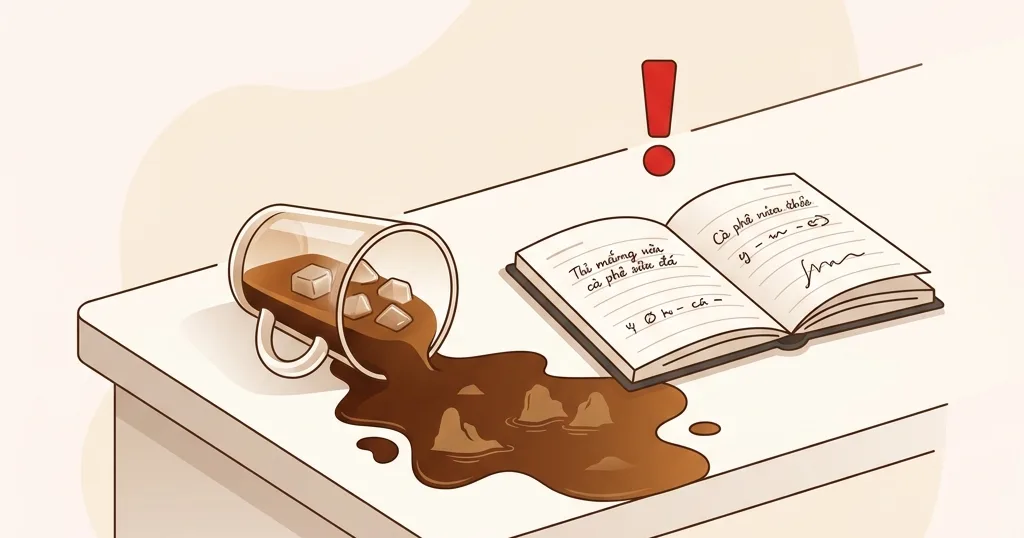
Cốc bị vỡ. — The glass broke.
Cốc vỡ mất rồi. — The glass has gone and broken (what a pity).
The broken glass is now framed as a loss — perhaps it was a favorite cup or the last clean one. Notice how often mất pairs with rồi (“already / now”). Together, mất rồi is the everyday combination for “it's already happened and there's no undoing it,” which is exactly the texture of regret. The damage is done.
Anh ấy đi rồi. — He left already.
Anh ấy đi mất rồi. — He's gone (and I missed my chance to talk to him).
This last pair is a perfect illustration. Đi rồi just reports a departure. Đi mất rồi says he slipped away — the speaker wanted to catch him and now it's too late. You can almost hear the sigh.
To see how natural this feels in real conversation, picture two friends bumping into each other on the street:
A: Sao cậu không đi xem phim? — Why didn't you go to the movie?
B: Tớ đến nơi thì hết vé mất rồi. — By the time I got there the tickets were all gone (so frustrating).
Without mất, B's reply would simply state a fact. With it, you instantly hear the disappointment of someone who showed up and just missed out. That emotional color is doing real work in the dialogue — it tells A how to react.
What kinds of situations call for mất?
Three everyday scenarios cover most of what learners need. If you master these, you'll recognize mất in conversation and reach for it correctly yourself.
1. Missing a chance or being too late
This is mất's home turf. The window closed, the opportunity slipped away, and you only realized it afterward.
Tôi ngủ quên mất buổi học sáng nay. — I overslept and missed this morning's class (ugh).
Vé bán hết mất rồi. — The tickets are all sold out now (and I really wanted to go).
Tàu chạy mất rồi, mình đến trễ hai phút. — The train has already left — we got there two minutes late.
2. Something breaks, spoils, or gets lost
Here the literal “loss” meaning of mất shines through most clearly. The thing is damaged or gone, and that's a setback.
Điện thoại của tôi hỏng mất rồi. — My phone has gone and broken (just my luck).
Rót nước mà đổ mất một nửa. — I poured the water and spilled half of it (annoyingly).
Cây hoa héo mất rồi, tôi quên tưới mấy hôm. — The flower has wilted — I forgot to water it for a few days.
3. Running out, using up, or losing time
mất is also natural when a resource is depleted against your wishes — money, time, food, energy.
Hết tiền mất rồi, chưa đến cuối tháng. — I'm out of money already, and it's not even the end of the month.
Làm cái này mất cả buổi chiều. — This ended up taking my whole afternoon.
That last example is worth pausing on. Here mất is doing double duty: it's both the verb “to take/cost” (time) and it carries the flavor that the cost was unwelcome. Vietnamese loves this kind of economy, where one word holds both the action and the speaker's feeling about it.
Why do learners confuse mất with other particles?
Vietnamese has a rich set of sentence-final particles, and several of them cluster around emphasis and emotion. Beginners often lump them together as “little ending words” and use them interchangeably. They are not interchangeable. Each one points the speaker's attitude in a specific direction.
Here is the crucial distinction: most emphatic particles are neutral about whether the news is good or bad. mất is not. mất specifically marks the outcome as negative, regrettable, or contrary to what the speaker wanted. Keep that contrast in mind and the others fall into place.
- mất — signals an unwanted, regrettable result. It happened, and that's bad.
- rồi — signals completion or a change of state (“already / now”). Emotionally neutral on its own; it just says “this is now the case.”
- luôn — signals “right away,” “go ahead and,” or decisiveness. Often upbeat or energetic, not regretful.
- thôi — softens or limits (“just / only”), or gently wraps things up (“that's enough / let's stop”).
- đấy / đâu — add emphasis, insistence, or contradiction, but say nothing about good or bad.
Watch the same core sentence change personality depending on which particle you choose:
Nó ăn hết rồi. — He's finished eating it all (neutral statement of completion).
Nó ăn hết mất rồi. — He's gone and eaten it all up (and I wanted some — too bad for me).
Nó ăn hết luôn. — He just went ahead and ate the whole thing (emphatic, almost impressed).
Three sentences, three feelings. Only the mất version tells you the speaker is unhappy about it. This is why swapping particles at random gives you sentences that are grammatically fine but emotionally off — the kind of mistake that makes a fluent speaker pause and tilt their head.
Where exactly does mất go in the sentence?
The good news: the placement is consistent and easy. mất comes right after the main verb (and its object, if short), and typically before rồi if you use it. The basic shape is:
[subject] + [verb] + (object) + mất + (rồi)
Tôi đánh rơi mất ví rồi. — I've gone and dropped my wallet (lost it).
Bài hát hay quá, tôi nghe mất cả tiếng đồng hồ. — The song was so good I ended up listening for a whole hour.
You'll also see mất hug the verb tightly even when there's a longer object, especially in fixed expressions like quên mất (“clean forgot”) and mất tiêu / mất hút (“vanished without a trace”). For now, the safest pattern is the one above: verb, then mất, then optionally rồi. Build that into muscle memory first, and the trickier placements will come naturally as you hear more real speech.
A note on tone: don't let it sound harsh
One subtle point that textbooks rarely mention: mất usually carries a soft, rueful, almost self-deprecating tone, not anger. It's the verbal equivalent of a small wince or a sheepish smile. When you forget something and say tôi quên mất, you're not furious — you're admitting a slip with a touch of “silly me.” That gentle, human quality is part of why mất is so common and so likeable in everyday conversation. It lets you acknowledge a mishap without making a big dramatic scene out of it.
Can you overuse mất?
Yes — and new learners often do, precisely because it feels so satisfying once it clicks. Three warnings will keep your mất natural rather than cartoonish.
First, don't use it for genuinely good news. mất is for outcomes you regret. Pairing it with something positive sounds strange or sarcastic at best:
Tôi đỗ mất kỳ thi rồi. — (Odd) “I've gone and passed the exam” — passing isn't a misfortune, so mất doesn't fit. Just say Tôi đỗ kỳ thi rồi.
Second, don't stack it on every sentence. If every line you speak ends in mất rồi, you'll sound like everything in your life is a tiny tragedy. Use it where the regret is real, and let neutral events stay neutral. Contrast carries the meaning; constant use flattens it.
Third, watch the difference between mất as a real verb and mất as the particle. Tôi mất điện thoại (“I lost my phone”) uses mất as the main verb — it's literally about losing. Điện thoại hỏng mất rồi (“my phone has gone and broken”) uses mất as the regret particle attached to hỏng (“to break”). Same word, two jobs. Reading lots of examples is the fastest way to keep them straight.
The bigger picture: particles carry feeling, not just facts
Here's the idea worth taking away beyond mất itself. In Vietnamese, the end of a sentence is where the speaker's evaluation lives. English tends to keep facts and feelings somewhat separate — we report what happened, then add a comment. Vietnamese can fold the feeling directly into the grammar, so a single particle tells you both what occurred and how to feel about it.
mất is your introduction to this whole layer of the language. Once you notice that sentence-final particles are doing emotional work, you start hearing the difference everywhere: the cheerful luôn, the resigned mất rồi, the soft closing thôi. Learning to read these is what separates a learner who understands the words from one who understands the speaker. That's the real goal, and mất is a perfect doorway into it.
How can you practice mất until it feels natural?
Knowing what mất means is one thing; producing it at the right moment, with the right tone, is another. Here's a concrete, do-it-today practice plan:
- Build minimal pairs. Take five neutral sentences you already know and say each one twice — once plain, once with mất rồi. Feel the shift each time. For example: Trời tối → Trời tối mất rồi (“it's gotten dark — too late now”).
- Narrate small mishaps. For one day, every time something minor goes wrong — you drop something, miss a bus, forget a name — narrate it out loud in Vietnamese with mất. Real regret in real time builds the strongest memory.
- Check the nuance, not just the words. The hard part isn't the grammar; it's knowing whether your sentence sounds genuinely rueful or accidentally cheerful. That's exactly where feedback matters most.
This is where focused practice pays off fast. On VietLingo, you can run a short speaking exercise built around regret sentences: you'll be prompted with everyday situations — a missed train, a broken cup, a wasted afternoon — and asked to respond using mất. The AI tutor then tells you not just whether your grammar is correct, but whether the nuance landed: did your sentence actually convey regret, or did the particle slip into the wrong spot? Getting that instant, specific feedback on tone is something a textbook simply can't do, and it's the quickest way to turn mất from a rule you know into an instinct you use.
If you want to keep building this layer of expressiveness, explore our other deep-dives on Vietnamese sentence-final particles and how Vietnamese encodes mood and attitude — each small word you add makes your speech sound markedly more native. Start with the VietLingo blog and pick the particle that trips you up most.
One small word, a whole shade of meaning
mất proves something lovely about Vietnamese: you don't always need a long phrase to express a feeling. Sometimes a single syllable at the end of a sentence is enough to turn a plain report into a sigh, a wince, or a quiet “well, that's a shame.” Master mất and you gain more than a grammar point — you gain the ability to sound like someone who genuinely feels the language, not just speaks it. So go ahead, narrate your next little misfortune, drop a mất rồi at the end, and listen to how much more alive your Vietnamese suddenly sounds.




Comments (0)
A new word, a question, or a different perspective? Share it with fellow learners.
Be the first to comment.