Key takeaway
Vietnamese myths (thần thoại) explain how the world began: a giant god props up the sky, the Rice Goddess teaches respect for food, and the Thunder God punishes wrongdoers. The famous dragon-and-fairy story of Lạc Long Quân and Âu Cơ, the origin of the Vietnamese people, is usually taught in Vietnam as a legend (truyền thuyết), although English accounts often call it an origin myth.
Vietnamese mythology (thần thoại) is the set of early folk stories that explain how the world, food and nature began. Its best-known figures are Thần Trụ Trời, the giant who propped up the sky, the Rice Goddess Nữ thần Lúa, and the Thunder God Thần Sét. The best-known origin story, the dragon lord Lạc Long Quân and the fairy Âu Cơ, is usually classed in Vietnam as a legend rather than a myth.
This guide retells the great creation myths with their Vietnamese names, shows where the famous legends fit, and gives a glossary for learners and teachers.
Key figures of Vietnamese mythology at a glance
| Name | Who they are | What the story explains | Type of story |
|---|---|---|---|
| Thần Trụ Trời | A giant god who pushed up the sky | How heaven and earth were parted; mountains, islands and the sea | Myth |
| Nữ thần Lúa | The Rice Goddess, daughter of the Jade Emperor | Why rice must be planted and treated with respect | Myth |
| Thần Sét (Thiên Lôi) | The Thunder God, heaven's enforcer with a stone axe | Thunderstorms, and why they stop in winter | Myth |
| Quả bầu mẹ | The mother gourd | How the peoples of the land were reborn after a great flood | Myth |
| Ngọc Hoàng | The Jade Emperor, ruler of heaven | Who gives the orders in the world of the gods | Appears across myths and folktales |
| Lạc Long Quân and Âu Cơ | A dragon lord of the sea and a fairy of the mountains | The origin of the Vietnamese people: 100 children from 100 eggs | Legend |
| Sơn Tinh and Thủy Tinh | The Mountain God and the Water God | The floods that come every year | Legend |
| Thánh Gióng | A boy who grew into a giant to fight invaders | Courage in defending the country | Legend |
| Táo Quân | The Kitchen Gods | Why families send them to heaven on the 23rd day of the last lunar month | Folk tale, belief and custom (details vary by region) |
The dragon-and-fairy story is why Vietnamese people call themselves con Rồng cháu Tiên, “children of the Dragon, grandchildren of the Fairy”. In the story, Âu Cơ gives birth to a sac of one hundred eggs (một bọc trăm trứng) that hatch into one hundred sons; fifty follow their father to the sea and fifty follow their mother to the mountains, and the eldest becomes the first Hùng King. Read more about legends in our Vietnamese legends guide.
What a Vietnamese myth (thần thoại) is
A thần thoại is often described as the earliest layer of Vietnam's folk literature. Its characters are usually gods, demigods, or culture-heroes, and it explains how things began: the sky and land, people, rice, thunder. The versions we have today were retold over many centuries, so they mix older and newer details. Behind every myth lies a double wish: the ancient mind wanted to understand nature and, just as deeply, to master it. So a thunderstorm becomes a god with an axe, and the shape of the coastline becomes the work of a giant's hands.
Artistically, myths share a recognisable style. The plots are simple and direct, the characters are gigantic and one-dimensional — a single mighty trait rather than a rounded personality — and the storytelling leans on bold phóng đại (hyperbole) and metaphor. Where a folktale charms you with cleverness, a myth overwhelms you with scale. Knowing this helps a learner read these stories on their own terms, as the imagination of a very old people reaching for the cosmos.
Myths, legends and folktales: the difference
It is easy to confuse the three great narrative genres, so a quick map helps. A thần thoại (myth) is about gods and the origin of the world; it is cosmic in scale and set in a timeless beginning. A truyền thuyết (legend) is about national heroes, founders, and real places, tied loosely to history. A truyện cổ tích, often translated as fairy tale or folktale, usually follows ordinary lives and justice, with or without magic, set in a vague "once upon a time." Myths often explain origins or natural forces, while legends connect a community's past with named people and places. The lines between them overlap, and collections do not always agree.
This distinction matters for teaching. When a student meets the giant of Thần Trụ Trời, you can place him in the myth family, then contrast that creation story with a legend tied to a community's remembered past. Legends can have gods, giants and miracles too; what decides the genre is what the story is about and the role it plays, not the size of its heroes.
Sky, earth and water in the old stories
Many of the old stories move between trời (sky or heaven), đất (earth) and nước (water). Some accounts describe them as three realms, but Vietnamese folk and religious traditions do not share one single map of the universe, and the phrase ba cõi (three realms) names different realms in different traditions. Sky, earth and water still appear in many everyday phrases today.
For teaching, the myths can be grouped by what they explain:
- Origin of the universe — how the sky, mountains, and seas came to be, as in Thần Trụ Trời.
- Origin of creatures — how animals, plants, and life forms appeared.
- Origin of humankind — how people came to be, including the great-flood myths and the famous Quả bầu mẹ ("gourd-mother") story, in which the peoples of the land are reborn from a single great gourd after a flood.
That last group is especially moving. Versions of the gourd story are told by several ethnic groups in Vietnam and elsewhere in Southeast Asia; the peoples named and the details vary, but the shared gourd expresses kinship among the peoples in each telling.
Thần Trụ Trời: how the world got its shape
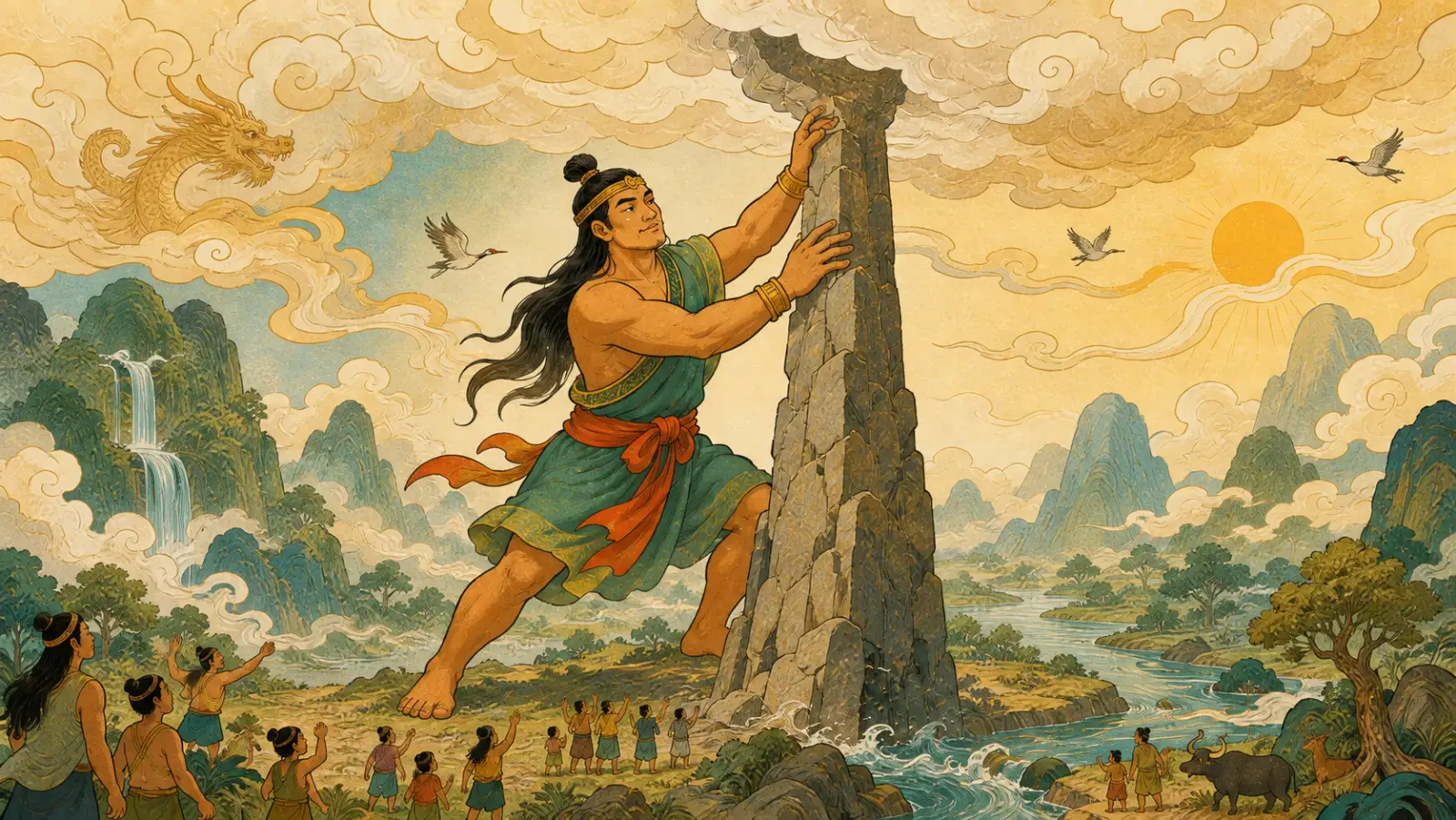
The grandest Vietnamese creation myth is Thần Trụ Trời, "The God Who Propped Up the Sky." In the beginning, the story tells, there were no creatures and no people — only dark, formless chaos. Then a gigantic god stood up. He lifted the sky on his head, dug up earth and stone with his hands, and piled them into a tall pillar that pushed the sky higher and higher, until heaven and earth were finally parted.
When his work was done, the god did something that explains the very landscape of Vietnam. Here is the ending, retold in short:
Khi trời đã cao và vững, thần phá cột chống trời, tung đất đá đi khắp nơi. Đất đá văng ra thành núi và đảo; chỗ đào lấy đất đá đắp cột trở thành biển cả.
"Once the sky was high and firm, the god broke the pillar and flung its earth and stone everywhere. The flying earth and stone became mountains and islands; the pit he dug for the pillar became the wide sea."
In one stroke the myth explains mountains, islands, and the ocean — the whole shape of the country — as the leftovers of a single act of creation. This is phóng đại at its most beautiful: geography itself becomes the footprint of a god.
The naming verse of the world-builders
The god who propped up the sky was not alone. Folk memory keeps a chanting verse that names a whole team of world-building gods, each with one cosmic job. Read it aloud and feel its drumbeat rhythm:
Ông đếm cát / Ông tát bể / Ông kể sao / Ông đào sông / Ông trồng cây / Ông xây rú / Ông trụ trời...
"The god who counts the sand / the god who bails out the sea / the god who tallies the stars / the god who digs the rivers / the god who plants the trees / the god who builds the mountains / the god who props up the sky..."
Each short line has three syllables. Bể is an older word for sea, rú is a regional (Central) word for forested hills, and kể sao uses an old sense of kể, to count. For a learner this verse is a gift: the repeated Ông (a respectful title for a man, here a god) followed by a verb and its object teaches a clean grammar pattern, while the verbs — đếm (count), tát (bail), đào (dig), trồng (plant), xây (build) — are everyday action words you will use forever.
Nữ thần Lúa, the Rice Goddess
If Thần Trụ Trời explains the land, Nữ thần Lúa (the Rice Goddess) explains the food that grows on it — and the respect a rice-farming people owe their staple grain. In a well-known retelling she is a daughter of Ngọc Hoàng (the Jade Emperor), the ruler of Heaven, sent down to earth after a great flood to help the survivors by making rice grow.
But the myth carries a warning inside its kindness. In a common version, ripe rice once came home to people's houses by itself. One woman had not got her house ready, and when the rice arrived she scolded it and struck it with a broom. Offended, the goddess never let rice come home on its own again, so ever since people have had to harvest it and carry it home themselves. Details differ between tellings, but the story is read as a lesson in valuing rice and the work behind it (quý trọng hạt gạo).
This is a lovely example of how myth doubles as ethics. A Vietnamese child who hears the tale learns both why rice must be grown by hand and that grain deserves reverence, all in one story. Quote it to a Vietnamese friend at the dinner table and you will likely earn a knowing smile.
Thần Sét, the Thunder God
The most frightening figure in the pantheon is Thần Sét, the Thunder God, also called Thiên Lôi, and linked in folk speech with ông Sấm ("Mr Thunder"). Strictly, sấm is thunder, chớp is a flash of lightning, and sét is a lightning strike (sét đánh). He is the Jade Emperor's executioner: a fierce-faced enforcer who carries out heaven's law on wrongdoers below. In his hand he grips a stone axe (búa đá), and when an offender is to be punished, he leaps down from the sky and strikes — the flash and crash of the storm made into a single terrifying act of justice.
What makes this myth so charming is its folk detail. People said the Thunder God most fears the crowing of a rooster — so a cockcrow could frighten him off — and that he sleeps right through the winter, waking only when the storm season returns. The winter sleep is a story motif that explains the season of storms where the story was told; it is not a weather rule for all of Vietnam.
Here the ancient wish to understand and master nature is fully on display: an awesome, dangerous force is given a face, a weapon, a weakness (the rooster), and a schedule (winter sleep). Once nature has a story, it feels a little less terrifying — which is exactly what a myth is for.
What these myths tell us about ancient Vietnam
Read together, Vietnam's myths are a portrait of how an early agricultural people saw their world. Several themes stand out, and they reward a thoughtful learner or teacher.
- A water-and-rice civilisation. Water is everywhere in the flood and origin stories, and a whole goddess governs rice. This is the worldview of people whose lives depended on rivers, monsoon, and the paddy.
- Nature explained and tamed. Mountains, seas, thunder, and seasons all get an origin story. The myths turn frightening forces into characters you can name — the first step toward feeling at home in the world.
- Shared human origin. The Quả bầu mẹ gourd-mother myth imagines the peoples of the land reborn together from one source, a vision of kinship among Vietnam's many communities.
- Ethics inside wonder. The Rice Goddess teaches respect for food; the Thunder God embodies justice. Even the grandest cosmic tale carries a quiet moral.
For English speakers, this is why myths are more than entertainment: they are a compact lesson in the values, fears, and hopes of the culture whose language you are learning.
A bilingual glossary of myth terms
Keep this table close as you read. These words unlock almost any Vietnamese discussion of thần thoại.
| Vietnamese | English | Notes |
|---|---|---|
| thần thoại | myth | Tales of gods and the origin of the world. |
| thần | god / deity | The usual hero of a myth. |
| ba cõi | the three realms | Which realms it names depends on the tradition. |
| trời / Trời | sky / Heaven | Sky in everyday speech; Heaven or a divine power in some stories. |
| đất | earth / soil / land | The ground; in some stories, the human world. |
| nước | water; country | The meaning depends on context. |
| Ngọc Hoàng | the Jade Emperor | Supreme ruler of Heaven. |
| phóng đại | hyperbole | The bold exaggeration typical of myth. |
| Thần Trụ Trời | God Who Propped Up the Sky | The great creation myth. |
| Nữ thần Lúa | the Rice Goddess | Daughter of the Jade Emperor; brings rice. |
| Thần Sét | the Thunder God | Also Thiên Lôi or ông Sấm. |
| Quả bầu mẹ | the gourd-mother | Myth of peoples reborn from one gourd. |
Tóm tắt bằng tiếng Việt
Thần thoại là những truyện kể dân gian kỳ ảo mà nhân vật thường là các vị thần hay anh hùng văn hóa. Thần thoại giải thích nguồn gốc vũ trụ và con người, thể hiện khát vọng hiểu và chinh phục thiên nhiên của người xưa. Trời, đất và nước là những không gian quen thuộc trong nhiều truyện. Truyện Thần Trụ Trời kể về một vị thần khổng lồ đắp cột chống trời. Khi thần phá cột, đất đá văng ra thành núi và đảo; chỗ đào lấy đất đá trở thành biển cả. Tương truyền, Nữ thần Lúa là con gái của Ngọc Hoàng; câu chuyện nhắc con người quý trọng hạt gạo và công sức làm ra hạt gạo. Dân gian kể rằng Thần Sét thi hành luật trời, sợ tiếng gà gáy và ngủ suốt mùa đông. Học tiếng Việt qua thần thoại giúp ta hiểu thêm về văn hóa Việt Nam.
Using myths to learn and teach Vietnamese
Myths are an unusually rich classroom resource because they pair concrete, high-frequency vocabulary with unforgettable images. For learners, a single tale delivers everyday words in vivid context: trời (sky), đất (earth), nước (water), núi (mountain), biển (sea), lúa (rice plant), sấm (thunder). Reciting the Ông đếm cát verse drills a clean grammar pattern while training your ear for Vietnamese rhythm. Reading the retellings aloud, then summarising them in your own simple Vietnamese, turns passive vocabulary into active speech. Pair these stories with our structured Vietnamese courses to build the grammar that holds them together.
For teachers, myths make superb culture units and speaking prompts. Tell the story of Thần Trụ Trời, then ask students to explain — in Vietnamese — how mountains, islands, and the sea were made. Use the Rice Goddess to open a discussion on food and respect, or contrast a creation myth with a legend (truyền thuyết) tied to a community's past to teach genre, noting that both can contain gods and miracles. Because myths overlap with the rhymed world of ca dao folk poetry, they slot naturally into any oral-tradition lesson.
Vietnamese mythology FAQ
What is Vietnamese mythology called in Vietnamese?
Myths are called thần thoại, literally “stories of the gods”. They are often described as the earliest layer of Vietnamese folk literature and explain how the world, nature and people began. Legends about heroes and kings are called truyền thuyết, and truyện cổ tích are usually called fairy tales or traditional tales in English.
Who is the main god in Vietnamese mythology?
There is no single creator god. The oldest myths are about giant world-builders such as Thần Trụ Trời, who propped up the sky. In later folk belief, Ngọc Hoàng, the Jade Emperor, rules heaven and gives orders to gods such as the Thunder God and the Kitchen Gods.
Is Lạc Long Quân and Âu Cơ a myth or a legend?
In Vietnam it is usually taught as a legend (truyền thuyết), because it explains the origin of the Vietnamese people and the Hùng Kings rather than the creation of the world. Many English sources call it a creation myth, so you will see both labels.
Are there dragons in Vietnamese mythology?
Yes. Lạc Long Quân, the father of the Vietnamese people in the origin legend, is a dragon lord from the sea, and the dragon (rồng) is a symbol of the nation. That is why Vietnamese people call themselves con Rồng cháu Tiên, children of the Dragon and grandchildren of the Fairy.
What are the most famous Vietnamese myths and legends?
The best known are Thần Trụ Trời (the god who propped up the sky), the Rice Goddess, the Thunder God, the dragon-and-fairy origin story, Sơn Tinh and Thủy Tinh, Thánh Gióng, and the Lake of the Returned Sword in Hà Nội. Many Vietnamese children meet them in books, at school or at home, though the versions vary.
Next step
Read the stories in simple Vietnamese with a native teacher, and turn each one into a short speaking exercise about the characters and what they explain.
Keep going in the accent you chose: Everyday Southern Vietnamese, Everyday Northern Vietnamese, or Everyday Huế Vietnamese.
Prefer to learn from video? Start with the Northern Vietnamese Pronunciation Course or the Southern Complete Vietnamese Course (A1), and train your ear with Slow Vietnamese 01 (Northern) or Slow Vietnamese 01 (Southern).
Read next: the Tấm Cám story and Vietnamese folktales.
More: Vietnamese folktales · Vietnamese legends · Find a Vietlingo teacher
Editorial note
This update adds a key-figures table, a FAQ and clearer myth-versus-legend labels. The retellings are simplified versions of commonly told stories; folk stories vary between communities and collections. Prepared with AI assistance; the Vietnamese passages were checked by a second model for natural Vietnamese.

Comments (0)
A new word, a question, or a different perspective? Share it with fellow learners.
Be the first to comment.