Key takeaways
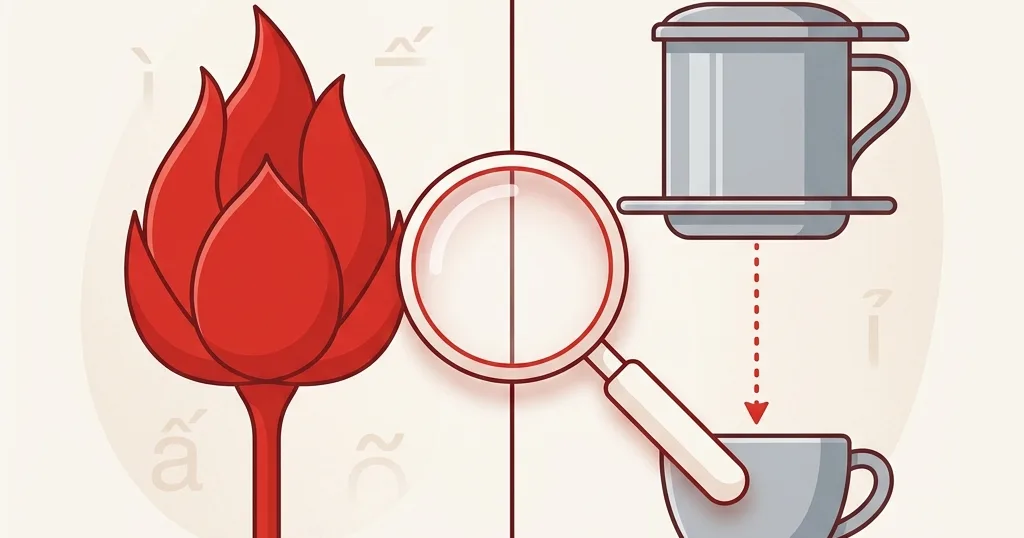
- One test separates them every time: ẩn dụ (metaphor) links two things because they RESEMBLE each other; hoán dụ (metonymy) links them because they are REALLY connected in the world.
- "Con cáo già" (an old fox) for a cunning man is metaphor — there is no real fox, just a chosen similarity (cunning).
- "Cả làng đổ ra đón đoàn" (the whole village poured out) is metonymy — the place actually contains the people, a real physical link.
- Metonymy follows recurring patterns: part for whole, container for contents, a concrete attribute for an abstract quality, and an instrument/sign/symbol for the agent.
- Telling them apart matters because Vietnamese news, song lyrics, and street talk lean heavily on both, and confusing them quietly wrecks comprehension.
You read a Vietnamese headline that says a country “raised its voice” about a trade dispute, and a song lyric that calls a heartless ex “a block of ice.” Both swap one word for another. Both feel poetic. And both will quietly wreck your comprehension if you can’t tell which trick is being played — because ẩn dụ (metaphor) and hoán dụ (metonymy) are not the same move. Learners blur them constantly. The good news: there is one clean test that separates them every single time, and once you own it, a huge slice of Vietnamese news, music, and street talk suddenly clicks into focus.
The one test: resemblance or real association?
Here it is, the whole thing in one line. Metaphor links two things because they RESEMBLE each other. Metonymy links two things because they are REALLY CONNECTED in the world.
That word “really” is doing heavy lifting. In metonymy the connection is not imagined — it is an actual, factual relationship: a part sits inside a whole, a cup actually holds coffee, a crown actually sits on a king’s head. In metaphor there is no real-world link at all; you are inventing a similarity to make a point.
Compare these two sentences:
Thằng đó là một con cáo già. — That guy is an old fox.
Cả làng đổ ra đón đoàn. — The whole village poured out to welcome the delegation.
In the first, the man is not actually connected to any fox. There is no fox anywhere. You call him a fox because he resembles one in a chosen quality — cunning. That is metaphor: a bridge built on similarity. In the second, “the village” (làng) really does contain the people who came out; the place and its residents are genuinely, physically linked. You named the container to mean its contents. That is metonymy: a bridge built on a real connection.
So whenever you hit a figurative phrase, ask yourself one question: “Is the link a resemblance I’m inventing, or a connection that actually exists?” Resemblance → metaphor. Real connection → metonymy. That’s the test. Everything below just shows you what the “real connection” looks like in the wild, because that is the side learners find slippery.
Why metaphor is the easier half
Most learners already have decent metaphor radar, because metaphor works the same way in English. “He’s a snake,” “she’s a star,” “my heart is a desert” — you map a quality from one thing onto another that merely looks or feels similar. Vietnamese does exactly this:
Cô ấy là ánh nắng của cả nhà. — She is the sunshine of the whole family. (She resembles sunshine: warm, brightening — not literally made of light.)
Lời nói của ông ta sắc như dao. — His words are sharp as a knife. (Words resemble a blade in their cutting effect.)
Thời gian là vàng. — Time is gold. (Time resembles gold in value; the two are not otherwise connected.)
Notice you could often insert như (“like / as”) and the sentence would still make sense as a comparison. That is a handy secondary clue: if a hidden “is like” is lurking under the phrase, you are almost certainly looking at metaphor. The trouble starts when the swap is not a hidden comparison — when the two things are bound together in reality. That is metonymy, and Vietnamese leans on it heavily. Let’s map its four most common shapes.
Metonymy pattern 1: the part for the whole
You name one piece of something to mean the entire thing (or the reverse). The link is real: the part genuinely belongs to the whole. This pattern is everywhere in counting and describing people.
Nhà máy cần thêm ba mươi tay thợ. — The factory needs thirty more hands. (“Hands” = workers; a worker really has hands, and the work is done with them.)
Gản đó có chững năm mươi nóc nhà. — There are around fifty roofs nearby. (“Roofs” = households / homes; the roof is a real part of each house.)
Sân vận động hôm nay có bốn mươi nghìn khán giả. — The stadium had forty thousand faces today. (Bốn mươi nghìn gương mặt) — forty thousand faces, meaning spectators.
Crucial contrast: in pattern 1 the body part is actually attached to the person it stands for. That is what makes it metonymy, not metaphor. When you call someone “a fox,” no fox is attached to them — pure resemblance, pure metaphor. When you count “thirty hands,” those hands are real and really belong to the thirty workers. Run the test and the line stays crisp.
Metonymy pattern 2: the container for its contents
You name a vessel or a place to mean what is inside it. The connection is physical: the container literally holds the contents.
Uống thêm một ly nữa không? — Want one more glass? (“Glass” = the drink in it, usually beer or wine — nobody is offering to eat the cup.)
Cả phòng cười ầm lên. — The whole room burst out laughing. (“Room” = the people in the room; the room contains them.)
Đểu tôi một bát nữa, chị ơi. — Give me one more bowl, please. (“Bowl” = a serving of phở or rice in the bowl.)
This is one of the most useful patterns to internalize because Vietnamese ordering, drinking, and eating talk runs on it. If you take “one more glass” literally you’ll think your friend wants an empty cup. Apply the test: is a glass like a drink (resemblance)? No. Does a glass actually hold a drink (real connection)? Yes. Metonymy, every time.
Metonymy pattern 3: a concrete attribute for an abstract quality
Here a tangible, visible feature stands in for the abstract idea it signals. The link is real because that feature genuinely accompanies the quality in the world — not because the two merely look alike.
Cô ấy có một trái tim ấm áp. — She has a warm heart. (The heart, a concrete organ, stands for kindness/compassion — the felt seat of emotion in Vietnamese, as in English.)
Ông ấy là người có máu mặt trong giới kinh doanh. — He’s a person of weight in the business world. (có máu mặt) — literally “has blood and face,” standing for status and influence.
Chúng ta cần những cái đầu lạnh trong lúc này. — We need cool heads right now. (“Cool heads” = calm, rational judgment.)
This pattern is the trickiest because it can feel like metaphor — isn’t calling someone “warm-hearted” a comparison? Run the test carefully. We are not saying the heart resembles kindness. We are using the heart because, in the shared cultural model, the heart is the real locus of feeling — kindness is associated with it, housed in it. The attribute (heart) is genuinely tied to the quality (compassion), so it’s metonymy. Contrast: trái tim của anh là băng đá (“his heart is a block of ice”) — that is metaphor, because a heart is not really connected to ice; you’re inventing a resemblance (cold = unfeeling). Same body part, two different figures, and the test still sorts them.
Metonymy pattern 4: an instrument, sign, or symbol for the agent
You name a tool, an emblem, or a representative object to mean the person, group, or power behind it. The connection is real because that object is actually used by, or stands for, the agent.
Hà Nội và Tokyo nhất trí tăng cường hợp tác. — Hanoi and Tokyo agreed to deepen cooperation. (The capital cities stand for the two governments — the seat of power really sits in those cities.)
Cây bút ấy đã viết nên bao nhiêu số phận. — That pen has written so many fates. (“Pen” = the writer; the writer really wields the pen.)
Toàn đội áo đỏ ăn mừng bàn thắng. — The whole team in red celebrated the goal. (áo đỏ) — “the reds,” the players who really wear the red jersey.
Nhà Trắng chưa đưa ra bình luận. — The White House has not commented. (The building stands for the U.S. administration that works there.)
This pattern dominates news writing. “Hanoi says,” “Beijing warns,” “the White House responds” — a place-name standing for the government housed there. Buildings don’t talk and cities don’t sign treaties; the people inside do, and the link between place and people is real, not a resemblance. Metonymy, locked in.
Why this actually matters for comprehension
This isn’t a grammar-class curiosity. Three of the registers learners most want to understand — news headlines, song lyrics, and everyday speech — are saturated with both figures, and the two demand different reading strategies.
With metaphor, your job is to find the shared quality. When a headline calls inflation con quái vật (“a monster”), you ask: which monstrous quality — that it’s frightening, devouring, hard to stop? You decode by hunting for the resemblance the writer intends.
With metonymy, your job is different: identify the real-world link and substitute the literal referent. When a sports report says áo vàng bứt phá ở những kílômét cuối (“the yellow jersey broke away in the final kilometers”), you don’t look for a resemblance — you just swap in “the race leader,” because the yellow jersey is the thing the leader actually wears. Treat it as metaphor and you’ll waste energy looking for a deep comparison that isn’t there.
Get the figure wrong and you mis-read meaning in predictable ways. A learner who reads “the whole room laughed” as metaphor might strain to imagine how a room is like a person. A learner who reads “he’s a fox” as metonymy might hunt for some real fox the man owns. Both errors come from skipping the one test. Run it first, and you read the line the way a native speaker does — automatically.
Actionable practice: build the reflex in five steps
You don’t learn this by memorizing definitions. You learn it by running the test until it becomes a reflex. Here is a sequence that works:
- Step 1 — Catch the swap. When reading or listening, flag any word that obviously doesn’t mean its literal self (“thirty hands,” “Hanoi said,” “a warm heart”). Don’t classify yet — just notice the substitution.
- Step 2 — Ask the one question. “Is this a resemblance I’m inventing, or a connection that really exists?” Force yourself to answer in one word: resemblance or connection.
- Step 3 — If connection, name the pattern. Part-for-whole? Container-for-contents? Attribute-for-quality? Instrument/sign-for-agent? Naming the pattern cements it and speeds you up next time.
- Step 4 — Substitute and re-read. Replace the figure with its plain meaning (“thirty workers,” “the Vietnamese government,” “a kind person”) and read the sentence again. If it now makes flat, literal sense, you classified correctly.
- Step 5 — Keep a two-column log. One column ẩn dụ, one column hoán dụ. Drop every example you meet into the right column. After a week of news headlines you’ll have a personal corpus — and the reflex will be forming on its own.
If you want a richer source of real sentences to run this drill on, our trial lesson drops you straight into authentic Vietnamese headlines and dialogue, which is exactly the diet your new figure-spotting reflex needs.
Spot the figure: a 5-item self-quiz
Label each phrase metaphor (ẩn dụ) or metonymy (hoán dụ). Run the one test on each before peeking at the answers. Don’t just guess — say out loud whether the link is resemblance or real connection.
- 1. Lớp tôi có ba mươi cái miệng ăn. — My class has thirty mouths to feed.
- 2. Anh ta là một con sư tử trên sân cỏ. — He’s a lion on the football pitch.
- 3. Cả rạp vỗ tay không ngớt. — The whole theater clapped nonstop.
- 4. Đôi bàn tay vàng của bếp trưởng đã cứu món súp. — The chef’s golden hands saved the soup.
- 5. Sài Gòn đêm nay không ngủ. — Saigon doesn’t sleep tonight.
Answers and reasoning:
- 1. Metonymy (part for whole). “Mouths” stands for people; a mouth is a real part of each person and is what does the eating. No resemblance involved.
- 2. Metaphor. He is not really connected to any lion — you’re inventing a resemblance (fierce, dominant). Notice you could say “like a lion.”
- 3. Metonymy (container for contents). “Theater” stands for the audience inside it — the building really contains them.
- 4. Metonymy (instrument/attribute for agent), with a metaphorical flavoring. “Hands” stands for the chef, whose hands really do the cooking — that core swap is metonymy. The word “golden” layered on top is a small metaphor for skill. Real Vietnamese often stacks the two; spotting the dominant move is the skill.
- 5. Metonymy (container/place for contents). “Saigon” stands for its residents — the city really holds the people who are out late. The city doesn’t literally sleep; the people in it don’t.
If item 4 tripped you, good — that’s the real lesson. Authentic Vietnamese rarely serves you one clean figure at a time; it layers them. The test still works, you just apply it to the main swap first, then notice any decoration on top.
Your next move: a mini-drill, then let the AI tutor mark your work
Here’s a 60-second drill to lock it in. Open any Vietnamese news site, read the first five headlines, and for each one whisper “resemblance” or “connection” before you read the body. You’ll be shocked how many headlines hide a metonymy — a capital city for a government, a jersey color for a team, a building for an institution. Do this daily for a week and the classification stops being a decision and becomes a reflex.
Then check yourself. Paste any Vietnamese sentence — a headline, a song lyric, a line a friend texted you — into VietLingo’s AI tutor and ask it to break down whether the sentence uses metaphor, metonymy, or neither, and why. It will name the exact pattern (part-for-whole, container-for-contents, and the rest), point to the real-world link or the resemblance, and give you the plain literal meaning underneath. It’s like having a native-speaker editor sitting next to you, confirming your call on every line until you no longer need to ask.
Most learners spend years quietly mis-reading figures of speech, treating every swap as “just poetic.” You now have something better: a single question that sorts metaphor from metonymy on the spot, and four concrete patterns that show you what to expect. Keep running the test, keep logging examples, and within a few weeks you’ll read a Vietnamese headline the way a native does — instantly seeing the trick, and instantly seeing through it.




Comments (0)
A new word, a question, or a different perspective? Share it with fellow learners.
Be the first to comment.