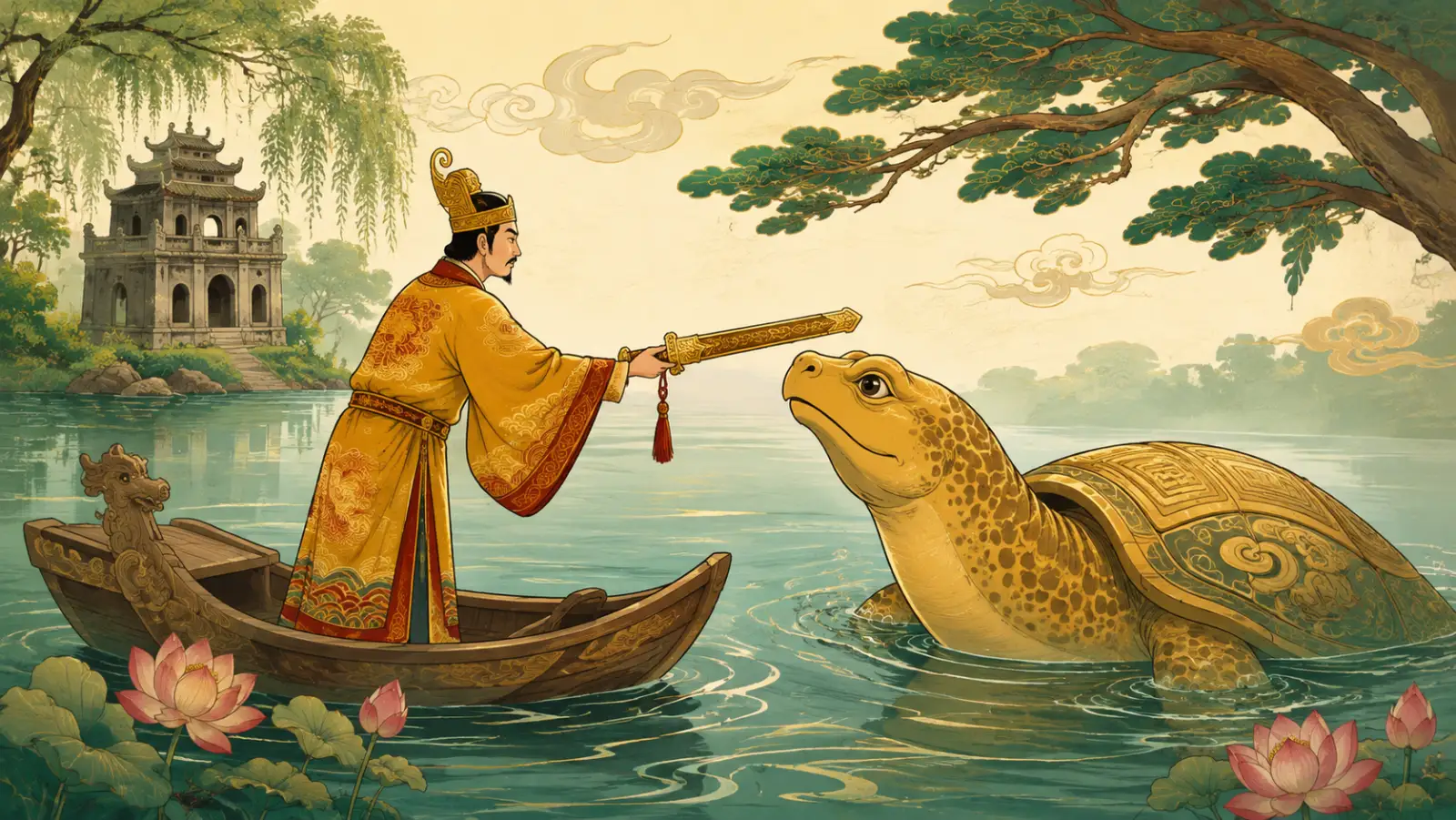
Ask a Vietnamese child why a lake in the heart of Hanoi is called Hồ Gươm, the Lake of the Sword, and you will not get a geography lesson. You will get a story about a magic blade, a hero, and a giant golden turtle. That is the gift of truyền thuyết (legend): it turns history into something you can feel and pass on. For English speakers learning Vietnamese, and for the teachers who guide them, legends are a joyful way in, because every famous hero, festival, and place-name carries one. This guide retells three of the most beloved and shows you how to read them as both stories and language lessons.
What is a Vietnamese legend (truyền thuyết)?
A truyền thuyết is a folk story about real historical events and figures, woven through with fantastic, larger-than-life elements. Unlike myth, which explains gods and the birth of the world, legend grows directly out of history. It begins with something that truly happened, a war, a king, a rebellion, and then the people add wonder: a hero who flies to heaven, a turtle who speaks, a crossbow that never misses. Through these embellishments the community expresses its admiration and its judgment, deciding together who was a hero and who was a traitor.
This is the key difference to hold onto. Where thần thoại (myth) reaches back before history, truyền thuyết keeps one foot in the historical record and one in imagination. Our guide on Vietnamese myths (thần thoại) traces that older, divine layer; both sit inside the larger world of Vietnamese folk literature, the oral tradition that carried these tales for centuries before they were written down.
How do Vietnamese scholars classify legends?
Vietnamese tradition sorts legends into three broad groups, and knowing them helps you place any new tale on the map. Each answers a slightly different question about the past.
Legends of historical figures and events
These are tales built around real people and moments of the nation's story: An Dương Vương, king of ancient Âu Lạc; the Hai Bà Trưng (the Trưng Sisters), who rose against foreign rule; Bà Triệu (Lady Triệu), the warrior woman who rode an elephant into battle; Trần Hưng Đạo, the general who repelled the Mongols; and Nguyễn Trãi, the fifteenth-century scholar-strategist. History remembers them; legend makes them shine.
Place-name and origin legends
This second group explains how a place got its name or how a landmark came to be. The most famous is Sự tích Hồ Gươm (the Lake of the Returned Sword) in Hanoi, but every region has its own; in Đà Nẵng, the marble peaks of Ngũ Hành Sơn (the Five Elements Mountains) carry their own cluster of tales. When a guide points to a hill, a river, or a temple, there is almost always a legend attached.
Legends of cultural figures
The third group honours people who shaped the nation's crafts, learning, and customs: the founders of trades, the teachers, the makers. These legends explain not a battle but a way of life, crediting a figure with a gift the community still uses today.
How is a Vietnamese legend built? The three-part shape
Vietnamese legends about a hero tend to follow the same three-part shape. Once you see the pattern, every hero legend becomes easier to follow and easier to retell in Vietnamese. The shape moves like this:
- The hero's extraordinary origin (nguồn gốc khác thường). The hero rarely enters the world the ordinary way: a miraculous birth, an omen, or a strange sign marks them out from the start.
- The hero's deeds (chiến công). The heart of the tale, where the hero performs great acts, usually defeating an invader through courage and wonder.
- The end of the hero's life (kết thúc cuộc đời). Rarely an ordinary death. The hero ends in glory or, very often, in hóa thân (transfiguration), passing out of human form into heaven or into the landscape itself.
Keep this three-beat rhythm in mind as we retell the tales below; naming the parts in Vietnamese is a small, satisfying vocabulary win.
Who was Thánh Gióng, the boy who became a giant?
Of all Vietnam's legends, the tale of Thánh Gióng, honoured as the Phù Đổng Thiên Vương (the Phù Đổng Heavenly King), may be the most loved. It is the perfect example of the three-part shape, and it carries the nation's oldest ideal: standing up to defend the homeland.
The story is set in the reign of the sixth Hùng King. An old, childless couple longed for a son. One day the wife stepped into a giant footprint in the field and soon gave birth to a boy, his extraordinary origin in plain view. But the child was strange: he reached the age of three without ever speaking, sitting, or smiling. His parents despaired.
Then the land was threatened by the giặc Ân (the Ân invaders), and the king sent a herald to seek anyone who could drive them out. Hearing the call, the silent boy suddenly spoke for the first time, declaring he would defeat the enemy. He asked for three things:
Ta cần một con ngựa sắt, một roi sắt và một áo giáp sắt.
"I need an iron horse, an iron rod, and a suit of iron armour."
From that moment Gióng grew at a miraculous speed, eating enormous bowls of rice as the whole village pooled its food to feed him, until he rose into a towering warrior. When the invaders came, he mounted his fire-breathing iron horse and charged, scattering the enemy ranks. When his iron rod snapped in battle, he did not pause; he uprooted whole clumps of bamboo from the roadside and swung them as weapons until the foe was broken.
The ending is pure hóa thân. His task complete, Gióng did not return to claim a reward. He rode to the summit of Mount Sóc (Sóc Sơn), and there both rider and horse rose into the heavens, never seen again.
What traces did Thánh Gióng leave behind?
Like many legends, the tale of Gióng doubles as an explanation for things you can still point to in the landscape, part of why it has lasted so long. The fire from the iron horse, it says, scorched a grove of bamboo into the burnt-yellow tre đằng ngà ("ivory bamboo") seen to this day. The hoofprints of the galloping horse filled with water and became a chain of ponds. And one village, set ablaze in the fighting, kept the name làng Cháy ("Burnt Village") ever after.
Gióng's legacy reaches far past the page. The Hội Gióng, the great festival held in his honour near Hanoi, is recognised by UNESCO as Intangible Cultural Heritage. Even Vietnam's national school sports games are named Hội khỏe Phù Đổng ("the Phù Đổng Fitness Games") after him, a quiet sign that the spirit of the boy who grew strong to defend his country still inspires children today.
What happened to An Dương Vương and the magic crossbow?
If Thánh Gióng is the legend of triumph, the tale of An Dương Vương is the legend of warning, one of the most haunting in the tradition. It is a love story, a spy story, and a lesson about misplaced trust all at once.
King An Dương Vương ruled the kingdom of Âu Lạc and set out to build a great spiral citadel, Loa Thành (the "Snail Citadel," at Cổ Loa in today's Đông Anh, Hanoi). But the walls kept collapsing as fast as they rose, until the Rùa Vàng (the Golden Turtle), also called Kim Quy, came from the waters to help. The citadel finally stood, and before departing the turtle gave the king one of its claws to use as a crossbow's trigger. This nỏ thần (magic crossbow) fired countless arrows at once and defeated every army that attacked.
The enemy lord Triệu Đà, unable to win by force, turned to cunning. He proposed peace and a marriage, sending his son Trọng Thủy to wed the king's beloved daughter, Mỵ Châu. The young couple truly fell in love, but Trọng Thủy had a secret mission. Trusting her husband completely, Mỵ Châu showed him the magic trigger, and he secretly swapped it for a fake before slipping away home.
War came again, but this time the crossbow was powerless. The king fled south on horseback with Mỵ Châu behind him. Still believing her husband would follow and rescue her, she plucked the goose feathers (lông ngỗng) from her coat and scattered them along the road to mark the way, never dreaming she was leading the enemy straight to them. At the sea's edge, with nowhere left to run, the Golden Turtle surfaced and cried out the terrible truth:
Kẻ ngồi sau lưng chính là giặc đó!
"The enemy is the one sitting behind you!"
Understanding at last, the heartbroken king drew his sword and killed his own daughter. Before she died, Mỵ Châu swore that if she had been a traitor, let her become dust; but if she had been loyal and merely deceived, let her blood turn into pearls. The legend says it became pearls in the sea. Trọng Thủy, arriving too late and consumed by grief, drowned himself in a well. The tale endures as a warning about vigilance, and about the cost of trust given without care.
Why is Hồ Gươm called the Lake of the Returned Sword?
The third great legend, Sự tích Hồ Gươm, names the most famous lake in Vietnam and celebrates one of its greatest heroes. It belongs to the fifteenth century, during the harsh occupation by the Chinese Minh (Ming) dynasty.
In those dark years the Lam Sơn uprising gathered under a leader named Lê Lợi, and heaven, it is said, chose to help. The Long Quân (the Dragon Lord) lent the rebels a magic sword, but gave it in two halves by a strange path. A fisherman named Lê Thận netted the same iron bar three times; realising it was no ordinary metal, he kept it, and it proved to be a sword blade. Separately, while fleeing through a forest, Lê Lợi spotted a jewelled hilt glowing in a tree and took it down.
When blade and hilt were brought together, they fit perfectly, and on the blade gleamed two words:
Thuận Thiên
"In Accord with Heaven."
Here was the sign that Lê Lợi was the rightful leader, blessed by heaven to free his people. Wielding the sword, he united the resistance and, after years of struggle, drove the Ming out and founded a new dynasty.
Then came the moment that named the lake. One day, sailing on a lake in the newly freed capital, Lê Lợi saw the Golden Turtle rise and ask for the sword back, now that its work of saving the nation was done. He drew the blade and held it out; the turtle took it in its mouth and sank into the depths. From that day the lake has been called Hồ Hoàn Kiếm or Hồ Gươm, the Lake of the Returned Sword, still at the green heart of Hanoi today. The legend says the people fought only as long as they had to, and that peace, once won, is meant to be kept.
Why do legends still shape Vietnam today?
These are not stories sealed in old books; they live in the modern country, woven into festivals, temples, and the map itself. For a learner, the language of legend is also the language of daily life and travel.
- Festivals. The Hội Gióng draws crowds each year and carries a UNESCO honour, re-enacting the hero's deeds with banners, drums, and dance.
- Temples. Shrines to the Hai Bà Trưng, to Trần Hưng Đạo, and to An Dương Vương at Cổ Loa receive incense all year round.
- Place-names. Every time someone says Hồ Gươm, Cổ Loa, or Sóc Sơn, they speak a legend without thinking.
- Everyday speech. To call someone a "Mỵ Châu" hints gently at a person too trusting for their own good, the way English invokes a Trojan horse.
If you want to walk this living map with a guide, our Vietnamese teachers can bring the heroes and place-names into real conversation, the way a Vietnamese parent first shares them.
A bilingual glossary of legend terms
Keep this table beside you as you read and retell these tales; these words unlock almost any Vietnamese discussion of legends.
| Vietnamese | English | Notes |
|---|---|---|
| truyền thuyết | legend | History woven with the fantastic. |
| thần thoại | myth | The older layer, about gods and origins. |
| nguồn gốc | origin | Often "extraordinary" for a hero. |
| chiến công | great deed / feat | The heart of a hero legend. |
| hóa thân | transfiguration | The hero passes beyond human form. |
| anh hùng | hero | The central figure of the tale. |
| giặc | invader / enemy | As in giặc Ân, the Ân invaders. |
| Rùa Vàng / Kim Quy | Golden Turtle | The helper-spirit of the waters. |
| nỏ thần | magic crossbow | An Dương Vương's invincible weapon. |
| gươm / kiếm | sword | Hồ Gươm = Lake of the Sword. |
| sự tích | origin story | "The tale of how..." a place or thing. |
| hội | festival | As in Hội Gióng, the Gióng Festival. |
How do legends help you learn Vietnamese?
Legends are far more than entertainment for a learner; they are some of the most efficient lessons in the language. Here is what they give you.
- High-value vocabulary. Words like anh hùng (hero), giặc (invader), and vua (king) recur across countless tales, so learning them once pays off many times.
- Narrative grammar. Retelling a legend trains the storytelling patterns and sequence words (rồi, "then"; sau đó, "after that") you need for real conversation.
- Cultural fluency. Knowing why Hồ Gươm has its name, or what a "Mỵ Châu" hints at, unlocks jokes, news, and references a textbook never covers.
- Place-name confidence. Legends reveal the meaning hidden inside names like Cổ Loa and Sóc Sơn, so a map of Vietnam reads like a storybook.
- Memorable hooks. A vivid scene, an iron horse, a turtle rising from a lake, anchors new words far better than an isolated list.
The best way to make a legend stick is to retell it aloud to a listener who can correct your tones. You can book a trial lesson and tell the story of Thánh Gióng yourself, or browse our Vietnamese courses that weave culture into everyday speaking. For more of the tradition, see our guide to ca dao, Vietnamese folk poetry, which carries the same heart in verse.
Tóm tắt bằng tiếng Việt
Truyền thuyết là những câu chuyện dân gian kể về nhân vật và sự kiện lịch sử có thật, được thêu dệt thêm yếu tố kỳ ảo để thể hiện sự ngợi ca và đánh giá của nhân dân. Khác với thần thoại, truyền thuyết bắt nguồn từ lịch sử. Người ta chia thành ba loại: về nhân vật lịch sử (An Dương Vương, Hai Bà Trưng); về địa danh (Sự tích Hồ Gươm); và về danh nhân văn hóa. Truyện về người anh hùng thường có ba phần: nguồn gốc khác thường, chiến công, và kết thúc cuộc đời (thường là hóa thân). Bài viết kể lại Thánh Gióng, An Dương Vương với nỏ thần, và Sự tích Hồ Gươm. Với người học, truyền thuyết là cánh cửa quý để hiểu tâm hồn Việt Nam.
Learn Vietnamese with Vietlingo
Legends turn the Vietnamese past into something you can feel, and they make memorable lessons. Bring the tale of the iron horse or the returned sword to a real teacher and watch your storytelling come alive. Book your trial lesson today, or explore our Vietnamese courses that blend authentic culture with everyday speaking. Một truyền thuyết, một bài học mới — one legend, one new lesson at a time.



Comments (0)
A new word, a question, or a different perspective? Share it with fellow learners.
Be the first to comment.