Key takeaways
- In Vietnamese the family words ARE the everyday words: you call a market vendor cô (aunt), a taxi driver anh (older brother), an elderly woman bà (grandmother).
- There's no neutral "you" — the language reaches into the family and picks a kinship word driven mostly by the person's apparent age relative to you.
- The word for "I" changes to match: call someone anh and you usually call yourself em, so the pair moves together.
- Guessing age wrong can flatter or insult, so the article gives safe fallbacks for when you truly can't tell.
- Treating a stranger as kin is a small act of inclusion that makes you instantly likeable, not just grammatically correct.
You walk into a market in Saigon, point at a basket of mangoes, and the right way to ask the price is to call the vendor your aunt. Hail a taxi and the driver might become your older brother. Greet the elderly woman sweeping her doorstep and she is, quite literally, your grandmother — even though you met her three seconds ago. This is not a quirk you can skip. In Vietnamese, the family words are the everyday words. Learn to choose them by age and you stop sounding like a textbook and start sounding like a person who belongs.
Why does Vietnamese use family words for strangers?
English gives you one tidy pronoun for almost everyone: you. The cashier, your boss, a toddler, the president — all of them are you. Vietnamese refuses that flatness. Instead of a neutral you, the language reaches into the family and pulls out a relationship word that fits the person in front of you. The choice is driven mostly by relative age: how old this person seems compared to you.
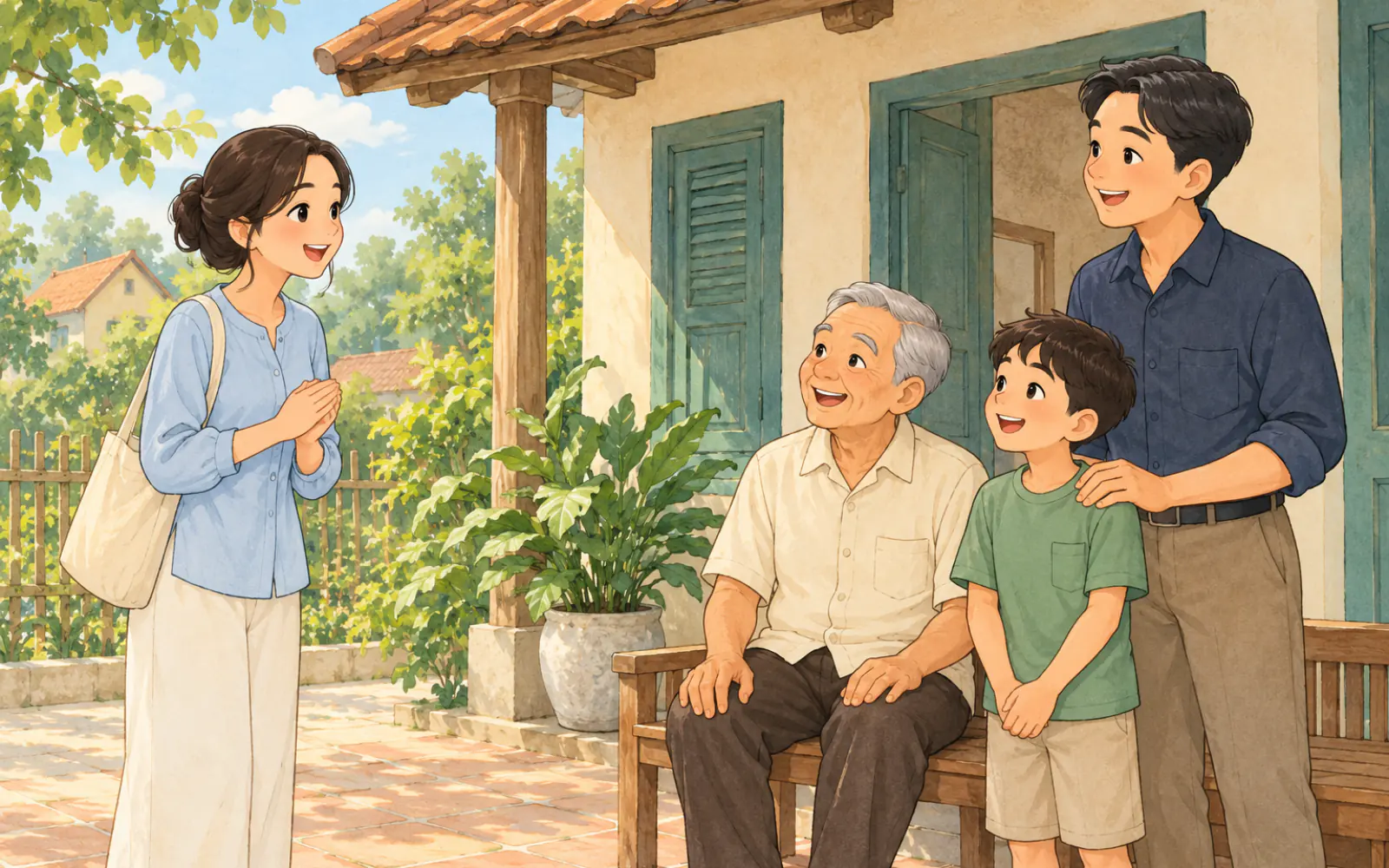
The logic is warm rather than cold. Treating a stranger as kin is a small act of inclusion. When you call a middle-aged woman cô (aunt), you are quietly placing her in the role of a respected elder relative, and placing yourself as the polite younger one. The whole exchange becomes a tiny family scene, and Vietnamese people feel that warmth instantly. Get it right and you are not just grammatically correct — you are likeable.
There is a second consequence that trips up beginners: in Vietnamese, the word for I changes too. If you call someone anh (older brother), you usually call yourself em (younger sibling). The pair moves together. So learning these terms is not just about addressing other people; it is about knowing who you become in each conversation.
The core kinship set you actually need
You do not need the entire sprawling family tree to function. A compact set covers the vast majority of daily encounters. Here is the practical core, arranged roughly from youngest to oldest.
- em — someone clearly younger than you (a teenager, a younger server). Literally "younger sibling."
- anh — a man a bit older than you, from a few years up to roughly your generation. Literally "older brother."
- chị — a woman a bit older than you, same range. Literally "older sister."
- cô — a woman around your parents' age, or a younger-feeling middle-aged woman. Often "auntie" or "miss."
- chú — a man around your parents' age, leaning slightly younger than your own father. "Uncle."
- bác — a respectful term for someone clearly older than your parents but not yet elderly. Works for both men and women. Think "senior uncle/aunt."
- ông — an elderly man, grandfather age. "Grandfather" or "sir."
- bà — an elderly woman, grandmother age. "Grandmother" or "ma'am."
And the words for yourself that pair with them:
- To an anh or chị, you are usually em.
- To a cô, chú, or someone of clear parent-age, you can be con (child) — warm and respectful — or cháu.
- To a bác, ông, or bà, you are cháu (grandchild / niece / nephew).
Memorize the pairs together, not as isolated vocabulary. anh / em, cô / con, ông / cháu. They are dance partners; they always step at the same time.
One English word, several Vietnamese words
Here is the trap that catches every learner. In English, your sibling's gender splits "brother" from "sister," but age does not change the word. Your older brother and your younger brother are both "brother." Vietnamese flips the priority: age matters more than you expect, and it changes the word entirely.
"Brother" is not one word. An older brother is anh; a younger brother is em trai. "Sister" splits the same way: older is chị, younger is em gái. When you address a stranger, the gender is usually visible — it is the age call that you have to make, and that single decision selects the word.
So the mental question is never just "is this a man or a woman?" It is "is this person older or younger than me, and by how much?" That second question is the one English never taught you to ask, and it is the heart of sounding natural in Vietnamese.
How do you estimate which term fits?
You will not have a birth certificate. You estimate, and you get better with practice. Use this rough ladder, anchored to your own age:
- Visibly younger than you (kids, teens, young servers) → em.
- Close to your age, slightly older → anh (man) or chị (woman). When unsure between same-age and slightly older, lean toward anh/chị — flattering up is safer than flattening down.
- Roughly your parents' age → cô (woman) or chú (man).
- Older than your parents, but still active and not frail → bác — a graceful, respectful catch-all for either gender.
- Clearly elderly, grandparent age → ông (man) or bà (woman).
A few real-world cues sharpen the guess. Grey hair, posture, and how the person carries themselves matter more than a precise number. Context helps too: a young woman behind a university coffee counter is almost certainly chị or em, while a woman running a fabric stall she has clearly owned for decades is comfortably cô. And remember it is relative: a 30-year-old learner and a 60-year-old learner will correctly call the very same vendor different things.
Worked mini-examples
Let us walk through four everyday encounters. Imagine you are a learner in your late twenties so the age math is concrete.
The market vendor (a woman around fifty)
She is roughly your mother's age, so she becomes cô, and you become con. The warmth is built right into the words.
Cô ơi, bánh mì này bao nhiêu vậy cô? — Auntie, how much is this banh mi?
Dạ con lấy hai ổ cô. — Yes, I'll take two, auntie. (Notice how you call yourself con, "child," softening the whole request.)
The taxi driver (a man maybe a few years older than you)
He reads as slightly senior to you, so he is anh and you are em.
Anh ơi, cho em đến phố cổ Hội An nha anh. — Hey (older brother), take me to the Hoi An old quarter, please.
Dạ, cám ơn anh nhiều. — Thanks a lot, anh. (If the driver were clearly your father's age instead, you would switch to chú and call yourself con.)
The elderly neighbor (a woman in her seventies)
She is grandmother age, so she is bà and you are cháu. This is where respect should be unmistakable.
Dạ, cháu chào bà ạ. — Good morning, grandmother. (Literally "I, your grandchild, greet you.")
Bà đi chợ về ạ hả? Để cháu xách giúp bà nha. — Are you back from the market, grandma? Let me carry that for you.
A peer (someone clearly the same age as you)
With a true peer — a fellow student, a colleague born the same year — the easy, friendly route is the bạn / mình pair: bạn for "you" (friend) and mình for "I." It sidesteps the age question entirely and feels equal and warm.
Bạn cũng học tiếng Việt à? Mình học được mấy tháng rồi. — You're studying Vietnamese too? I've been learning for a few months now.
If you later learn the person is actually a little older, you can gracefully shift to anh or chị. Vietnamese people adjust these terms mid-friendship all the time; it is normal, not awkward.
What happens when you guess the age wrong?
This is the part learners fear, and a little honesty helps. There are two ways to miss, and they are not equally dangerous.
Guessing too young is the safer mistake. Calling a 45-year-old woman chị (older sister) instead of cô (aunt) usually lands fine — you have implied she looks youthful, which rarely offends. Many vendors will smile.
Guessing too old is the riskier mistake. Calling a 30-year-old woman cô when she expected chị can sting, because you have aged her up into your parents' generation. The same goes for jumping to bà on someone who is merely middle-aged. When you are genuinely unsure, err slightly younger.
The good news: native speakers are forgiving with foreigners. They can hear that you are learning, and the very fact that you reached for a kinship term at all reads as respectful effort. A small miss is forgotten the moment the conversation continues. What they notice and appreciate is that you tried to place them properly, instead of defaulting to a cold, flat pronoun.
Safe fallbacks when you really cannot tell
Some people are genuinely hard to read — an ambiguous fifty-something, a person whose age you simply cannot place. Keep these escape hatches ready.
- Lead with Dạ. Starting a sentence with dạ (a soft, polite particle) signals respect on its own and buys you a beat before you commit to a term.
- For an ambiguous middle-aged-to-older person, bác is your best friend. It is respectful, it works for either gender, and it flatters by treating the person as a senior. When in doubt above parent-age, reach for bác.
- For an ambiguous peer-ish person, anh or chị plus a friendly tone rarely goes wrong. You are being warm and slightly deferential, which is almost always welcome.
- With true peers, default to bạn. It is the neutral, friendly choice that needs no age calculation at all.
- Listen and copy. If the person addresses themselves or you with a term first, mirror it. Vietnamese speakers constantly signal the relationship; let them set the frame and follow their lead.
One more tactic: you can often delay the term entirely for the first sentence. A simple Dạ, cho hỏi... ("Excuse me, may I ask...") gets a conversation moving while you gather more clues about who this person is.
Putting it into practice
Reading about this system is easy; producing the right term in half a second, out loud, in a noisy market is the real skill. Build it deliberately.
- Drill the pairs, not the singles. Say them aloud as couplets until they are automatic: anh–em, chị–em, cô–con, chú–con, bác–cháu, ông–cháu, bà–cháu.
- Play the age-guessing game. As you go about your day — even at home, with photos or while people-watching — silently assign each person a term. Speed and confidence come from repetition.
- Script your top three errands. Write out, word for word, how you would order coffee, ask a price, and greet a neighbor, choosing the kinship terms in advance. Rehearse them until they feel like reflexes.
- Rehearse the graceful recovery. Practice switching terms mid-conversation so that if you start with cô and realize she is younger, sliding to chị feels smooth instead of panicked.
The fastest way to make these choices stick is to use them in conversation where someone can catch your slips before they become habits. With the Vietlingo AI tutor, you can roleplay a vendor, a driver, or an elderly neighbor and let it gently correct you when your chosen term does not match the situation — for example, gently pointing out that the "older woman" in your scenario should be cô, not chị. That immediate, judgment-free feedback is exactly how the age-scaling instinct gets wired in. If you want the underlying logic of I and you shifting together, our deeper guide to Vietnamese pronouns and how relationships choose them pairs naturally with this habit.
Keep going in the accent you chose: Everyday Southern Vietnamese, Everyday Northern Vietnamese, or Everyday Huế Vietnamese.
Prefer to learn from video? Start with the Northern Vietnamese Pronunciation Course or the Southern Complete Vietnamese Course (A1), and train your ear with Slow Vietnamese 01 (Northern) or Slow Vietnamese 01 (Southern).
Read next: the Vietnamese pronouns guide and Vietnamese greetings.
Why this one habit pays off so much
Of all the things you can learn early in Vietnamese, age-scaled kinship address gives you the biggest jump in how natural and polite you sound for the least grammar. You are not conjugating verbs or memorizing irregular forms — you are simply choosing the right family word for the human in front of you. Yet that single choice signals that you understand how Vietnamese relationships work, that you respect your elders, and that you see the people you talk to as more than transactions.
So the next time you reach for that basket of mangoes, do not say a cold, foreign-sounding "you." Call her cô. Watch her face. That small word is the difference between a tourist reading from a phrasebook and a learner who is genuinely becoming part of the conversation — one aunt, one uncle, one big brother at a time.




Comments (0)
A new word, a question, or a different perspective? Share it with fellow learners.
Be the first to comment.