Key takeaways
- This is a working bilingual reference of 50 hotel phrases grouped by situation — check-in, room service, complaints, check-out — for hospitality staff to drill, print, and laminate.
- Don't memorize it flat: drill one situation (about ten phrases) per session until automatic before moving on — trying to absorb all fifty in a week makes none stick.
- Twelve check-in phrases cover roughly 90% of normal arrivals (e.g. Chào quý khách, em có thể giúp gì ạ?).
- Phrases use a neutral polite register suitable for most hotel chains; adjust pronouns up or down for very formal or very casual settings.
- Each entry is Vietnamese first then English, with pronunciation cues on the items that catch English speakers out.
This is the reference page hospitality learners actually use on shift: 50 Vietnamese hotel phrases organized by situation, side by side with English, with pronunciation cues on the items that catch English speakers out. Whether you are a front-desk agent learning Vietnamese for the first time, a tour-company manager training new staff, or a teacher building a hotel-specific syllabus, this list gives you a bilingual phrase bank you can drill, print and laminate. The phrases are written in a neutral polite register suitable for most hotel chains; adjust pronouns up or down for very formal or very casual establishments.
How should I use this phrase list?
Do not memorize it as a flat list. Pick one situation per training session — check-in, room service, complaints, check-out — and drill those ten phrases until they are automatic before moving on. The single most common mistake is trying to absorb all fifty in a week; the brain treats them as undifferentiated noise and none stick. One section per week, drilled to fluency, beats the whole list skimmed in a day.
Each phrase is given Vietnamese first, then —, then English. The Vietnamese version is the version you should aim to produce; the English is a working translation, not a literal one. For pronunciation help on items marked tricky, see the cues at the end of each section. For the underlying tones, our tones guide is the right pre-reading.
What are the essential check-in phrases?
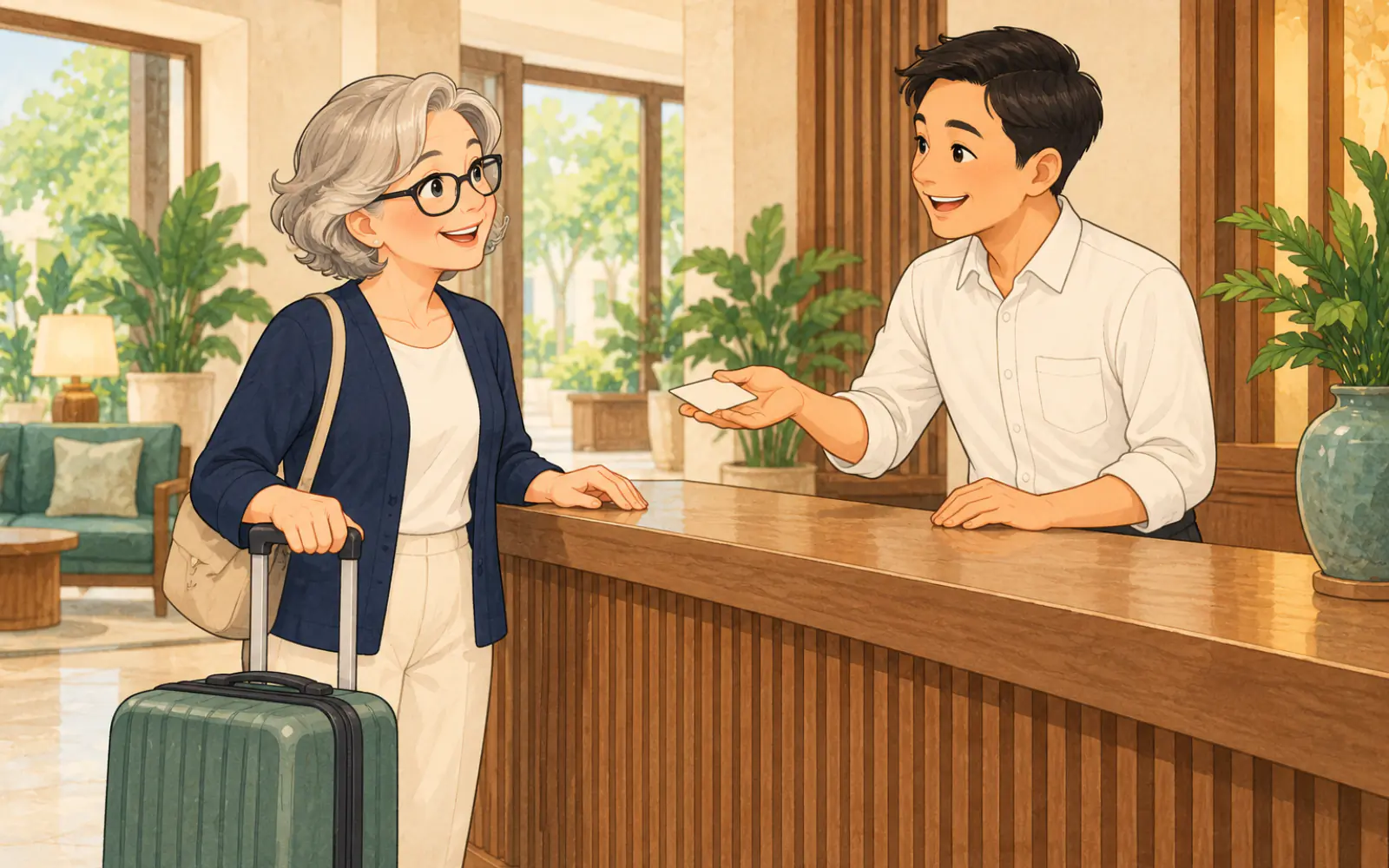
Check-in is the highest-frequency hotel exchange and the one where first impressions are set. These twelve phrases cover roughly 90% of normal arrivals.
- Chào quý khách, em có thể giúp gì ạ? — Hello, how may I help you?
- Anh chị đã đặt phòng trước chưa ạ? — Have you booked a room in advance?
- Cho em xin tên đặt phòng được không ạ? — May I have the booking name, please?
- Anh chị cho em mượn hộ chiếu để làm thủ tục ạ — Please let me have your passport for check-in.
- Phòng của anh chị là phòng đôi, có cửa sổ hướng biển — Your room is a double room with a sea-view window.
- Phòng của anh chị ở tầng năm, số 502 — Your room is on the fifth floor, number 502.
- Đây là chìa khóa phòng và thẻ ăn sáng — Here are your room key and breakfast card.
- Bữa sáng phục vụ từ sáu giờ đến mười giờ ở nhà hàng tầng hai — Breakfast is served from 6 to 10 in the second-floor restaurant.
- Wifi miễn phí, mật khẩu in trên thẻ — Wifi is free; the password is printed on the card.
- Giờ trả phòng là mười hai giờ trưa ạ — Check-out time is 12 noon.
- Nếu cần gì anh chị bấm số 0 gọi lễ tân nhé — If you need anything, dial 0 for reception.
- Chúc anh chị có kỳ nghỉ vui vẻ ạ — Wishing you a pleasant stay.
Pronunciation tip: the closing particle ạ carries a low falling tone and is the single most important politeness signal in this section. Drop it and the phrases sound abrupt; keep it and even a beginner sounds courteous.
What are the essential room service phrases?
Room service language is short but high-variation: every order is different. These twelve phrases give you the predictable structure around the variable order itself.
- Phục vụ phòng xin nghe ạ — Room service, may I help you?
- Anh chị muốn gọi món gì ạ? — What would you like to order?
- Anh chị muốn ăn ngay hay đặt trước cho giờ nào ạ? — Would you like it now or pre-ordered for a specific time?
- Món này khoảng hai mươi phút sẽ lên phòng ạ — This dish will be sent to your room in about twenty minutes.
- Em xin nhắc lại đơn để chắc chắn nhé — Let me repeat the order to confirm.
- Anh chị có dị ứng món gì không ạ? — Do you have any food allergies?
- Món này hơi cay, anh chị có ăn được không ạ? — This dish is a bit spicy; can you eat it?
- Em xin thêm phí phục vụ là mười phần trăm ạ — A 10% service charge will be added.
- Anh chị thanh toán ngay hay cộng vào hóa đơn phòng ạ? — Will you pay now or add it to the room bill?
- Phục vụ đến rồi ạ, em xin phép vào phòng — Room service is here; may I enter?
- Em để trên bàn được không ạ? — Shall I place it on the table?
- Khi nào xong xin anh chị để khay ngoài cửa nhé — When you are finished, please leave the tray outside the door.
Pronunciation tip: the word phòng (room) has a falling-rising tone (huyền) and a final nasal ng. Englishmen often clip it to "fong"; the Vietnamese ear hears a clear difference between phòng, phong and phóng. Slow down on this word until your tone is reliable.
What are the essential complaint and apology phrases?
Complaint phrases are the hardest section to deliver naturally because they require both correct words and a calm tone of voice. Drill the script first, then drill it again with a partner playing an irritated guest, then drill it one more time on the phone where you cannot rely on body language.
- Em rất xin lỗi anh chị về sự bất tiện này ạ — I am very sorry for this inconvenience.
- Anh chị có thể nói rõ hơn vấn đề được không ạ? — Could you describe the problem in more detail?
- Em xin ghi lại sự việc và báo cáo quản lý ngay ạ — I will record the issue and report to management immediately.
- Em sẽ kiểm tra ngay và báo lại trong vòng năm phút — I will check and report back within five minutes.
- Em xin đổi phòng khác cho anh chị, được không ạ? — May I move you to another room?
- Em xin gửi tặng anh chị một bữa sáng miễn phí để bù lại ạ — I would like to offer you a complimentary breakfast as compensation.
- Em hiểu cảm giác của anh chị, em sẽ làm ngay ạ — I understand how you feel; I will act on it right away.
- Cảm ơn anh chị đã thông cảm cho khách sạn ạ — Thank you for your understanding.
- Em xin lỗi vì điều hòa chưa hoạt động tốt, kỹ thuật sẽ lên ngay — I apologize that the air conditioner is not working well; the technician will come right away.
- Em xin lỗi vì tiếng ồn, em sẽ nhắc phòng bên cạnh ạ — I apologize for the noise; I will speak to the next room.
- Anh chị thấy như vậy có ổn không ạ? — Does that work for you?
- Em hy vọng anh chị sẽ có một đêm thoải mái hơn ạ — I hope you will have a more comfortable night.
Pronunciation tip: xin lỗi (I am sorry) is the load-bearing phrase of this section. The lỗi carries the ngã tone — a glottalized rising tone that English speakers tend to flatten. Without the tone, lỗi can be misheard as lối (path), turning your apology into nonsense. Drill this one word in isolation before drilling the full phrase.
What are the essential check-out phrases?
Check-out is shorter than check-in but carries the same first-impression weight in reverse: the last words a guest hears shape the review they write. These fourteen phrases cover normal departures and a few common variations.
- Anh chị làm thủ tục trả phòng ạ? — Are you checking out?
- Cho em xin chìa khóa phòng và thẻ ăn sáng — May I have the room key and breakfast card?
- Đây là hóa đơn tổng cộng của anh chị ạ — Here is your total bill.
- Anh chị có dùng minibar trong phòng không ạ? — Did you use anything from the minibar?
- Anh chị muốn thanh toán bằng tiền mặt hay thẻ ạ? — Would you like to pay by cash or card?
- Anh chị cần hóa đơn đỏ công ty không ạ? — Do you need a company VAT invoice?
- Em xin gửi lại hộ chiếu cho anh chị ạ — Here is your passport.
- Anh chị có muốn em gọi taxi ra sân bay không ạ? — Would you like me to call a taxi to the airport?
- Em có thể giữ hành lý cho anh chị đến chiều ạ — I can store your luggage until the afternoon.
- Cảm ơn anh chị đã chọn khách sạn của chúng em — Thank you for choosing our hotel.
- Em hy vọng anh chị đã có kỳ nghỉ vui vẻ ạ — I hope you had an enjoyable stay.
- Lần sau anh chị quay lại em sẽ dành phòng tốt nhất ạ — Next time you return, I will reserve the best room for you.
- Chúc anh chị thượng lộ bình an ạ — Wishing you a safe journey.
- Hẹn gặp lại anh chị ạ — See you again.
Pronunciation tip: thượng lộ bình an is a fixed four-syllable expression for "safe travels" and should be delivered in a single rhythmic phrase, not four separate words. Drill it as one chunk.
What is the quick situation-to-phrase reference table?
Use this table on the desk when memory fails mid-shift. Find the situation, deliver the phrase, recover.
| Situation | Vietnamese | English |
|---|---|---|
| Greet arriving guest | Chào quý khách, em có thể giúp gì ạ? | Hello, how may I help you? |
| Ask for passport | Anh chị cho em mượn hộ chiếu ạ | May I have your passport, please? |
| Confirm booking | Anh chị đã đặt phòng chưa ạ? | Have you booked a room? |
| Hand over key | Đây là chìa khóa phòng của anh chị ạ | Here is your room key. |
| Apologize | Em rất xin lỗi anh chị ạ | I am very sorry. |
| Offer to investigate | Em sẽ kiểm tra ngay ạ | I will check immediately. |
| Offer remedy | Em xin đổi phòng khác cho anh chị ạ | May I move you to another room? |
| Take a room-service order | Anh chị muốn gọi món gì ạ? | What would you like to order? |
| Present bill | Đây là hóa đơn của anh chị ạ | Here is your bill. |
| Ask payment method | Anh chị thanh toán tiền mặt hay thẻ ạ? | Cash or card? |
| Offer luggage storage | Em giữ hành lý cho anh chị nhé ạ | Shall I store your luggage? |
| Farewell | Chúc anh chị thượng lộ bình an ạ | Wishing you a safe journey. |
What pronouns should I use with hotel guests?
The neutral polite default in modern Vietnamese hospitality is em for yourself and anh chị for the guest, regardless of the guest's gender or apparent age. Em here does not mean "younger sibling" literally — it is the service-industry convention for staff addressing customers, and it signals respect without pretending intimacy. Anh chị covers a mixed pair or single guest of unknown preference. For very senior guests or formal occasions, upgrade to quý khách (honored guest), as used in the greeting phrases above.
Avoid tôi in hotel speech — it sounds bureaucratic and cold. Avoid bạn with guests — it sounds too familiar. The em / anh chị / quý khách triangle covers almost every situation you will meet on shift.
How should I drill these phrases on my own?
Three drills, each ten minutes, will move the phrases from list to reflex within a fortnight.
- Read-and-replay. Read each Vietnamese phrase aloud, then play a native-speaker recording, then re-read trying to match the tones. Five passes per phrase.
- Shadowing. Play the recording at normal speed and speak the same words a fraction of a second behind, like a simultaneous interpreter. Builds rhythm and breath control.
- Solo role-play. Imagine a guest sitting in front of you and deliver the relevant phrase from memory. Use a mirror; watch your face stay calm even as you mentally search for words.
Pair these solo drills with a weekly 30-minute live lesson where a native teacher plays the guest. The combination of solo drilling plus pressured live practice is far more efficient than either alone.
Frequently asked questions
Do these phrases work in all dialects?
Largely yes. The phrases above are written in a neutral Northern-leaning register that is understood nationwide. In Southern hotels, expect to hear dạ at the front of polite responses where the list shows vâng. For dialect-specific listening practice, see the Southern versus Northern comparison.
Should I learn the phrases with tones or without?
With tones, always. A toneless version of these phrases is not a beginner shortcut — it is a different and often incorrect utterance. Tones are part of the word.
What if a guest replies with something I do not understand?
Use the universal recovery phrase: Anh chị nói lại được không ạ? — Could you say that again, please? Followed by: Anh chị nói chậm chậm giúp em ạ — Please speak slowly. Neither phrase loses face; both are heard daily in real hotels.
Where to go next as a hospitality Vietnamese learner
This list is a working reference, not a finished syllabus. Pair it with structured lessons that drill the phrases into reflex and with role-play that puts them under emotional pressure. For the underlying teaching framework, read advanced lesson design for tourism professionals and the từ láy classroom method. For more bilingual vocabulary, see our restaurant phrase reference and the numbers and money guide.
Want a native-speaker tutor to drill these phrases with you weekly? Book a trial lesson with a Vietlingo teacher and bring the phrases on this page.




Comments (0)
A new word, a question, or a different perspective? Share it with fellow learners.
Be the first to comment.