Key takeaway
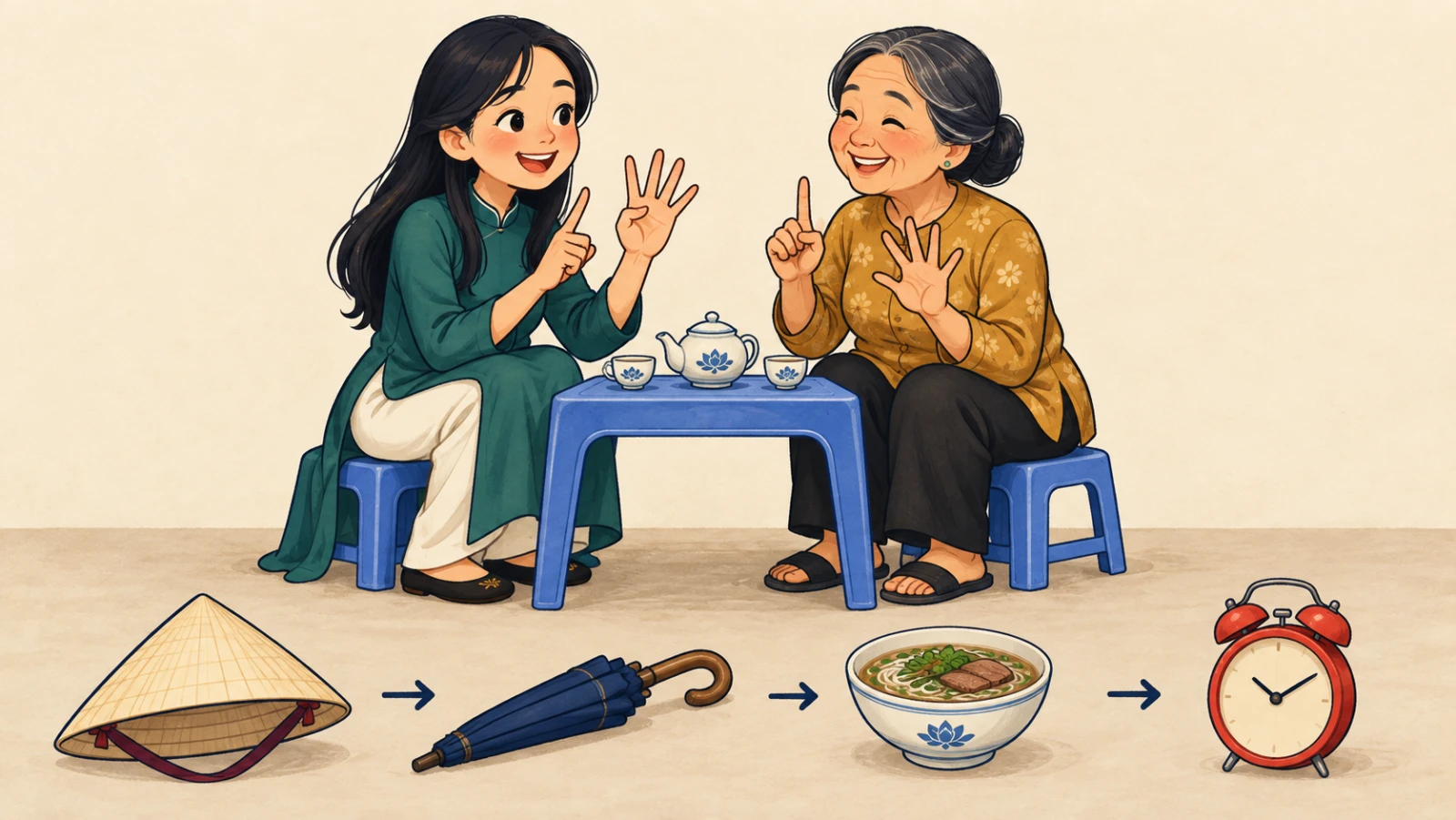
Vietnamese has no verb conjugation, plurals, cases or gender agreement, so the work is learning which small word to add and where. Learn address terms, là, classifiers, the time markers, negation and clause linking first; the passive, comparison and mood particles can wait until you meet them.
Vietnamese has no verb conjugation, no plural endings, no cases and no gender agreement. The work is not memorising forms; it is learning which small word to add, and where it goes. That single shift decides what you should study first and what you can safely leave for later.
Suggested level: A1–B1. Goal: know the order to learn Vietnamese grammar in, and be able to say something useful after each step.
Why the order matters more than the list
Most grammar lists are alphabetical or copied from a syllabus. That is fine for reference and poor for learning, because Vietnamese grammar points are not equally urgent. A few of them block every sentence you try to make. Others only matter once you are already talking.
Here is the practical test: if you cannot finish an ordinary sentence without it, learn it now. Everything else can wait until you meet it.
Six things that unlock everyday conversation
1. Decide who you are in the sentence
Vietnamese does not have one fixed word for “I”. You choose a word based on who you are talking to, and the choice is the first thing a listener notices.
Alô, tôi gọi về cái đơn hàng hôm qua. — Hello, I’m calling about yesterday’s order.
Tớ đến rồi, cậu đang ở đâu thế? — I’m here, where are you?
Both sentences say “I”. The first uses tôi, the neutral word for a stranger on the phone. The second uses tớ with cậu, the pair close friends use in the North. Using tôi with a close friend is not wrong, but it sounds like you are keeping your distance.
With people older than you, kinship words do the job: call a slightly older man anh, a slightly older woman chị, and call yourself em.
Anh ơi, cho em xin thêm đá. — Excuse me, could I have more ice?
Read both free lessons: choosing a word for “I” and addressing people by age. If you want the full picture afterwards, our complete guide to Vietnamese pronouns goes wider.
2. Say what something is
Là links two nouns, the way “is” does in “this is my roommate”.
Đây là Quân, bạn cùng phòng của tớ. — This is Quân, my roommate.
Tớ là sinh viên năm nhất. — I’m a first-year student.
The trap is using it before an adjective. English says “I am tired”, so learners reach for là. Vietnamese does not: say Tớ mệt, not Tớ là mệt. Adjectives behave like verbs here and need nothing in front of them.
3. Count things the way Vietnamese counts them
You cannot put a number straight in front of most nouns. A classifier goes in between, and cái is the general one for inanimate things.
Tớ vừa mua một cái ô mới, xinh không? — I just bought a new umbrella, cute or what?
Cái này bao nhiêu tiền hả chị? — How much is this one?
The same word also lets you point: cái này is “this one”, which is the single most useful phrase in any Vietnamese market.
Numbers have a quirk worth learning early. After mươi, một becomes mốt, so 21 is hai mươi mốt.
Nhà em ở số hai mươi mốt, cổng xanh anh nhé. — I’m at number twenty-one, the green gate.
Free lessons: the classifier cái and counting from one to a billion.
4. Handle time without tenses
Vietnamese verbs never change shape. Time comes from a small marker before the verb, or from a time word in the sentence, and often you need neither because the context is obvious.
Tớ đang ăn cơm, lát tớ gọi lại nhé. — I’m eating, I’ll call you back.
Tớ chưa ăn trưa, đói quá. — I haven’t had lunch yet, I’m starving.
Đang marks something in progress. Chưa means “not yet”, and it has a second job that beginners love: put it at the end and you have a question.
Con làm bài tập chưa? — Have you done your homework yet?
Free lessons: đang, chưa and sẽ for the future.
5. Say no, and tell someone not to
Không goes directly before the verb or the adjective.
Tớ không thích sầu riêng. — I don’t like durian.
Chợ không xa lắm, đi bộ năm phút. — The market isn’t far, five minutes on foot.
One exception is worth memorising now, because it comes up constantly: a noun after là takes không phải là, not plain không.
To tell somebody not to do something, use đừng instead.
6. Join two ideas
Once you can make single sentences, the fastest way to sound fluent is to connect them. Vietnamese likes paired markers: one opens the clause, one answers it.
Vì đêm qua mưa nên lối đi còn ướt. — Because it rained last night, the path is still wet.
Vì introduces the reason and nên the result. In fast speech people often drop one of the two when the link is obvious, but learning the pair first makes the relationship visible.
Free lessons: vì… nên… and nếu… thì….
What can wait
None of these are hard. They are simply not blocking you yet, so learning them early costs attention you need elsewhere.
- The passive. Vietnamese usually just says who did it. Bị carries a sense that something unwelcome happened to you, which is a nuance, not a grammar requirement.
- Comparison. Hơn is easy and you will pick it up from context.
- Sentence-final particles. Words such as nhỉ add warmth and invite agreement. They make you sound natural, but nothing breaks without them.
- Word formation and loanwords. Interesting, and better once you have vocabulary to attach it to.
Leaving these for later is a scheduling decision, not a judgement. Come back to them when you start noticing them in real speech.
The regional question, answered honestly
Learners often worry that studying one region wastes the other. In grammar, it mostly does not. The structures above are shared across Vietnam. What changes is vocabulary, some pronouns and a handful of particles, and the change is usually to the whole sentence rather than to one word.
Compare the umbrella sentence from earlier with how it sounds in the South:
Tớ vừa mua một cái ô mới, xinh không? — Northern.
Tui mới mua một cây dù mới nè, dễ thương hông? — Southern.
The grammar is identical. The umbrella becomes cây dù, “I” becomes tui, and the final particles change. This is why swapping a single connector and calling it a dialect note is misleading: real speakers change the whole utterance or nothing at all.
If you are still choosing, read which Vietnamese dialect to learn.
How to actually make it stick
Grammar explanations are quick to read and quick to forget. What makes a pattern automatic is meeting it many times in sentences you would plausibly say yourself. One example teaches you the rule; a dozen teaches you the habit, and the range of situations is what stops you from producing textbook Vietnamese that nobody speaks.
So: read the explanation once, then spend your time on the examples. Say them aloud. Change one word and say them again. That is the whole method.
One thing worth saying about the examples on this site: they are written as speech, not as exercises. You will see texting, ordering, haggling and family chat rather than the formal set pieces most courses drill. Textbook openers are easy to write and almost nobody says them out loud.
Where to read all of this
We built Grammar Essentials in exactly this order: 172 lessons across 18 chapters, from address terms and classifiers through tense markers, questions, negation and sentence linking. Each lesson gives you the pattern, a real-life exchange, twelve everyday examples, the mistakes learners actually make, and a regional note where the whole sentence genuinely changes.
Thirty-five of the lessons are free to read in full, with no account needed — including every lesson linked above. Start with choosing your word for “I”, or browse the whole library by chapter and see how far the free tier takes you before you decide anything.




Comments (0)
A new word, a question, or a different perspective? Share it with fellow learners.
Be the first to comment.