Key takeaway
Vietnamese folktales (truyện cổ tích) usually open with Ngày xửa ngày xưa, “once upon a time”, and follow an orphan or poor stepchild whom a kind spirit, often Bụt, helps until justice arrives. This guide covers the best-known tales, such as Tấm Cám and Thạch Sanh, how they begin and end, and a bilingual glossary for learners.
Every Vietnamese childhood begins with the same four words, murmured at bedtime by a grandmother or mother: Ngày xửa ngày xưa, "once upon a time." What follows is almost always a truyện cổ tích, a folktale, in which an orphan or a poor stepchild suffers, a kind spirit appears, and justice arrives at last. For English speakers learning Vietnamese, and for the teachers who guide them, these tales are pure gold: the language is simple and repetitive, the values run deep, and the stories pull you forward to the end. This guide explains what a Vietnamese folktale is, how every one begins and ends, the three scholarly kinds, and how to turn them into lessons.
What is a Vietnamese folktale (truyện cổ tích)?
A truyện cổ tích is a fictional folk story about the fates of ordinary people. Unlike myth or legend, which reach back to gods and real history, the folktale is freely invented; its heroes are not kings or deities but the small and the overlooked. Through them the laboring people poured out their humane spirit, their stubborn optimism, and above all their faith in justice. The folktale is the dream of people who had little: a dream that goodness would be rewarded and cruelty punished.
That faith has a name the whole country knows: ở hiền gặp lành, "live kindly and good things will come to you." It is the moral engine of nearly every tale. The downtrodden, the mồ côi (orphan), the con riêng (stepchild), the poor and the mocked, are exactly the ones who win in the end. The folktale belongs inside the wider world of Vietnamese folk literature, the oral tradition that carried these stories for centuries before anyone wrote them down.
How does a Vietnamese folktale always begin and end?
One of the joys of folktales for a learner is how predictable their frame is. Master the opening and the moral, and you already hold the two most useful phrases in the genre.
The opening: Ngày xửa ngày xưa
Almost every tale opens with the same formula, the Vietnamese equivalent of "once upon a time":
Ngày xửa ngày xưa, có một cô gái mồ côi...
"Once upon a time, there was an orphan girl..."
The doubled xửa... xưa pushes the story into a vague, timeless past, exactly the dreamy distance a fairy tale needs. You will also hear ngày xưa ("in the old days") and thuở ấy ("in that era") as variations. For a learner, this is a gift: the same four syllables launch a thousand stories.
The ending: ở hiền gặp lành
If the opening is fixed, so is the destination. The good are rewarded, often with marriage to royalty or sudden wealth; the wicked are punished, sometimes gently, sometimes with startling severity. This is the principle of ở hiền gặp lành made into plot. A close cousin sums up the fate of the cruel: ác giả ác báo, "evil deeds bring evil returns." Together these two sayings are the moral compass of the entire folktale tradition.
What are the three kinds of Vietnamese folktale?
Vietnamese scholars sort truyện cổ tích into three groups. Knowing them helps you place any new tale and predict its flavour before you reach the end.
Animal tales (cổ tích loài vật)
The cổ tích loài vật star talking animals and often explain a trait of the natural world, why the tiger has stripes, or how a creature came by its habits. They sit close to the world of Vietnamese fables (truyện ngụ ngôn), though a fable points to a sharp moral while an animal folktale is happy simply to delight and explain.
Magical or wonder tales (cổ tích thần kỳ)
This is the great, glittering heart of the tradition, the cổ tích thần kỳ, full of magic, helper-spirits, and transformation. Here belong the most famous tales of all: Tấm Cám, Thạch Sanh, Sọ Dừa, and Cây tre trăm đốt. When magic carries the downtrodden to triumph, you are in a wonder tale.
Realistic everyday tales (cổ tích sinh hoạt)
The cổ tích sinh hoạt drop the magic and win through human wit, humour, or sharp moral observation. The classic example is Trí khôn của ta đây ("Here is my wit"), in which a clever farmer outsmarts a tiger using nothing but his own cunning, no spirits required.
Who is Bụt, the kindly spirit?
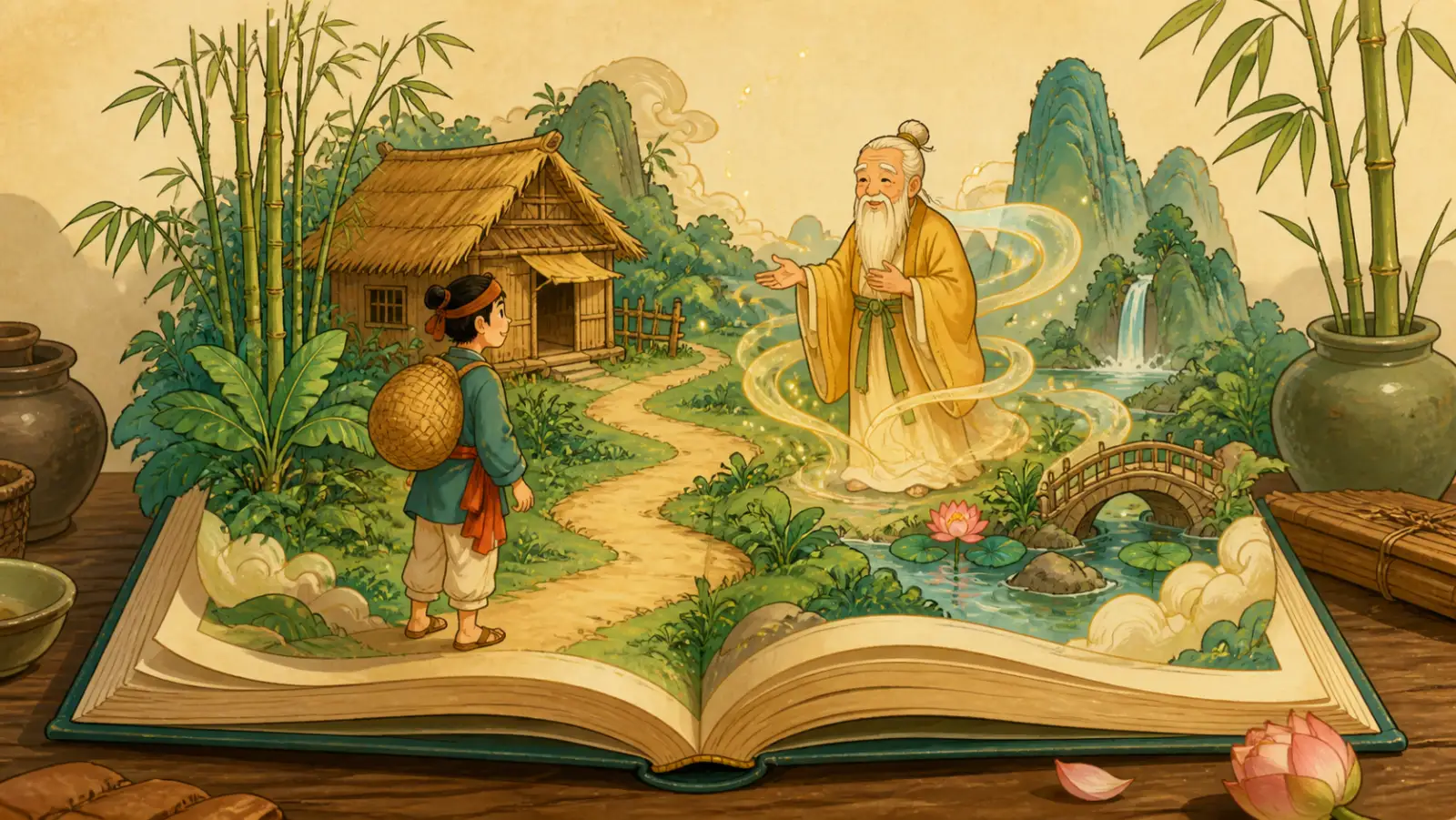
If one figure defines the Vietnamese wonder tale, it is Bụt. Derived from the word for Buddha, Bụt is a gentle, white-bearded old man who appears out of nowhere to the kind-hearted in their darkest moment. He never helps the cruel; he comes only to those who deserve it, which makes his arrival the story's promise that ở hiền gặp lành is about to come true.
His signature question is one every Vietnamese person can recite:
Vì sao con khóc?
"Why are you crying, child?"
When the weeping orphan answers, Bụt provides exactly what is needed, often through hóa thân (magical transformation): a fish that becomes a friend, bones that become slippers, a helper who turns the whole story around. He is the kindness of the universe given a face.
What are the most famous Vietnamese folktales?
A handful of tales are known to every Vietnamese household. Learn these names and you can join almost any conversation about childhood and culture.
- Tấm Cám — Vietnam's "Cinderella": a gentle stepdaughter, Tấm, is tormented by her stepmother and half-sister Cám, helped by Bụt, and reborn again and again until she finally becomes queen. See our full retelling of the Tấm Cám story.
- Thạch Sanh — a poor, honest orphan woodcutter of superhuman strength who slays a monster and an eagle, is betrayed by the scheming Lý Thông, and wins a princess. Read more in our guide to Thạch Sanh.
- Cây Khế (Ăn khế trả vàng) — "The Starfruit Tree": a greedy elder brother and his humble younger brother meet a magic bird that pays for fruit in gold; greed sinks the wicked one into the sea. See The Starfruit Tree.
- Sọ Dừa — "Coconut Head": a boy born as a strange, limbless coconut-shell proves his worth, sheds his ugly form, and marries a kind mandarin's daughter.
- Cây tre trăm đốt — "The Bamboo of a Hundred Joints": a tricked farmhand wins his promised bride when Bụt teaches him the magic words khắc nhập, khắc xuất ("join at once, split at once") to assemble an impossible bamboo.
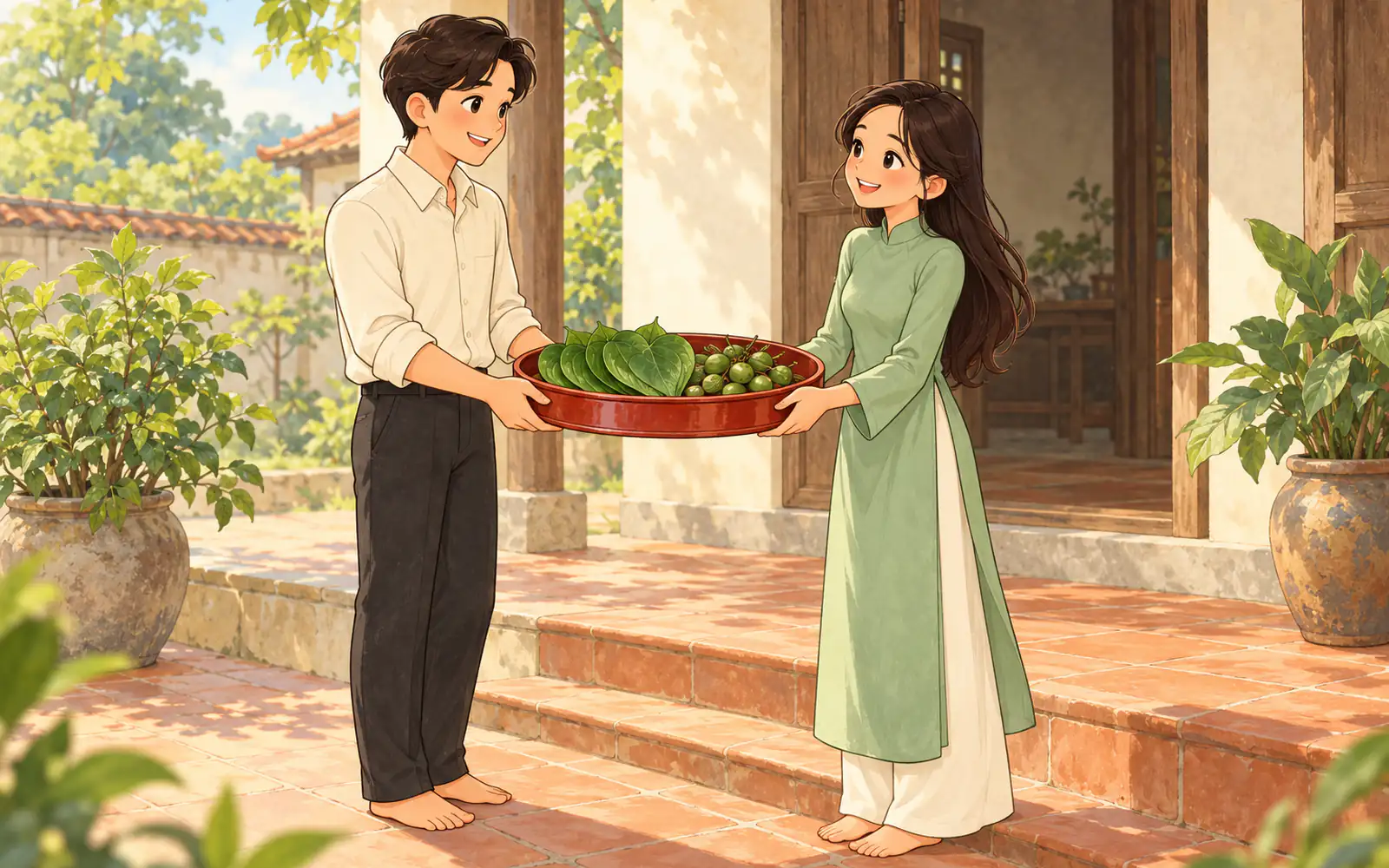
- Sự tích trầu cau — "The Tale of Betel and Areca": two devoted brothers and a faithful wife die of love and loyalty, transforming into the areca palm, the betel vine, and the limestone of the betel quid Vietnam still chews at weddings.
- Sự tích chú Cuội cung trăng — "The Man in the Moon": a woodcutter named Cuội clings to a magic banyan tree as it flies to the moon, where Vietnamese children say you can still see him sitting at every Mid-Autumn Festival.
Why are folktales gold for learning Vietnamese?
Folktales are not just charming, they are one of the most efficient ways to grow your Vietnamese. Here is what they give a learner.
- Simple, repetitive language. Tales were made to be told aloud and remembered, so they recycle the same easy words and patterns again and again, perfect for building fluency.
- Built-in narrative grammar. Retelling a tale drills the sequence words you need for real talk: rồi ("then"), sau đó ("after that"), cuối cùng ("at last").
- Deep cultural values. A single tale teaches what Vietnamese society prizes, kindness, filial loyalty, honesty, and exposes you to ideas a textbook skips.
- Strong motivation. A good story makes you want to reach the end, so you keep reading Vietnamese long after a vocabulary list would have lost you.
- Memorable hooks. A fish that talks or a bird that pays in gold anchors new words far better than an isolated phrase ever could.
How should you actually use a folktale as a lesson?
Start with a tale you already know in English, such as Tấm Cám, so the plot frees your mind to focus on language. Read it once for the story, then again hunting the recurring phrases, Ngày xửa ngày xưa, Vì sao con khóc?, ở hiền gặp lành. Notice the famous number three: three trials, three transformations, three brothers; that rhythm makes the structure easy to predict and retell. Finally, tell the tale aloud to someone who can correct your tones. You can book a trial lesson and narrate Thạch Sanh yourself, browse our Vietnamese courses that weave culture into everyday speaking, or work one-to-one with our Vietnamese teachers who can read a tale with you line by line.
A bilingual glossary of folktale terms
Keep this table beside you as you read; these words unlock almost any Vietnamese discussion of folktales.
| Vietnamese | English | Notes |
|---|---|---|
| truyện cổ tích | folktale / fairy tale | Fictional stories of ordinary fates. |
| Ngày xửa ngày xưa | once upon a time | The standard opening formula. |
| ở hiền gặp lành | kindness brings good fortune | The genre's central moral. |
| ác giả ác báo | evil brings evil returns | The fate of the wicked. |
| Bụt | kindly Buddha-spirit | Helper who aids the good. |
| hóa thân | transformation | Magical change of form. |
| mồ côi | orphan | A common folktale hero. |
| con riêng | stepchild | Often the mistreated good one. |
| dì ghẻ | stepmother | The classic cruel figure. |
| thần kỳ | magical / wondrous | As in cổ tích thần kỳ. |
| sự tích | origin tale | "The tale of how..." something began. |
| nhân hậu | kind-hearted | The trait Bụt rewards. |
Tóm tắt bằng tiếng Việt
Truyện cổ tích là những câu chuyện tưởng tượng kể về số phận của những con người bình thường, thể hiện tinh thần nhân đạo, lạc quan và niềm tin vào công lý của nhân dân lao động. Người tốt được đền đáp, kẻ ác bị trừng phạt, đúng như câu "ở hiền gặp lành". Các nhân vật mồ côi, con riêng, người nghèo cuối cùng đều chiến thắng. Truyện thường mở đầu bằng "Ngày xửa ngày xưa", có ông Bụt hiền từ, có phép hóa thân, con vật biết nói và con số ba quen thuộc. Có ba loại: cổ tích loài vật, cổ tích thần kỳ (Tấm Cám, Thạch Sanh, Sọ Dừa) và cổ tích sinh hoạt. Với người học, cổ tích là kho báu vì ngôn ngữ giản dị và giàu giá trị văn hóa.
Keep going in the accent you chose: Everyday Southern Vietnamese, Everyday Northern Vietnamese, or Everyday Huế Vietnamese.
Prefer to learn from video? Start with the Northern Vietnamese Pronunciation Course or the Southern Complete Vietnamese Course (A1), and train your ear with Slow Vietnamese 01 (Northern) or Slow Vietnamese 01 (Southern).
Read next: the Tấm Cám story and Vietnamese riddles.
Learn Vietnamese with Vietlingo
Folktales turn simple, repeated Vietnamese into stories you cannot put down, and that makes them unforgettable lessons. Bring the tale of Tấm, of Thạch Sanh, or of the magic starfruit tree to a real teacher and watch your storytelling come alive. Book your trial lesson today, or explore our Vietnamese courses that blend authentic culture with everyday speaking. Ngày xửa ngày xưa — once upon a time, your Vietnamese journey began.



Comments (0)
A new word, a question, or a different perspective? Share it with fellow learners.
Be the first to comment.