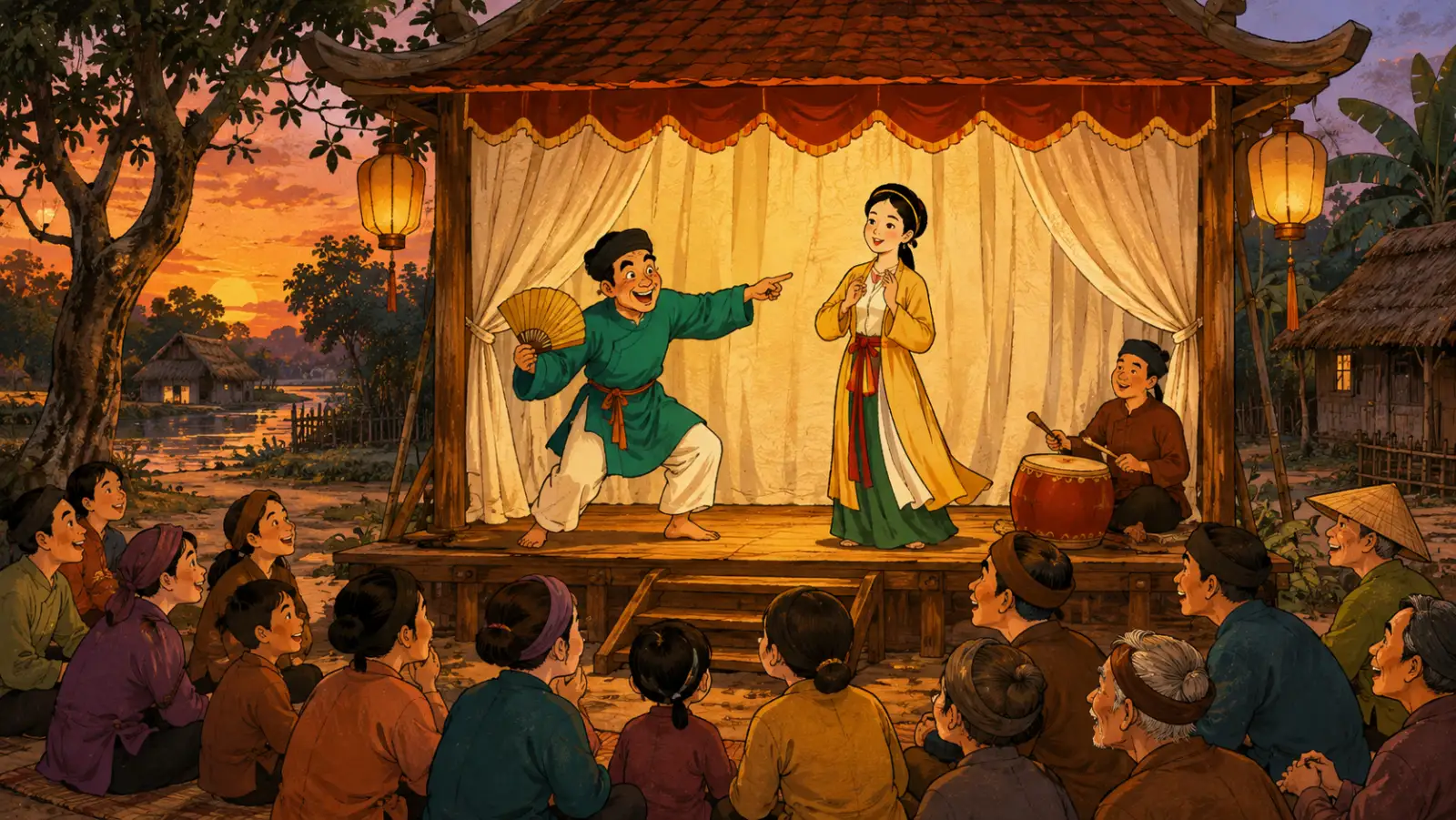
Imagine a village square at dusk: a drum begins to throb, a singer bends a melody into a long ache of longing, a clown tumbles in to puncture the mood with a joke, and the whole crowd leans forward as one. This is sân khấu dân gian (folk theatre), the living, performed branch of Vietnamese folk culture, where words, music, dance, costume and comedy fuse into a single art. For anyone learning Vietnamese, folk theatre is one of the richest windows into the language, because it carries the country's poetry, humour and values in a form you can actually watch. This guide walks English-speaking learners and their teachers through the four great forms, their regional homes, and why the stage doubles as a language classroom.
What is Vietnamese folk theatre?
The umbrella term is sân khấu dân gian, literally "the folk stage." It belongs to the fourth great family of Vietnamese folk literature, the one scholars call diễn (to perform), set apart from the families you only nói (say), kể (tell) or hát (sing). On the folk stage, a piece is not read on a page; it is brought to life in front of a live audience through what Vietnamese call diễn xướng (performance), a blend of singing, speech, gesture and music.
What makes folk theatre special is that it grew from the people, not from the royal court alone. It was performed at lễ hội (festivals), at temple courtyards, on floating ponds and on bamboo platforms in the rice fields, by and for ordinary farmers, fishers and traders. Over the centuries Vietnam developed four major forms, each with a distinct character and, crucially for learners, a distinct regional home. Those homes map almost perfectly onto the country's three great dialect regions, which is why folk theatre and the spoken language are so deeply intertwined. To understand the broader family these forms belong to, see our overview of Vietnamese folk literature.
Cheo: the North's singing satire
Chèo is the beloved folk opera of the North, born and raised in the đồng bằng sông Hồng (Red River Delta) around Hanoi, Thái Bình, Nam Định and Hải Dương. For centuries it was the entertainment of the village: performed on a simple mat in the temple courtyard, lit by lamplight, with the audience sitting close on all sides. Chèo weaves together lyric song, graceful dance and broad comedy, and it almost always carries a moral or satirical message wrapped in laughter.
The form runs on a cast of stock roles that audiences know on sight. The most loved is the hề chèo (the chèo clown), a quick-witted servant or commoner who mocks the powerful and speaks the truths the noble characters cannot. Around the clown move the female leads: the nữ chính (the virtuous heroine), patient and good, and the nữ lệch (the coquettish, wayward woman), playful and dangerous. The interplay between virtue, mischief and comic deflation is the engine of every chèo play.
The most famous chèo work is Quan Âm Thị Kính ("Quan Âm Thị Kính," the story of Thị Kính). It follows a woman wrongly accused, first of trying to murder her husband, then, while disguised as a monk, of fathering a village girl's child. She endures every injustice with serene patience and is finally revealed as the Bodhisattva of Mercy, Quan Âm. Inside this solemn tale sits one of the most beloved comic scenes in all Vietnamese theatre, Thị Mầu lên chùa ("Thị Mầu goes to the temple"), in which the flirtatious Thị Mầu shamelessly chases the "young monk." Audiences have laughed at it for generations, and the phrase "Thị Mầu" is still shorthand in Vietnamese for a boldly forward woman.
For a learner, chèo is a gift. Its language is the supple, witty Northern speech of the delta, and because the clown comments directly on the action, the humour is verbal, full of puns and proverbs. If you are drawn to the Northern sound, our guide on which Vietnamese dialect to learn explains how that region shapes pronunciation and vocabulary.
Tuong: painted-face heroics of the Centre
Tuồng, also widely known as hát bội, is Vietnam's classical heroic theatre, the grandest and most stylised of the four forms. Its strongholds are in the Centre, above all Bình Định province and the old imperial capital of Huế, where it once entertained the royal court as well as the people. Where chèo is intimate and comic, tuồng is epic and ceremonial, built around themes of trung (loyalty), hiếu (filial duty) and the clash between righteousness and treachery.
The most striking feature of tuồng is its visual code. Every gesture is stylised: a circling walk shows a long journey, a flick of the sleeve signals anger or grief. Most memorable of all is the mặt nạ hóa trang (painted-face makeup). The colours are a language in themselves: a red face marks a loyal, brave hero; white marks a cunning traitor; black marks a bold, blunt, honest character. An audience can read a character's moral nature the instant they step on stage, before a single word is sung.
Alongside the lofty court-style plays sits a warmer, folksier branch called tuồng đồ (folk or satirical tuồng), which trades emperors for villagers and adds sharp social comedy. Its classic is Nghêu Sò Ốc Hến ("Clam, Mussel, Snail and Hến," named after its rogues' gallery of characters), a riot of petty crooks, corrupt officials and a clever woman named Thị Hến. Its show-stopping scene, Xét xử Thị Hến ("The trial of Thị Hến"), satirises greedy magistrates who fall over themselves to flirt with the very woman they are supposed to be judging. It is biting, funny, and beloved across central Vietnam.
For learners, tuồng offers a more formal, literary register of Vietnamese, rich in Sino-Vietnamese vocabulary and the cadences of the Central dialect. It rewards patience, and watching even one scene with subtitles trains your ear for the heroic, declamatory style of speech.
Cai luong: the South's reformed opera
Cải lương, whose name literally means "reformed theatre," is the youngest of the four forms and the most beloved in the South. It was born in the early twentieth century in the đồng bằng sông Cửu Long (Mekong Delta) and the city of Saigon, growing out of southern chamber music and a hunger for stories that felt modern. As the name promises, it "reformed" older traditions, loosening the rigid stylisation of tuồng and embracing realistic sets, contemporary costumes and emotionally direct, melodramatic plots, both modern dramas and sweeping historical romances.
At the heart of cải lương beats one unforgettable song form: the vọng cổ ("longing for the past"). This is a long, flexible, deeply melancholic melody, and when a singer lands the first long-held note that drops into the song, southern audiences sigh with pleasure and often burst into applause before the line is even finished. The vọng cổ is the soul of the genre, capable of carrying grief, love and nostalgia in a single phrase, and its great performers are treated as national stars.
Because cải lương is modern, its language is the warm, melodic Southern Vietnamese that millions of people speak today, making it especially approachable for learners who plan to live or travel in Ho Chi Minh City and the delta. The stories of separation, sacrifice and reunion are easy to follow emotionally even before you catch every word, and the slow, sustained singing of the vọng cổ is a wonderful way to absorb southern pronunciation. Folk theatre like this is the dramatic cousin of the sung tradition we explore in dân ca, Vietnamese folk songs.
Water puppetry: Vietnam's gift to the stage
If one Vietnamese art form is truly unique in the world, it is múa rối nước (water puppetry). Invented by rice farmers in the flooded paddies of the northern deltas roughly a thousand years ago, it turns water itself into the stage. The performers stand waist-deep behind a bamboo-and-cloth screen, hidden in the pond, and guide lacquered wooden puppets across the shimmering surface using long underwater poles, so the figures seem to dance, swim and fight on the water by magic.
A live band sits at the side, singing and playing drums, gongs, wooden bells and the bamboo flute, while the puppets act out scenes drawn straight from village life: planting and harvesting rice, fishing, raising ducks, racing boats, the lion dance, the joyous explosion of festival fireworks, and dragons breathing real smoke and water. Legends appear too, such as the tale of the Hồ Gươm (Lake of the Restored Sword), in which a golden turtle reclaims the magic sword that won Vietnam's freedom. Presiding over it all is chú Tễu (Tễu the narrator-puppet), a round-bellied, grinning country fellow who introduces the scenes and cracks jokes, the water-stage cousin of the chèo clown.
For travellers and learners, water puppetry is the most accessible folk theatre of all, because the visual storytelling carries you even with little Vietnamese. It is easy to see live: the Thăng Long Water Puppet Theatre in Hanoi runs daily shows, and most performances offer a printed synopsis in English. Going with a few key words in your pocket, such as con rồng (dragon) and con rùa (turtle), turns a charming spectacle into a genuine listening lesson.
How does folk theatre connect to the three dialects?
Here is the detail that makes folk theatre so useful to a language learner: the four forms grew up in different parts of the country, so each one carries the sound of its home region. Learning where a form comes from is also learning which dialect you are hearing. Vietnam's three great dialect regions, North, Centre and South, line up neatly with three of the four forms, while water puppetry shares chèo's northern roots.
| Form | Region | Dialect you hear |
|---|---|---|
| Chèo | Red River Delta (North) | Northern Vietnamese |
| Tuồng / hát bội | Bình Định, Huế (Centre) | Central Vietnamese |
| Cải lương | Mekong Delta, Saigon (South) | Southern Vietnamese |
| Múa rối nước | Northern deltas | Northern Vietnamese |
This map is a quiet study tool. If you are learning Northern Vietnamese, chèo and water puppetry will sound like home; if your teacher speaks the warm Southern dialect, cải lương will reward you most; and the Central dialect of tuồng, with its distinctive vowels, is a wonderful ear-stretcher. Folk theatre even sits inside a longer storytelling tradition that includes sung epics, such as those we cover in Vietnamese epics: Sử thi and Đăm Săn. If you have not yet chosen a region to anchor your studies, our guide to which Vietnamese dialect to learn pairs perfectly with this map.
How can learners enjoy folk theatre?
You do not need to be fluent to start loving Vietnamese folk theatre. The trick is to treat it as listening practice with a built-in story, and to choose the form that matches your level and your dialect. Here are practical ways in, from gentlest to most ambitious.
- Start with water puppetry. The action is visual, the scenes are short, and venues like the Thăng Long theatre in Hanoi hand you an English synopsis, so you can follow along while soaking up the music and a few key words.
- Watch a comic scene first. Short, famous clips such as Thị Mầu lên chùa or Xét xử Thị Hến are funny enough to enjoy even when you miss words, and the humour pulls you back to listen again.
- Match the form to your dialect. Learning Southern? Put on a cải lương with a famous vọng cổ. Learning Northern? Choose chèo. Your ear will train faster on the accent you are actually studying.
- Listen for the stock roles. Spotting the hề chèo (clown) or reading a tuồng character's painted face teaches you cultural shorthand that natives use in everyday speech.
- Bring a scene to your lesson. A teacher can pause a clip, unpack a proverb or a tricky line, and turn three minutes of theatre into a memorable vocabulary session.
That last point matters most. A live teacher turns folk theatre from a pretty mystery into real, usable Vietnamese. You can book a trial lesson, browse our Vietnamese courses that weave culture into everyday speaking, or meet the guides who bring it all to life on our teachers page.
A bilingual glossary of folk-theatre terms
Keep this table close when you read a programme or chat with a Vietnamese friend about the stage. These words unlock almost any conversation about folk theatre.
| Vietnamese | English | Notes |
|---|---|---|
| sân khấu dân gian | folk theatre | The umbrella term for the folk stage. |
| chèo | northern folk opera | Sung comedy and satire from the Red River Delta. |
| tuồng / hát bội | classical theatre | Heroic painted-face opera of the Centre. |
| cải lương | reformed theatre | Southern modern opera, born 1900s. |
| múa rối nước | water puppetry | Puppets danced on a water stage. |
| vọng cổ | "longing for the past" | The haunting signature song of cải lương. |
| hề chèo | the chèo clown | Witty servant who mocks the powerful. |
| mặt nạ hóa trang | painted-face makeup | Colours code a character's nature in tuồng. |
| chú Tễu | Tễu the puppet | Grinning narrator of water puppetry. |
| diễn xướng | performance | Bringing a work to life aloud. |
| lễ hội | festival | Where folk theatre is traditionally staged. |
Tóm tắt bằng tiếng Việt
Sân khấu dân gian là nhánh trình diễn của văn học dân gian Việt Nam, nơi lời ca, âm nhạc, điệu múa và tiếng cười hòa làm một. Có bốn loại hình lớn, mỗi loại gắn với một vùng miền và một giọng địa phương. Chèo là opera dân gian của đồng bằng sông Hồng, giàu chất trữ tình và trào phúng, với vở nổi tiếng Quan Âm Thị Kính. Tuồng (hát bội) là sân khấu anh hùng của miền Trung, nổi bật với mặt nạ hóa trang. Cải lương ra đời ở Nam Bộ đầu thế kỷ 20, mang điệu vọng cổ da diết. Múa rối nước là nghệ thuật độc đáo của làng quê Bắc Bộ. Vì vậy, sân khấu dân gian là cánh cửa tuyệt vời để học tiếng Việt.
Learn Vietnamese with Vietlingo
Folk theatre is one of the most joyful doors into the Vietnamese language, and you do not have to step through it alone. Bring a comic scene, a vọng cổ melody or a painted-face hero to a real teacher and watch the words come alive. Book your trial lesson today, or explore our Vietnamese courses that blend authentic culture with everyday speaking practice. Một vở chèo, một bài học mới — one folk play, one new lesson at a time.

Comments (0)
A new word, a question, or a different perspective? Share it with fellow learners.
Be the first to comment.