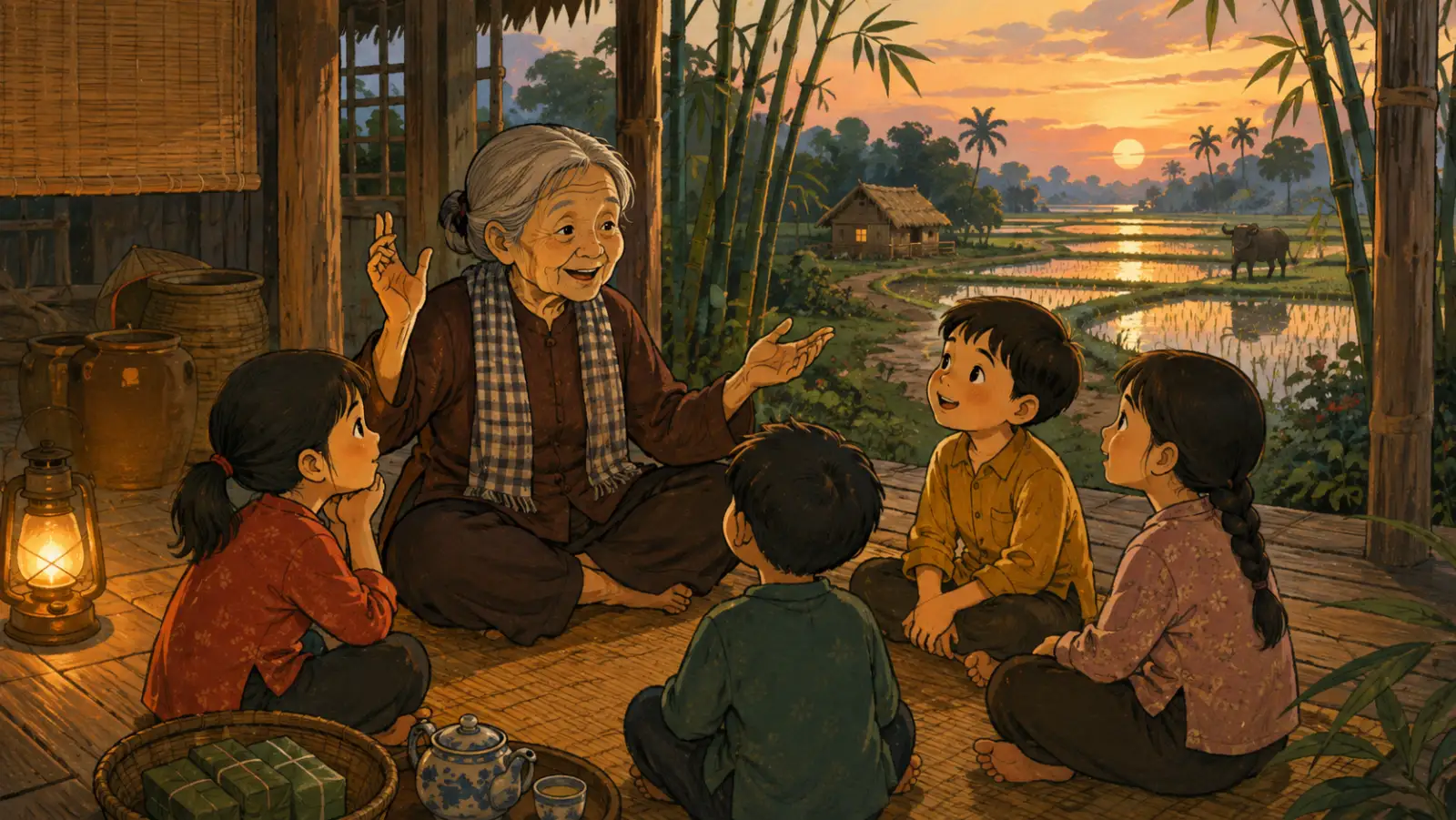
Long before Vietnam had a written script, it had voices. Mothers sang lullabies, grandfathers told tales by the rice paddy, and farmers traded clever proverbs across the fields. All of this living, spoken art has a name: văn học dân gian (folk literature). For anyone learning Vietnamese, it is one of the warmest doors into the language, because it carries the history, humour, and values of the people inside its rhythm. This guide walks English speakers and their teachers through what folk literature is, how the Vietnamese organise it, and why it rewards the patient learner.
What is Vietnamese folk literature?
The standard term is văn học dân gian (literally "literature of the folk"). You will also hear it called văn chương bình dân (popular literature) or văn chương truyền miệng (oral literature). These are the verbal-art creations of ordinary, laboring people, not of court scholars. They were born in the very earliest communal period of human society and kept developing through every later age, all the way into modern times.
The English word "Folklore" was coined in the mid-1840s, and Vietnamese scholars have glossed it beautifully as trí tuệ nhân dân (the wisdom of the people). In Vietnam the idea is understood broadly as folk arts, folk culture, and folk literature woven together. So when you read a Vietnamese proverb or hear a folk song, you are not reading one author's clever idea; you are listening to centuries of shared experience that a whole community polished smooth.
What are the four families of Vietnamese folk literature?
Scholars sort the whole tradition into four great families, each grouping genres that behave in similar ways. Getting to know these families gives you a map, so that when a teacher mentions ca dao or truyện cổ tích, you know which neighbourhood of the tradition you are standing in.
1. Folk speech (Lời ăn tiếng nói dân gian)
This family is the everyday verbal wit of the people: short, sharp, and memorable. It holds tục ngữ (proverbs), the compact sayings that pack a lesson into a single line, and câu đố (riddles), the playful puzzles that make you look twice at an ordinary object. For learners these are gold, because they are short enough to memorise yet rich enough to teach grammar, tone, and culture at once. Our deeper dives on Vietnamese proverbs (tục ngữ) and Vietnamese riddles (câu đố) show this family in action.
2. Folk lyric (Trữ tình dân gian)
This is the singing, feeling heart of the tradition: poetry meant to express emotion. It contains ca dao (folk verse), the short rhymed poems about love, work, and longing, and dân ca (folk song), the regional melodies that set such verse to music. If you want to feel the Vietnamese soul, start here; you can explore ca dao, Vietnamese folk poetry and the living world of dân ca, Vietnamese folk songs in their own guides.
3. Folk narrative (Tự sự dân gian)
This is the great storytelling family, and the largest of the four. It gathers thần thoại (myth), truyền thuyết (legend), truyện cổ tích (folktale), truyện ngụ ngôn (fable), truyện cười (comic tale), truyện thơ (verse-narrative), sử thi (epic), and vè (topical rhyme). These are the stories that explain where the world came from, why a custom exists, and how the clever or the kind triumph in the end. See our companions on Vietnamese myths (thần thoại) and Vietnamese legends (truyền thuyết).
4. Folk theatre (Sân khấu dân gian)
The fourth family steps onto the stage. It includes chèo, the beloved northern folk opera full of song, comedy, and gentle satire, and tuồng (also called hát bội), the older, more formal classical theatre with painted faces and heroic plots. Here folk literature becomes a full performance, blending words, music, costume, and movement before a live village audience.
What makes folk literature truly "folk"? Three defining traits
Three features set folk literature apart from the written literature of named poets. Understanding them helps a learner know what they are really hearing, and helps a teacher explain why two versions of the same song can both be "correct."
Collective and anonymous (tính tập thể and tính vô danh)
Folk literature has no single, named author. A work is the common product of the community, re-created and reshaped by countless mouths over time. The dreams and hopes of ordinary, often downtrodden people produced beloved tales such as Tấm Cám (a Cinderella-like story of a wronged girl who wins justice), Cây Khế (The Starfruit Tree, where greed is punished and kindness rewarded), and Sọ Dừa (Coconut Skull, where an odd-looking hero proves his worth). No one signed them, because everyone made them.
Oral transmission (tính truyền miệng)
These works travel by mouth, not by manuscript. Notice how the verbs differ: people nói (say) a proverb, kể (tell) a tale, and hát (sing) a folk verse. Because of this, folk literature is what scholars call a nghệ thuật tổng hợp (synthetic art), blending speech, music, gesture, and live performance. The Vietnamese word for that act of bringing a work to life in front of others is diễn xướng (performance). The page is only a shadow of the real thing, which is a human voice in a real moment.
Variation (tính dị bản)
Because the works pass from mouth to mouth, the same piece exists in many variants, or dị bản. The Vietnamese capture this with the saying tam sao thất bản ("three copyings and the original is lost"). This is not a flaw; it is the living signature of an oral tradition. A famous pair of regional variants describes a misty dawn. The Northern, Hanoi version runs:
Gió đưa cành trúc la đà / Tiếng chuông Trấn Vũ, canh gà Thọ Xương.
"The breeze sways the drooping bamboo branch; the bell of Trấn Vũ temple sounds, and a cockcrow marks the night-watch in Thọ Xương."
The Southern, Saigon version keeps the same shape but swaps in local landmarks:
Gió đưa tàu chuối la đà / Tiếng chuông Xá Lợi, canh gà Thủ Thiêm.
"The breeze sways the drooping banana leaf; the bell of Xá Lợi pagoda sounds, and a cockcrow marks the night-watch in Thủ Thiêm."
Same melody of words, different home. If you are still choosing where to root your own Vietnamese, our guide on which Vietnamese dialect to learn pairs nicely with this idea of regional colour.
How do Vietnamese classify folk literature by performance?
Besides the four families, there is a wonderfully practical way to sort the tradition: by how a work is performed. This "mode of delivery" map is easy to remember and instantly useful in a lesson, because it tells you what your mouth is supposed to do.
| Mode | Vietnamese | Genres delivered this way |
|---|---|---|
| Say | Nói | Proverbs (tục ngữ), riddles (câu đố) |
| Tell | Kể | Myth, legend, folktale, fable, comic tale |
| Sing | Hát | Ca dao, dân ca, children's rhymes (đồng dao) |
| Perform | Diễn | Chèo, tuồng |
This table is a quiet teaching tool. A beginner can nói a one-line proverb on day one, graduate to kể a short folktale a few weeks later, and eventually hát a verse of ca dao for fun. Each mode asks for a slightly different skill, so the map doubles as a gentle learning ladder.
Why should a learner of Vietnamese study folk literature?
The source text calls folk literature the "spiritual mother's milk" that has nourished the Vietnamese soul across generations. That image is worth holding onto. For a learner, this body of work is not a dusty museum; it is a direct window into Vietnamese history, values, humour, and worldview. Here is what it gives you in practice.
- Natural language. Proverbs and verses use the rhythms real people actually speak, so your Vietnamese starts to sound human rather than textbook-flat.
- Cultural fluency. A single tale like Tấm Cám teaches you about family roles, fairness, and the Vietnamese sense of justice in one sitting.
- Memorable structure. Rhyme and repetition make folk lines stick, so vocabulary you learn through ca dao tends to stay put.
- Shared ground. Quote even one well-known proverb and a Vietnamese friend lights up; you have shown you know the culture, not just the words.
- Confidence in listening. Folk lines train your ear for the music of real Vietnamese speech, so fast everyday conversation feels far less daunting over time.
If you are ready to bring tales and verses into real conversation, a live human teacher makes all the difference. You can book a trial lesson, browse our Vietnamese courses that weave culture into language, or meet the people who guide you on our teachers page. New to the whole journey? Start with our overview of how to learn Vietnamese.
A bilingual glossary of folk-literature terms
Keep this table close as you read further. These are the genre words that unlock almost any Vietnamese discussion of folk literature.
| Vietnamese | English | Notes |
|---|---|---|
| văn học dân gian | folk literature | The umbrella term for all of it. |
| truyền miệng | oral / by word of mouth | The way these works travel. |
| dị bản | variant version | Why one song has many forms. |
| tục ngữ | proverb | A short saying carrying a lesson. |
| câu đố | riddle | A playful guessing puzzle. |
| ca dao | folk verse | Short rhymed lyric poetry. |
| dân ca | folk song | Ca dao set to regional melody. |
| thần thoại | myth | Stories of gods and origins. |
| truyền thuyết | legend | Tales of national heroes and places. |
| truyện cổ tích | folktale | Magical tales like Tấm Cám. |
| truyện ngụ ngôn | fable | A short tale with a moral. |
| truyện cười | comic tale | Humorous, satirical stories. |
| chèo | folk opera | Northern sung folk theatre. |
| tuồng | classical theatre | Formal opera, also called hát bội. |
| diễn xướng | performance | Bringing a work to life aloud. |
Tóm tắt bằng tiếng Việt
Văn học dân gian là những sáng tác nghệ thuật bằng lời nói của nhân dân lao động, còn gọi là văn chương bình dân hay văn chương truyền miệng. Nó ra đời từ thời công xã nguyên thủy và phát triển qua nhiều thời đại cho đến ngày nay. Người ta chia văn học dân gian thành bốn nhóm lớn: lời ăn tiếng nói dân gian (tục ngữ, câu đố); trữ tình dân gian (ca dao, dân ca); tự sự dân gian (thần thoại, truyền thuyết, cổ tích, ngụ ngôn, truyện cười); và sân khấu dân gian (chèo, tuồng). Ba đặc trưng cơ bản là tính tập thể và vô danh, tính truyền miệng, và tính dị bản. Đối với người nước ngoài học tiếng Việt, văn học dân gian là dòng sữa tinh thần, một cánh cửa quý để hiểu lịch sử, giá trị và tâm hồn Việt Nam.
Explore Vietnamese culture with Vietlingo
Folk literature is the friendliest path into the Vietnamese heart, and you do not have to walk it alone. Bring a proverb, a riddle, or a verse of ca dao to a real teacher and watch the language come alive. Book your trial lesson today, or explore our Vietnamese courses that blend authentic culture with everyday speaking practice. Một câu ca dao, một bài học mới — one folk verse, one new lesson at a time.

Comments (0)
A new word, a question, or a different perspective? Share it with fellow learners.
Be the first to comment.