Key takeaway
Vietnamese family words vary by city: Hà Nội commonly uses bố, mẹ, ông, bà, cô; Huế uses ba, mạ, ôn, mệ, o; and Sài Gòn uses ba (or tía), má, ông, bà, cô. Southern má and Huế mạ are separate words with different tone marks. Pair elder titles with con or cháu, and answer elders with dạ.
Everyday Vietnamese family words change by region even when the relationship stays the same: father is commonly bố in Hà Nội and ba in Huế and Sài Gòn, while mother is mẹ, mạ, and má. Because má and mạ carry different tone marks, they are distinct written words, not two accents of one spelling.
| Relationship | Hà Nội | Huế | Sài Gòn |
|---|---|---|---|
| Father | bố | ba | ba; tía (regional) |
| Mother | mẹ | mạ | má |
| Grandfather | ông | ôn | ông |
| Grandmother | bà | mệ | bà |
| Father's sister | cô | o | cô |
| Older brother | anh | anh | anh |
| Older sister | chị | chị | chị |
What do you call your mom and dad in each city?
For mother, speakers commonly say mẹ in Hà Nội, mạ in Huế, and má in Sài Gòn. Are má and mạ the same word? No—their tone marks differ. Southern má carries the rising sắc mark, while Huế mạ carries the underdot nặng mark, which in Huế sounds lower and longer than Hà Nội's nặng, without the sharp cut-off. Visit Huế highlights mạ as the local word for mother, and Southern vs. Huế Vietnamese compares both five-tone accents.
For father, bố is common in Hà Nội, while ba is shared across Huế and Sài Gòn. Some Southern speakers also use regional tía, a contrast listed in Thompson's reference grammar and the SEAlang dictionary. In Huế, use ba as your default; bọ and thầy are family-specific forms in some households, to recognize rather than adopt automatically. As Bae and Đào's dialect study notes, regional words are tendencies rather than rigid rules, alongside the household pairs in our 50 everyday word comparisons.
What do ôn, mệ, and o mean in Huế?
Where Hà Nội and Sài Gòn say ông, bà, and cô, everyday Huế speech uses ôn, mệ, and o. At home, ôn is grandfather (ôn nội paternal, ôn ngoại maternal), mệ is grandmother (mệ nội, mệ ngoại), and o is a father's sister—see Northern vs. Huế Vietnamese. Context decides whether these words name family or address someone in town, as a Huế cultural overview of kinship terms explains: o politely addresses a noodle seller (o bán bún), while ôn and mệ show respect to elders.
| Huế word | Hà Nội / Sài Gòn | Inside the family | Outside or third person |
|---|---|---|---|
| ôn | ông | Grandfather (ôn nội, ôn ngoại) | Polite for an elderly man; ôn nớ (that gentleman) |
| mệ | bà | Grandmother (mệ nội, mệ ngoại) | Polite for an elderly woman; mệ nớ (that lady) |
| o | cô | Father's sister (paternal aunt) | Polite address to a woman (o bán bún); o nớ (that auntie) |
For third-person reference in Huế, add nớ (that): ôn nớ, mệ nớ, o nớ, anh nớ, and chị nớ match Hà Nội's ông ấy, bà ấy, cô ấy, anh ấy, and chị ấy. Never mix Southern coalesced pronouns (ổng, bả, cổ, ảnh, chỉ) into Huế speech; see our Huế dialect guide.

What do you call other people's relatives?
Family conversation separates reference (talking about someone) from address (speaking to them). Lan calls her own parents bố mẹ, ba mạ, or ba má by city, and you can refer to them as bố mẹ của Lan, ba mạ của Lan, or ba má của Lan. At the door, ask your partner or friend which title their parents prefer; if you are unsure, begin with bác, cô, or chú as appropriate to age and follow their lead—see age-scaled kinship address in Vietnamese.
Sibling words (anh, chị, em) and aunt or uncle words (bác, chú, dì, cậu, mợ, thím, dượng) stay shared across cities, while paternal aunt splits between cô and Huế o. Pair each title with your own pronoun: con or cháu with elders (plural chúng con or chúng cháu in Hà Nội; tụi con in Huế and Sài Gòn), em with slightly older peers, and tôi or tui outside close kinship, as Lê's study of Vietnamese politeness documents. In replies to elders, younger speakers can use dạ (or vâng in Hà Nội) and add polite ạ where appropriate; see phrases and manners for meeting your partner's family. In Huế, the older speaker does not say dạ to the younger one.
| Who you mean | Talking about them | Addressing them | Yourself |
|---|---|---|---|
| Your own parents | bố mẹ (N) · ba mạ (H) · ba má (S) | bố, mẹ (N) · ba, mạ (H) · ba, má (S) | con |
| Partner's or friend's parents | bố mẹ / ba mạ / ba má + name | bác, cô, or chú (follow host) | con or cháu |
| Grandparents | ông bà (N, S) · ôn mệ (H) | ông, bà (N, S) · ôn, mệ (H) | cháu or con |
| Older sibling or cousin | anh or chị + name | anh or chị | em |
How does a family introduction sound in each accent?

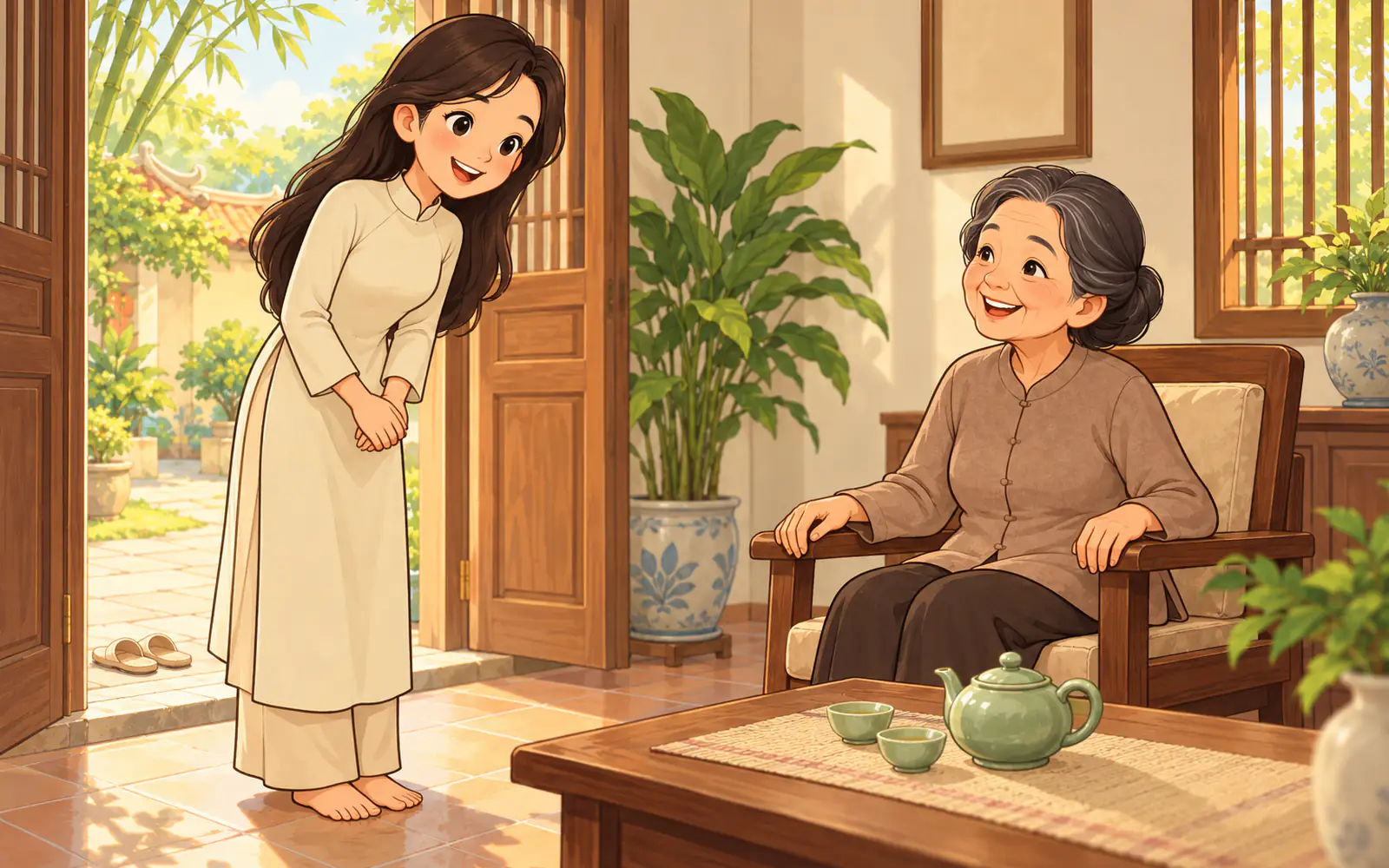
Here is one scene in Hà Nội (N), Huế (H), and Sài Gòn (S): Lan brings her friend Minh home before dinner to meet her paternal grandmother. Minh answers with dạ, the N and H lines add polite ạ, and the grandmother never says dạ back; recognize hí in the Huế invitation as a soft suggestion particle.
Hà Nội (N)
N (Lan): Bà ơi, đây là Minh, bạn của cháu ạ.
Grandma, this is Minh, my friend.
N (Minh): Dạ, cháu chào bà ạ. Hôm nay bà có khỏe không ạ?
Hello, Grandma. Are you doing well today?
N (Grandma): Bà khỏe. Mời hai cháu vào nhà ngồi nhé.
I am well. Come inside and sit down, you two.
N (Lan): Bà ơi, bây giờ bố mẹ và cô ở đâu ạ?
Grandma, where are Dad, Mom, and Auntie now?
N (Grandma): Bố mẹ đi chợ rồi, còn cô đang nấu cơm trong bếp.
Mom and Dad went to the market, and Auntie is cooking rice in the kitchen.
Huế (H)
H (Lan): Mệ ơi, đây là Minh, bạn của con ạ.
Grandma, this is Minh, my friend.
H (Minh): Dạ, con chào mệ ạ. Bữa ni mệ có khỏe không ạ?
Hello, Grandma. Are you doing well today?
H (Grandma): Mệ khỏe. Mời tụi con vô nhà ngồi hí.
I am well. Come inside and sit down, you two.
H (Lan): Mệ ơi, chừ ba mạ với o ở mô ạ?
Grandma, where are Dad, Mom, and Auntie now?
H (Grandma): Ba mạ đi chợ rồi, còn o đang nấu cơm trong bếp.
Mom and Dad went to the market, and Auntie is cooking rice in the kitchen.
Sài Gòn (S)
S (Lan): Bà ơi, đây là Minh, bạn của con.
Grandma, this is Minh, my friend.
S (Minh): Dạ, con chào bà. Bữa nay bà có khỏe không bà?
Hello, Grandma. Are you doing well today?
S (Grandma): Bà khỏe. Mời tụi con vô nhà ngồi nha.
I am well. Come inside and sit down, you two.
S (Lan): Bà ơi, bây giờ ba má với cô ở đâu bà?
Grandma, where are Dad, Mom, and Auntie now?
S (Grandma): Ba má đi chợ rồi, còn cô đang nấu cơm trong bếp.
Mom and Dad went to the market, and Auntie is cooking rice in the kitchen.
Which family words are for listening only?
When relatives speak casually among themselves, you may overhear words learners should keep for listening. In Huế, eng and ả are familiar forms for older siblings, while mi (you), tau (I), hắn (he or she), and bây (you plural) match the intimacy of mày, tao, nó, and chúng mày. From a learner, they risk sounding abrupt—never put eng, ả, mi, tau, hắn, or bây in a sentence you say. Keep Huế bọ and thầy for listening too unless your family uses them.
| What you hear | Meaning | Say instead |
|---|---|---|
| eng, ả (Huế) | Familiar older brother, sister | anh, chị |
| mi, tau, bây (Huế) | Intimate you, I, you all | Kinship pair or tui / tôi with peers |
| hắn (Huế) | Familiar he or she | anh nớ, chị nớ, ôn nớ, mệ nớ, o nớ |
| bọ, thầy (Huế) | Father in specific families | ba (unless your family asks otherwise) |
How do you choose the right word for your own family?

- Ask your relatives first. Before visiting, ask which titles the household uses—bố mẹ, ba mạ, or ba má; ông bà or ôn mệ; cô or o—and note each title beside the person's name.
- Learn each title as a pair. Practice the relative's title with your own pronoun: con or cháu for elders, and em for anh and chị.
- Separate reference from address. Ask how your partner's or friend's parents prefer to be addressed, while recognizing bố, ba, mẹ, mạ, or má when they speak about their own parents.
- Open replies to elders with dạ. Follow your host's introduction at the door and dinner table, remembering that in Huế the older speaker does not say dạ back to the younger one.
Key takeaways
- Parent and grandparent words vary by city—bố, mẹ, ông, bà, cô in Hà Nội; ba, mạ, ôn, mệ, o in Huế; and ba (or tía), má, ông, bà, cô in Sài Gòn—while anh, chị, em, chú, and bác stay shared.
- Southern má (sắc) and Huế mạ (nặng) carry different tone marks; they are distinct written words, not one word in two accents.
- Ask which title your partner's parents prefer; bác, cô, or chú may fit their age. Pair elders' titles with con or cháu, and use dạ in replies to elders.
- Keep Huế eng, ả, mi, tau, hắn, and bây for listening only, and ask your own household which titles they use.
Read next: which dialect overseas Vietnamese kids should learn and how to order coffee in Hà Nội, Huế, and Sài Gòn.
Ready to practice family introductions in the accent your relatives speak? Explore Everyday Southern Vietnamese (start with Southern Unit 1), Everyday Northern Vietnamese (Northern Unit 1), or Everyday Huế Vietnamese (Huế Unit 1).
Prefer to learn from video? Start with the Northern Vietnamese Pronunciation Course or the Southern Complete Vietnamese Course (A1), and train your ear with Slow Vietnamese 01 (Northern) or Slow Vietnamese 01 (Southern).
Frequently asked questions
Are má and mạ the same word in Vietnamese?
No. Southern má uses the rising sắc mark, Huế mạ uses the underdot nặng mark, and Hà Nội uses mẹ. Their spellings and tones differ, making them distinct words for mother.
What is the difference between bố, ba, and tía?
All three mean father: bố is common in Hà Nội, ba in Huế and Sài Gòn, and tía regionally in the South. Ask your relatives which title they prefer.
What do ôn, mệ, and o mean in Huế?
In Huế, ôn means grandfather or an elderly man, mệ means grandmother or an elderly woman, and o means a father's sister or politely addresses a woman in town.
What do I call my partner's parents when we first meet?
Ask your partner which title their parents prefer. You can begin with bác, cô, or chú when it fits their age, use con or cháu for yourself, and follow the family's lead.
Should learners use Huế words like eng, ả, mi, tau, or hắn?
No—keep eng, ả, mi, tau, hắn, and bây for listening only. Say anh and chị for older siblings, and use anh nớ, chị nớ, ôn nớ, mệ nớ, or o nớ for he or she.




Comments (0)
A new word, a question, or a different perspective? Share it with fellow learners.
Be the first to comment.