Some stories in Vietnam are only three or four sentences long, yet a whole nation has carried them for centuries and still quotes them today at the dinner table, in the office, and in parliament. These are the truyện ngụ ngôn (fables): tiny tales, usually starring animals or ordinary objects, that hand you a sharp lesson about human folly. This guide is for English speakers learning Vietnamese and for the teachers who guide them. We will define the genre, retell the three most famous fables with their real diacritics, draw out each moral, and show you how a story this short can teach so much language at once.
What is a Vietnamese fable (truyện ngụ ngôn)?
A truyện ngụ ngôn is a short narrative that uses a simple, often comic situation to teach a moral or expose a human weakness. The characters are frequently animals, plants, or everyday tools that stand in for people: a boastful frog, a foolish carpenter, a row of stubborn fortune-tellers. On the surface the story is light and amusing; underneath, it is a quiet argument about how to think and how to live. The word itself is telling — ngụ means "to lodge" or "imply" and ngôn means "speech", so a fable is literally speech with a meaning lodged inside it.
Like the rest of Vietnamese folk literature, fables have no named author. They were polished by countless retellings around the hearth long before anyone wrote them down, which is exactly why they are so compact and so memorable. They belong to the great storytelling family alongside the folktale (truyện cổ tích) and the comic tale (truyện cười); for the full map of the tradition, see our overview of Vietnamese folk literature. What sets the fable apart from its cousins is its purpose: a folktale enchants and a comic tale makes you laugh, but a fable always wants to make you wiser.
How do the blind men and the elephant quarrel?
The most famous Vietnamese fable of all is Thầy bói xem voi ("The blind fortune-tellers examine an elephant"). Five blind fortune-tellers, idle one slow afternoon, pool their coins to tip a keeper so they may touch a real elephant for the first time. Eager to know the beast, each man reaches out and grasps a different part of it, then announces with total confidence that he has discovered the truth of the whole animal.
The first man feels the trunk and declares the elephant is like a giant leech (đỉa), long and writhing. The second runs his hands along a tusk and insists it is hard and straight like a pole. The third strokes an ear and is sure the creature is broad and flat like a winnowing fan (quạt thóc). The fourth wraps his arms around a leg and swears it stands solid like a temple pillar (cột đình). The fifth grips the tail and laughs that they are all mad — clearly the elephant is frayed like a worn-out broom (chổi sể). Each man has touched something real, yet not one is right about the elephant.
None will yield an inch. The argument grows hotter until the five of them come to blows, blind fists swinging in the dust over a beast that stands patiently beside them, whole and unseen by all. The fable ends with the brawl, and the lesson needs no spelling out.
Xem xét sự vật mà chỉ thấy một phần thì không bao giờ hiểu được toàn thể.
"If you examine a thing and see only one part, you will never understand the whole."
The moral is timeless: never judge the whole from a single part, and never mistake your one narrow experience for the entire truth. So sharp is this image that the title became an everyday idiom. To say someone is doing thầy bói xem voi is to say they are forming a sweeping opinion from partial knowledge — a phrase Vietnamese people still reach for whenever a debate turns hasty.
What does the frog in the well believe?
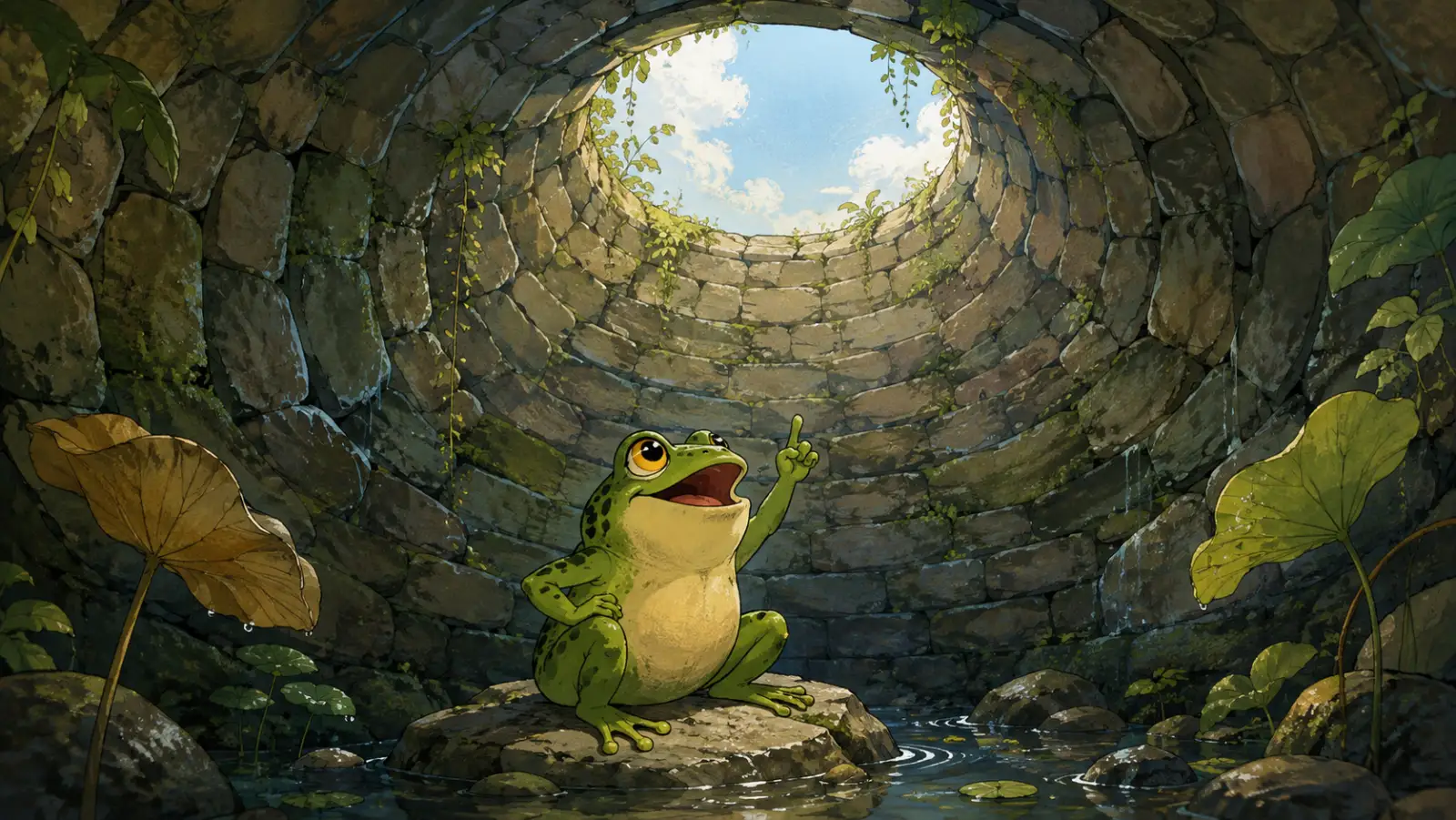
The second great fable is Ếch ngồi đáy giếng ("The frog sitting at the bottom of the well"). A frog has lived so long at the bottom of a deep, narrow well that the small circle of sky above is the only sky he has ever known. To him, the heavens are simply that little disc — as big as a pot lid (bằng cái vung), no larger. Around him live a few small creatures, crabs and tadpoles and snails, who tremble whenever he croaks his deep croak. From all this the frog draws a grand conclusion: he is mighty, he is feared, he is the king of the world.
Then the rains come. Heavy rain fills the well to the brim and floats the frog up and out onto open ground, into a world without walls. But the frog has learned nothing from his journey upward. Still convinced he is a king and that the sky is no bigger than his well mouth, he struts across the road with his nose in the air, croaking his commands at everything and looking at nothing. He never sees the water buffalo lumbering down the path. A single heavy hoof comes down, and that is the end of the king of the well.
Sống trong thế giới nhỏ hẹp mà tự cao tự đại thì sẽ phải trả giá.
"To live in a tiny, narrow world and yet be arrogant is to invite disaster."
The moral cuts in two directions at once: a narrow world breeds both ignorance and arrogance, and the cure for both is humility before how much you do not yet know. Ếch ngồi đáy giếng is now one of the most quoted idioms in the language, used affectionately or sharply to describe anyone whose horizon is too small for their self-regard — a person who mistakes their own little well for the whole sky.
Why is the roadside plough ruined?
The third classic is Đẽo cày giữa đường ("Carving a plough in the middle of the road"). A man inherits some money and decides to make his living carving wooden ploughs. Instead of working quietly in his yard, he sets up right beside the busy road, where everyone who passes can watch him and, of course, offer advice.
The first traveller stops and says the plough is far too big and clumsy; he should carve it smaller. The man thinks this sounds right and shaves the wood down. A second passer-by frowns and says no, a plough must be larger and heavier to bite the soil; so the man hunts for a bigger block and starts again. A third declares the whole shape is wrong for ploughing the high fields up in the hills, and the man, anxious to please, changes it once more. On and on it goes: with every new opinion he abandons his own work and follows the stranger, until the wood is hacked away to a useless scrap and his money is gone. He never finishes a single plough, and he ends up with nothing at all.
Làm việc gì cũng phải có chủ kiến, đừng nghe ai cũng theo.
"In whatever you do, hold your own judgement; do not follow every voice you hear."
The moral speaks directly to anyone who has ever been pulled apart by too much feedback: have your own judgement, weigh advice instead of obeying it, and do not let every passing opinion redirect your work. Đẽo cày giữa đường survives as a wry idiom for exactly this fate — the person who, by trying to satisfy everyone, accomplishes nothing and wastes what they had.
Why do Vietnamese people still quote these fables?
What makes Vietnamese fables so alive is that they did not stay inside storybooks. Each of the three great tales above collapsed into a four-word idiom that ordinary people use in everyday speech, often without retelling the story at all — because everyone already knows it. The fable became shorthand, a way to make a whole argument in a single phrase.
You will hear a colleague mutter thầy bói xem voi when a meeting jumps to conclusions from one report. A parent might gently warn a proud teenager not to be an ếch ngồi đáy giếng. A friend wrestling with conflicting advice will sigh that they feel like they are đẽo cày giữa đường. This is the special power of the genre: a fable is a story that becomes a saying. That overlap places it close to the world of the proverb (tục ngữ), where a single balanced line carries a whole lesson — except a fable carries its lesson by way of a tale you can picture.
For a learner, this is wonderful news. Master these three idioms and you are not merely learning vocabulary; you are gaining the keys to jokes, news headlines, and dinner-table arguments. Dropping ếch ngồi đáy giếng into the right moment tells a Vietnamese speaker that you understand the culture, not just the dictionary.
How can learners use fables to learn Vietnamese?
Fables may be the single best entry point into Vietnamese storytelling for a beginner or intermediate learner. They are short enough to finish in one sitting, the plots are simple and visual, the same words and phrases repeat as the action builds, and each tale is rich with idioms and concrete vocabulary you will actually reuse. Here is how to put them to work.
- Read it three times. First read for the gist, second with a glossary, third aloud for the tones. A fable is short enough that three passes still take only minutes, and by the third the rhythm sinks in.
- Mine the repeated patterns. Thầy bói xem voi repeats "sờ thấy... bảo rằng..." (touched it... and said...) five times. That repetition is a free grammar drill — copy the pattern and describe five objects of your own.
- Retell it in your own words. Once you know the plot, close the text and tell the story back, even clumsily. Narrating builds fluency far faster than re-reading.
- Learn the idiom, then hunt for it. Memorise ếch ngồi đáy giếng and watch for it in conversation, songs, and headlines. Spotting it in the wild fixes it in memory.
- Collect concrete nouns. Fables are full of touchable things — leech, broom, well, plough, buffalo — exactly the everyday vocabulary that powers real conversation.
How can teachers use fables in the classroom?
For teachers, a fable is a complete lesson hiding in a few lines: a text, a moral discussion, a grammar pattern, and a speaking task, all in one. Because the story is so compact, you can take a class from reading to free conversation inside a single session. A few proven approaches:
- Predict the moral. Read the story but stop before the ending. Ask the class what they think happens to the frog or the carpenter, then reveal it. The guessing pulls learners into the language and makes the lesson stick.
- Act it out. Thầy bói xem voi is a ready-made role-play: five learners each describe their "part" of the elephant and argue. The structure carries shy speakers, since each line follows the same shape.
- Build a culture bridge. "The blind men and the elephant" is known worldwide. Start from the version your learner already knows, then move into the Vietnamese telling and its idiom.
- Teach the idiom as a phrase. Set the four-word idiom as the takeaway and give learners one sentence each to use it correctly. They leave with a phrase real Vietnamese speakers genuinely use.
- Move from text to talk. End with an open question — "Have you ever felt like the frog in the well?" — that turns the moral into a personal, real conversation. To see how a live teacher runs this, meet the people who guide learners on our teachers page.
A bilingual glossary of fable terms
Keep this table close. It gathers the genre words plus the vivid nouns from the three fables above, so you can talk about each tale in Vietnamese.
| Vietnamese | English | Notes |
|---|---|---|
| truyện ngụ ngôn | fable | A short tale with a lodged-in moral. |
| bài học | moral / lesson | The point the fable teaches. |
| thầy bói | fortune-teller | The blind diviners of the first tale. |
| voi | elephant | The unseen whole the five men misjudge. |
| đỉa | leech | What the trunk feels like. |
| quạt thóc | winnowing fan | What the ear feels like. |
| cột đình | temple pillar | What the leg feels like. |
| chổi sể | worn-out broom | What the tail feels like. |
| ếch | frog | The arrogant "king" of the well. |
| giếng | well | The frog's whole tiny world. |
| cái vung | jar lid | The size the frog thinks the sky is. |
| trâu | water buffalo | What tramples the boastful frog. |
| cày | plough | What the indecisive man carves and ruins. |
| chủ kiến | own judgement | What the carpenter fatally lacks. |
Tóm tắt bằng tiếng Việt
Truyện ngụ ngôn là những câu chuyện ngắn, thường mượn loài vật hoặc đồ vật để nói về con người, nhằm rút ra một bài học hay phê phán thói hư tật xấu. Ba truyện nổi tiếng nhất là "Thầy bói xem voi" (đừng nhìn một phần mà phán xét toàn thể), "Ếch ngồi đáy giếng" (sống trong thế giới nhỏ hẹp mà kiêu căng thì sẽ trả giá), và "Đẽo cày giữa đường" (làm việc phải có chủ kiến, đừng nghe ai cũng theo). Điều đặc biệt là cả ba truyện đều trở thành thành ngữ mà người Việt vẫn dùng hằng ngày. Với người nước ngoài, truyện ngụ ngôn ngắn gọn, lặp lại, giàu thành ngữ nên là cách tuyệt vời để vừa học từ vựng, ngữ pháp, vừa hiểu văn hóa và lối nghĩ của người Việt.
Learn Vietnamese with Vietlingo
A fable is a whole way of thinking folded into a story you can tell in a minute, and the best way to make it yours is to retell it aloud to someone who has known it since childhood. Bring ếch ngồi đáy giếng or thầy bói xem voi to a real teacher, and watch the words, the tones, and the wisdom click into place together. Book your trial lesson today, or explore our Vietnamese courses that weave authentic stories and idioms into everyday speaking practice. Đừng làm ếch ngồi đáy giếng — step out of the well, and let your Vietnamese see the whole sky.




Comments (0)
A new word, a question, or a different perspective? Share it with fellow learners.
Be the first to comment.