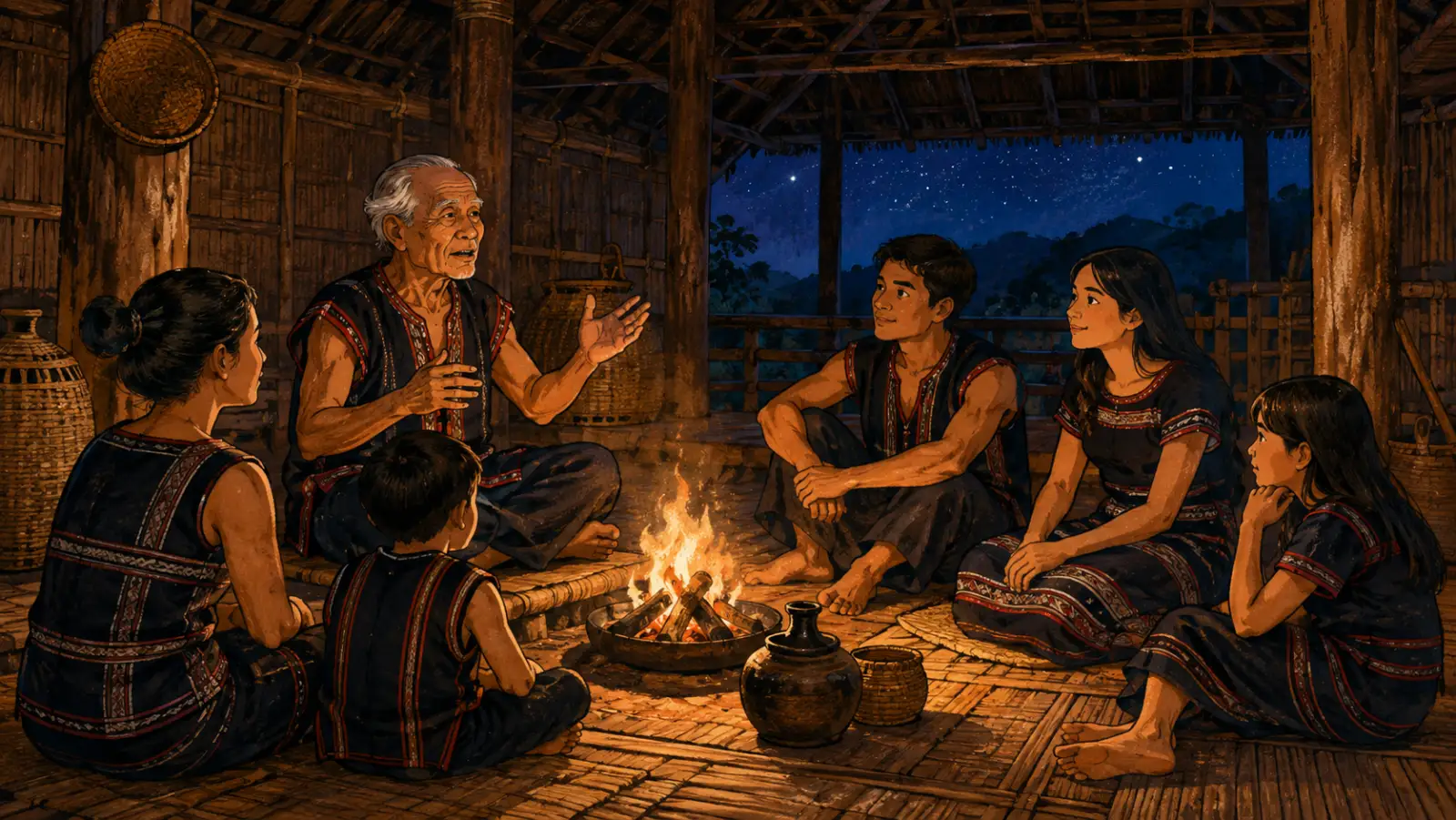
When most people think of Vietnamese literature, they picture the elegant verse of the lowland Kinh majority. But some of the grandest stories ever told in Vietnam come from the highlands and the hills, sung aloud by ethnic-minority peoples across many nights. These are the sử thi (epics) and truyện thơ (verse narratives) — sweeping tales of heroes, love, and fate. At their heart stands one unforgettable figure: Đăm Săn, the mighty chief of the Ê Đê people. This guide introduces these traditions for both learners and teachers, with authentic Vietnamese woven throughout.
What is a Vietnamese epic (sử thi)?
A sử thi (literally "history-poem," meaning an epic) is a long, grand-scale folk narrative that celebrates the heroes and origins of a whole community. Unlike a short folk tale told in a few minutes, an epic could take many evenings to perform. It glorifies larger-than-life champions whose deeds shape the destiny of their people.
In Vietnam, the great living epics belong above all to the ethnic-minority peoples, and especially to those of the Central Highlands, the Tây Nguyên (Western Highlands) region. The Ê Đê, Mnông, Ba Na and other peoples preserved enormous bodies of sung epic poetry, passed from generation to generation entirely by memory. Scholars often divide these into types such as khan (the Ê Đê word for an epic) and similar sung-narrative forms among neighbouring groups.
It is important to be clear and respectful about this: these masterpieces are the cultural heritage of specific ethnic-minority communities. They were created in their own languages — Ê Đê, Mường, Thái and others — long before scholars wrote them down and translated them into Vietnamese. When we study them, we are honouring the diversity of Vietnam, not folding everything into a single tradition.
Who is Đăm Săn, hero of the Central Highlands?
The most famous Vietnamese epic is the Sử thi Đăm Săn (the Epic of Đăm Săn), the great khan of the Ê Đê people. Its hero, the chief Đăm Săn, embodies the strength, pride and ambition of his community. The epic follows the well-established arc of his rise, his battles, and his final, defiant end.
The story begins with marriage. By the old Ê Đê custom of nối dây (the "tying of the thread," also called juê nuê), a man was expected to marry into a particular family line to continue it. Through this custom Đăm Săn becomes the husband of the two sisters Hơ Nhị and Hơ Bhị. At first he resists the obligation, but he ultimately takes up his role and, with it, the leadership of a powerful household.
Đăm Săn's fame grows through war. He defeats rival chieftains who threaten or covet his wives and his people — first Mtao Grứ, and then the arrogant Mtao Mxây. The duel with Mtao Mxây is the most celebrated episode of all, anthologised under the title "Chiến thắng Mtao Mxây" (The Victory over Mtao Mxây). It is a showcase of heroic combat: taunts traded before the fight, spears that fly like storms, and the decisive aid of the gods, who side with the just hero. After the victory, Đăm Săn's community swells with new people and wealth; his longhouse overflows with gongs, jars and cattle.
Chàng múa trên cao, gió như bão. Chàng múa dưới thấp, gió như lốc. — He dances on high, and the wind becomes a tempest; he dances below, and the wind becomes a whirlwind.
Yet Đăm Săn is not content to be merely rich and victorious. His defining quality is boundless ambition. He even dares to defy the gods themselves. In the final movement of the epic, he sets out to win the Nữ Thần Mặt Trời (the Sun Goddess) as a wife — a desire that reaches beyond what any mortal may grasp. When she refuses, he turns home, but on the way he and his horse are swallowed by the Rừng Sáp Đen (the Black Wax Forest), where he sinks down and dies. The hero who could conquer chieftains cannot conquer the limits of the human world.
This ending is what makes the epic so moving. Đăm Săn's death is not a punishment so much as the natural close of a life lived at full, fearless scale. In Ê Đê belief his spirit is reborn, and the cycle of the community continues — a reminder that the people endure even when a single hero falls.
How were Vietnamese epics performed?
Epics like Đăm Săn were not books to be read silently; they were performances to be heard. A skilled singer-narrator — among the Ê Đê, a master of the khan — would chant the story aloud, often late into the night, while listeners gathered in the communal longhouse. The performer needed extraordinary memory, because the whole epic lived only in the human voice.
To make such long works memorable, oral epics rely on a distinctive style. Three features stand out:
Hyperbole. Everything is enlarged. The hero is impossibly strong, the feasts impossibly abundant, the battles impossibly fierce. This grandeur is not exaggeration for its own sake; it expresses the community's pride and its sense of the heroic.
Formulaic language. Singers reuse set phrases, repeated comparisons, and stock descriptions — the same way of describing a feast, a journey, or a warrior's dance. These ready-made "building blocks" help the performer compose on the spot and help listeners follow along. The repeated image of Đăm Săn dancing with his spear, quoted above, is one such formula.
Rhythm and parallelism. Lines are often balanced in pairs, with matching structure ("he dances on high… he dances below…"). This musical patterning makes the verse easy to chant and easy to remember.
Today, UNESCO and Vietnamese cultural authorities recognise the sung-epic traditions of the Central Highlands as precious intangible heritage, and elders work to teach younger generations before the knowledge fades. If you ever hear a recording of a khan, listen for that hypnotic, repeated rise and fall — it is the sound of an entire library carried in one person's memory.
What other Vietnamese epics should you know?
Đăm Săn is the most famous, but it is one star in a wide sky. Two others are especially worth knowing.
Đẻ đất đẻ nước (literally "Giving Birth to Earth, Giving Birth to Water") is a great creation epic of the Mường people, who are closely related to the Kinh. It is a cosmogony — a story of how the world itself came into being, how earth and water and the first beings were born, and how human society took shape. Long and ceremonial, it was traditionally chanted at funerals to guide the community's understanding of life, death, and origins.
Xinh Nhã is another heroic epic of the Central Highlands, again from the Ê Đê tradition. Like Đăm Săn, its hero rises through courage and battle, avenging his family and defending his people. Read together, these works show that the highland epic was not a single story but a whole genre, with many heroes and many singers.
For the bigger picture of where epics sit among proverbs, tales and songs, see our guide to Vietnamese folk literature, and for the supernatural founding stories of the lowland tradition, our piece on Vietnamese legends (truyện thuyết).
What is a verse narrative (truyện thơ)?
Alongside the epic stands a gentler cousin: the truyện thơ, or verse narrative. Where the epic thunders with war and glory, the verse narrative usually sings of love and fate — the joys and sorrows of ordinary hearts caught in the rules of society.
A truyện thơ is a folk story told entirely in verse. Among the Kinh majority this form produced written masterpieces, but it also flourished as living oral poetry among many ethnic-minority peoples. The typical plot follows lovers who long to be together but are kept apart by custom, family, or circumstance, enduring great hardship before a resolution. The emotional power comes not from battles but from feeling: tenderness, separation, and the ache of faithful waiting.
Tiễn dặn người yêu: what is this Thái love story?
The most beloved ethnic-minority verse narrative is Tiễn dặn người yêu — in the Thái language, Xống chụ xon xao — meaning roughly "Sending Off and Advising the Beloved." It belongs to the Thái people of northwestern Vietnam and is one of the treasures of Vietnamese folk poetry.
The story follows two young people who fall deeply in love but are forced apart when the young woman's family marries her to another man, against her wishes. Both lovers suffer terribly through years of separation and hardship, holding their devotion through it all. After long trials, fate and faithfulness bring them back together, and they are at last reunited — a rare happy ending that has made the poem dear to generations of readers.
Its most celebrated passage is "Lời tiễn dặn" (Words of Farewell), the moment of parting in which the young man accompanies his beloved and pours out his grief, his loyalty, and his promise to wait. The lines are intimate and heartbreaking, full of the natural images — forests, fields, the changing seasons — that mark Thái poetry.
Đôi ta yêu nhau, đợi tới tháng Năm lau nở. — We who love each other will wait until the fifth month, when the reed flowers bloom.
To see how such stories also live on stage rather than only in song, explore our look at Vietnamese folk theatre (chèo and tuồng), where verse, music and drama meet.
Why do these stories matter?
The epics and verse narratives matter, first, because they are simply great art — thrilling, beautiful, and deeply human. But they matter for a second reason too: they reveal the true breadth of Vietnamese culture.
Vietnam is home to 54 officially recognised ethnic groups. The Kinh majority is the largest, but the Ê Đê, Mường, Thái, Ba Na, Mnông and dozens of others each carry their own languages, customs, and literatures. The su thi of the Central Highlands and the truyen tho of the northern hills are living proof that "Vietnamese literature" is not one voice but a chorus. To learn about Đăm Săn or about Tiễn dặn người yêu is to listen to communities whose stories are too often overlooked.
For learners of Vietnamese, these works are also a window into values and worldview: the highland ideal of the bold, generous hero; the importance of community and ancestry; the Thái celebration of faithful love. For teachers, they offer rich material for lessons on culture, history, and the diversity that makes Vietnam what it is — always taught with respect for the peoples who created them.
Bilingual glossary
| Vietnamese | English |
|---|---|
| sử thi | epic (grand heroic folk narrative) |
| truyện thơ | verse narrative (a story told in poetry) |
| khan | Ê Đê term for a sung epic |
| anh hùng | hero |
| tù trưởng | chieftain; tribal chief |
| Tây Nguyên | the Central Highlands |
| nối dây / juê nuê | the Ê Đê marriage-succession custom |
| Nữ Thần Mặt Trời | the Sun Goddess |
| Rừng Sáp Đen | the Black Mud Forest |
| chiến thắng | victory |
| lời tiễn dặn | words of farewell |
| dân tộc thiểu số | ethnic-minority people |
Tóm tắt bằng tiếng Việt
Những tác phẩm hùng vĩ nhất của văn học dân gian Việt Nam thuộc về các dân tộc thiểu số. Sử thi là những thiên truyện lớn, thường được hát kể qua nhiều đêm, ca ngợi người anh hùng của cộng đồng. Nổi tiếng nhất là Đăm Săn của người Ê Đê: theo tục nối dây, chàng cưới Hơ Nhị và Hơ Bhị, chiến thắng các tù trưởng Mtao Grứ và Mtao Mxây, làm buôn làng giàu mạnh, rồi chết khi đuổi theo Nữ Thần Mặt Trời và chìm trong Rừng Sáp Đen. Ngoài ra còn có sử thi Đẻ đất đẻ nước của người Mường và Xinh Nhã. Truyện thơ kể về tình yêu và số phận; tiêu biểu là Tiễn dặn người yêu của người Thái. Học những tác phẩm này giúp ta hiểu sự đa dạng văn hóa của Việt Nam.
Learn Vietnamese with Vietlingo
Stories like Đăm Săn come alive when you can read the language they were sung in. Start a trial lesson with a friendly teacher on our trial page, browse structured paths in our courses, and meet the people who can guide you on our teachers page. Begin your Vietnamese journey today.

Comments (0)
A new word, a question, or a different perspective? Share it with fellow learners.
Be the first to comment.