
Key takeaway
Vietnamese is commonly grouped into Northern, Central, and Southern dialects. Hà Nội, Huế, and Sài Gòn are useful reference accents, but each group contains local varieties. Hà Nội distinguishes six spoken tones; Huế and Sài Gòn merge hỏi and ngã. Shared writing and core grammar connect them, while sounds, everyday words, and particles differ.
Vietnamese is commonly grouped into Northern, Central, and Southern dialects, represented here by Hà Nội, Huế, and Sài Gòn. They share a writing system and core grammar but differ in pronunciation and everyday words. Hà Nội distinguishes six spoken tones; Huế and Sài Gòn merge hỏi and ngã, giving five.
| Feature | Hà Nội | Huế | Sài Gòn |
|---|---|---|---|
| Spoken tones | 6; hỏi/ngã distinct | 5; hỏi/ngã merged | 5; hỏi/ngã merged |
| Initial sounds | d/gi/r often [z] | d/gi [j]; r distinct | d/gi often [j]; r varies |
| Final sounds | -n/-ng, -t/-c distinct | Can merge after many vowels | Can merge after many vowels |
| Mom / bowl / cup | mẹ / bát / cốc | mạ / chén / ly | má / chén / ly |
| Where? / like that | đâu / thế | mô / rứa | đâu / vậy |
| Particles to notice | nhé / nhỉ | hí / hỉ / hè | nha / hen |
| Regional reference | Northern; Hà Nội | Central; Huế city here | Southern; Sài Gòn here |
| Media examples | National news; course audio | Huế course audio below | Southern course audio below |
How do the three main Vietnamese dialect groups work?
The three-group division is a useful starting point, rather than a claim that Vietnam has only three accents. Alves and Nguyễn's study of Thanh Chương Vietnamese introduces Hà Nội, Huế, and Ho Chi Minh City as common regional reference points while emphasizing local variation. This guide uses those cities so that its comparisons stay concrete.
Huế is one Central variety, not a model for every Central speaker. Likewise, a description of Hà Nội does not capture every Northern accent, and Sài Gòn is not interchangeable with every Southern hometown. When choosing learning material, check the city or community behind the recording as well as the broad regional label.
All three use chữ Quốc ngữ, the same Vietnamese writing system, and share core sentence grammar. A regional word can still change: the word for a small bowl might be bát or chén. The alphabet stays the same.
Accent refers to pronunciation; dialect also includes vocabulary and usage. In writing, vowel diacritics distinguish letters such as a, ă, â, while tone marks distinguish tone categories.
How do the six Vietnamese tones change by region?
Vietnamese spelling distinguishes six tone categories: ngang, huyền, sắc, hỏi, ngã, nặng. There are five added tone marks; ngang has none. In the three city varieties compared here, Hà Nội keeps six spoken contrasts, while Huế and Sài Gòn merge hỏi with ngã. Keep both spellings even when they sound the same.
Pitch is only part of the comparison. Kirby's description of Hà Nội Vietnamese explains the role of voice quality, including the break in ngã and the abrupt ending of nặng. Brunelle's Northern–Southern tone study finds that voice quality plays a more limited role in Southern tone perception.
Huế also has the hỏi/ngã merger, but its tones sound lower than Hà Nội's. Use the descriptions below as listening prompts, then compare recordings.
| Tone | Hà Nội | Huế | Sài Gòn |
|---|---|---|---|
| Ngang: ma | Level | Level, lower than Hà Nội | Level |
| Huyền: mà | Low falling; often breathy | Falls low | Low falling |
| Sắc: má | High rising | Rises from mid | Rising |
| Hỏi: mả | Dipping; distinct from ngã | Merged with ngã (same sound) | Merged with ngã; dipping-rising |
| Ngã: mã | Rising with a voice break | Merged with hỏi (same sound) | Merged with hỏi; dipping-rising |
| Nặng: mạ | Low with an abrupt cut-off | Lower and longer than Hà Nội; no sharp cut-off | Low dipping |
Hear how dấu ngã sounds in short clips from our Northern, Huế, and Southern courses; all three speakers say the same five words:

Consonant and rhyme differences you can hear
Initial consonants give another set of listening clues. In Hà Nội, d, gi, r commonly share a [z] sound, and tr/ch and s/x merge. Huế distinguishes r from the [j] sound of d/gi, and keeps tr/ch and s/x apart. Here [j] means the consonant at the beginning of English “yes.”
Sài Gòn also commonly has [j] for d/gi and often v. Its r has several realizations. Huế v varies by speaker between [v] and [j]; this is not simply a careful-versus-casual distinction. For a broader comparison, see Phạm and McLeod's review of Vietnamese speech sounds.
| Spelling | Hà Nội | Huế | Sài Gòn |
|---|---|---|---|
| d / gi / r | Commonly [z] | d/gi [j]; r distinct | d/gi [j]; r varies |
| v | [v] | [v] or [j], by speaker | Often [j] |
| tr / ch; s / x | Merged pairs | Distinct pairs | Distinct in careful speech; mergers also occur |
| -n / -ng; -t / -c | Distinct pairs | Can merge after many vowels | Can merge after many vowels |
| -anh / -ach | Fronted velar endings | Approximately -ăn / -ăt | Approximately -ăn / -ăt |
These are spelling-to-sound patterns, not instructions to rewrite words. The Huế and Southern -anh/-ach comparison involves the vowel as well as the ending. Listen to the whole rhyme rather than replacing one final letter mechanically. In Hà Nội, Kirby describes fronted velar endings in these rhymes: the closure is toward the back of the mouth, farther forward than a typical velar.
How everyday words, family terms, and particles differ across regions
While formal vocabulary is shared nationwide, everyday nouns, kinship terms, question words, and particles differ by region (Thompson’s grammar; SEAlang dictionary). Between Hà Nội and Sài Gòn, swaps include household nouns—bát vs. chén (bowl), thìa vs. muỗng (spoon), cốc vs. ly (glass), and lợn vs. heo (pig; add thịt for pork). Huế city speech shares several everyday forms (chén, ly, dĩa, muỗng, heo, trái, bông, vô, ngàn) with Sài Gòn.
Where Huế stands apart is in its question words, demonstratives, kinship terms, and particles (compare Alves on Central grammatical vocabulary). Instead of Đi đâu thế? (North) or Đi đâu vậy? (South), Huế speakers ask Đi mô rứa? ("Where are you going?"). Useful examples include mô (where), tê (over there), răng (why/how), rứa (so), chi (what), ni (this), nớ (that), and chừ (now). Family terms include mạ (mom), ôn (grandfather), mệ (grandmother or elderly woman), and o (paternal aunt, also an address term for a woman such as a seller). Choose address terms for the person and relationship. Treat mi, tau, hắn, bây as recognition-only vocabulary: these are not safe default pronouns for learners.
| Meaning | Northern (Hà Nội) | Central (Huế) | Southern (Sài Gòn) |
|---|---|---|---|
| Father / Mother | bố / mẹ | ba / mạ | ba / má |
| Grandpa / Grandma / Paternal aunt | ông / bà / cô | ôn / mệ / o | ông / bà / cô |
| Small bowl / Large bowl | bát / bát to | chén / tô | chén / tô |
| Spoon / Plate / Glass | thìa / đĩa / cốc | muỗng / dĩa / ly | muỗng / dĩa / ly |
| Fruit classifier / Pork | quả / thịt lợn | trái / thịt heo | trái / thịt heo |
| Thousand / Enter / Look | nghìn / vào / nhìn, xem | ngàn / vô / ngó, coi | ngàn / vô / nhìn, coi |
| Where? / What? | đâu / gì | mô / chi | đâu / gì |
| Why, how? / Like that | sao, thế nào / thế | răng, làm răng / rứa | sao / vậy |
| This / That / Over there | này / đấy / kia | ni / nớ / tê | này / đó / kia |
| Now / Today | bây giờ / hôm nay | chừ / bữa ni | bây giờ / hôm nay |
| Particles (right? / okay?) | nhỉ / nhé | hỉ, hè / hí | hen / nha, nghen |
These columns show useful regional choices, not exclusive ownership of each word. Avoid treating nè as a mechanical substitute for này in every sentence. Likewise, particles are conversational choices: compare nhỉ/hỉ/hen when seeking agreement and nhé/hí/nha in the suggestion below. A field study of Southwestern particles documents forms including nha, nghen, hen, nè; it does not make them interchangeable in every context.
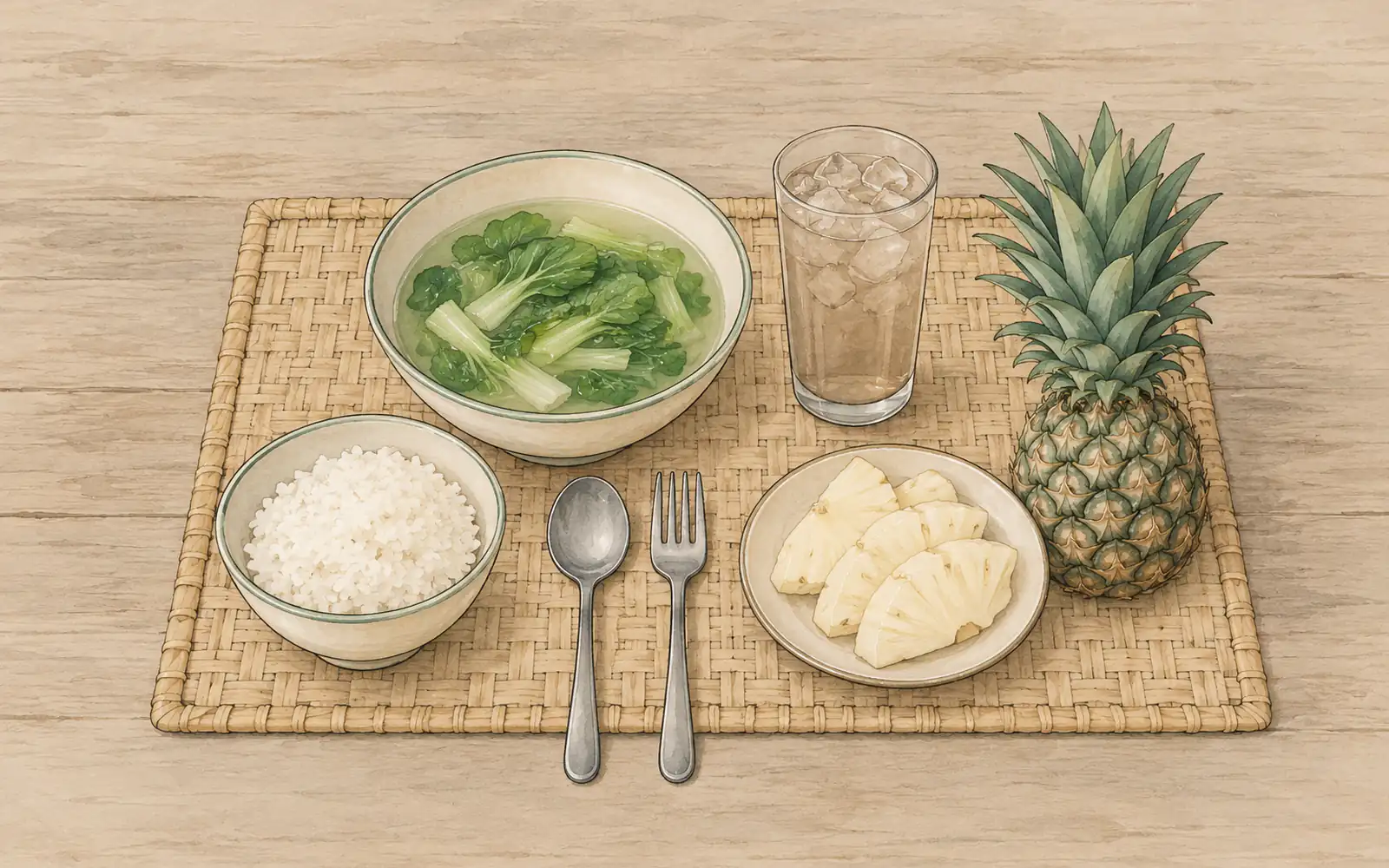
What the same conversation sounds like in Hà Nội, Huế, and Sài Gòn
Here is a morning exchange between a younger adult and an older female friend. The younger person addresses her as chị; she calls the younger person em. Compare the same exchange in Northern (Hà Nội), Central (Huế), and Southern (Sài Gòn) Vietnamese:
Line 1 — "Where are you going so early today?"
N (Hà Nội): Hôm nay chị đi đâu mà sớm thế?
H (Huế): Bữa ni chị đi mô mà sớm rứa?
S (Sài Gòn): Hôm nay chị đi đâu mà sớm vậy?
Line 2 — "I'm going to the market to buy fruit for my mom. Have you eaten yet?"
N (Hà Nội): Chị đi chợ mua ít hoa quả cho mẹ. Em ăn gì chưa?
H (Huế): Chị đi chợ mua ít trái cây cho mạ. Em ăn chi chưa?
S (Sài Gòn): Chị đi chợ mua ít trái cây cho má. Em ăn gì chưa?
Line 3 — "Not yet. Let's go into that café over there for an iced coffee, okay?"
N (Hà Nội): Chưa ạ. Mình vào quán bên kia uống cốc cà phê đá nhé!
H (Huế): Dạ chưa. Mình vô quán bên tê uống ly cà phê đá hí!
S (Sài Gòn): Dạ chưa. Mình vô quán bên kia uống ly cà phê đá nha!
Line 4 — "Great! It’s cool today, isn’t it?"
N (Hà Nội): Thế thì hay quá! Trời hôm nay mát nhỉ?
H (Huế): Rứa thì hay quá! Trời bữa ni mát hè!
S (Sài Gòn): Vậy thì hay quá! Trời hôm nay mát hen!
The sentence patterns in this exchange stay parallel while regional choices change: đâu/mô, mẹ/mạ/má, vào/vô, and cốc/ly. In the invitation, compare nhé/hí/nha. The younger person’s reply adds politeness with ạ or dạ.

How well speakers understand each other
Speakers from different regions can generally communicate, though familiarity, local vocabulary, and speaking pace matter. The shared grammar and writing system give speakers common ground. A listener can know every written word in a sentence and still need another hearing when its tones and consonants sound unfamiliar.
Be careful about turning laboratory findings into a score for everyday conversation. Brunelle's experiment tested tone identification and found that Southern listeners could adjust to Northern cues. It does not establish a universal percentage of whole sentences that speakers from any two regions understand.
Rapid Huế speech can be challenging for listeners unfamiliar with its tones and frequent words such as mô, răng, rứa. Those words carry questions and references, so missing one can hide the point of an otherwise familiar sentence. That is a reason to practice these small words in context, rather than rank one region's speech as clearer or better.
For a difficult clip, start with its transcript. Mark the unfamiliar regional words, listen again, and then ask for a slower repetition if you are speaking with someone.
Varieties beyond Hà Nội, Huế, and Sài Gòn
City reference accents are useful for choosing a course, but they cannot describe every hometown. Kirby explicitly notes variation even near Hà Nội. That is why a Northern label alone does not tell you exactly how a particular family speaks.
Central Vietnamese also deserves a closer look. Alves and Nguyễn's Thanh Chương study concerns Nghệ An, not Huế; its local forms should not be copied into a Huế dialogue. If your relatives come from another Central community, use recordings from that community alongside this city-based comparison.
For Southern speech beyond Sài Gòn, continue with the Mekong Delta Vietnamese dialect guide. Use the broad dialect group as a starting point, then narrow your listening to the people you actually want to understand.
Which Vietnamese dialect to learn first
Start with the people you want to speak with most often. A location or family connection is a more useful reason to choose than an abstract ranking of accents. Our guide to which Vietnamese dialect to learn explores those choices in more detail.
- Hà Nội: A practical choice for daily life in Hà Nội or conversations with a Hà Nội-speaking family.
- Sài Gòn: A practical choice for daily life in Ho Chi Minh City or a family that speaks this Southern variety.
- Huế: A practical choice for life in Huế or conversations with Huế-speaking relatives. For another Central hometown, check its local speech too.
If you are starting from Sài Gòn, SVFF, Vietlingo’s partner school for Southern, has its own article comparing Northern and Southern Vietnamese. SVFF teaches mainly Southern with native Southern teachers and recommends Vietlingo for live Northern and Huế lessons.
For practice, choose one short recording in your main accent. Read the transcript, replay a phrase, and record yourself saying it. Then listen to a second accent for recognition. Keep the spelling visible so that a sound merger does not become a spelling error.
Give each comparison a clear purpose: first compare hỏi/ngã, then an initial consonant, then a phrase from the dialogue. You do not need to imitate three accents in one practice session. Build a dependable speaking model while gradually broadening what you can understand.
Key takeaways
- One script, three voices: Northern, Central, and Southern Vietnamese share chữ Quốc ngữ and core grammar; Huế is one Central reference variety.
- Six vs. five spoken tones: Hà Nội contrasts six tones; Huế and Sài Gòn merge hỏi and ngã into five spoken tones.
- Listen beyond tone counts: Consonants, rhymes, everyday words, and particles help distinguish accents that share the same number of tones.
Go deeper into Vietnamese dialects and accents
Explore our Vietnamese dialect series for detailed comparisons, sound charts, and word lists:
- Southern vs. Northern Vietnamese: Tones, consonants, vocabulary, and dialogues between Sài Gòn and Hà Nội.
- Northern vs. Huế Vietnamese: Six-tone Hà Nội speech compared with five-tone Huế speech and family terms.
- Southern vs. Huế Vietnamese: Why two five-tone dialects sharing household nouns still sound distinct.
- Central Vietnamese & the Huế Dialect Guide: Complete guide to Huế tones, polite register, and mô, tê, răng, rứa.
- Vietnamese Tones Guide: How all six written tone marks work and how to train your ear.
Situation guides that compare the three cities in everyday use:
- How to order coffee in Hà Nội, Huế, and Sài Gòn
- Vietnamese family words by region
- Vietnamese question words by region
- Sentence-final particles by region
- Whether Northern and Southern speakers understand each other
- Which accent news, movies, and music use
- Which accent you will hear in Sài Gòn, Hà Nội, or Huế
- Which dialect overseas Vietnamese kids should learn
Start with recordings and lessons for your main speaking goal: Everyday Southern Vietnamese, Everyday Northern Vietnamese, or Everyday Huế Vietnamese. You can also browse every dialect from the Southern, Northern, and Central (Huế) pages.
Prefer to learn from video? Start with the Northern Vietnamese Pronunciation Course or the Southern Complete Vietnamese Course (A1), and train your ear with Slow Vietnamese 01 (Northern) or Slow Vietnamese 01 (Southern).
Frequently asked questions about Vietnamese dialects
How many dialects does Vietnamese have?
A common broad grouping is Northern, Central, and Southern. Each includes local varieties. This guide compares Hà Nội, Huế, and Sài Gòn as reference accents; it does not treat all Central speech as Huế or all Southern speech as Sài Gòn.
Which Vietnamese dialect is considered standard?
Vietnamese has a shared written standard. The national spoken standard is based on Northern Vietnamese, but literary pronunciation and everyday Hà Nội speech are not identical. Other regional speech remains valid for everyday communication.
Why can Huế Vietnamese be difficult for unfamiliar listeners?
Its tone realizations and frequent local words can be unfamiliar. Recognizing mô (where), răng (why/how), and rứa (like that) helps you follow questions and references. Difficulty depends on exposure and the speaker; it is not an inherent flaw of Huế speech.
Do all Vietnamese dialects use the same tone marks?
Yes. Standard spelling distinguishes six tone categories with five added marks and an unmarked ngang. Huế and Sài Gòn speakers still distinguish hỏi and ngã in writing even though the two merge in speech.
Can I learn another Vietnamese accent later?
Yes. Shared spelling and core grammar give you a foundation, but another accent still needs listening and speaking practice. Compare its sounds and everyday words with the variety you know. There is no fixed timetable or word count that makes the switch complete.




Comments (0)
A new word, a question, or a different perspective? Share it with fellow learners.
Be the first to comment.