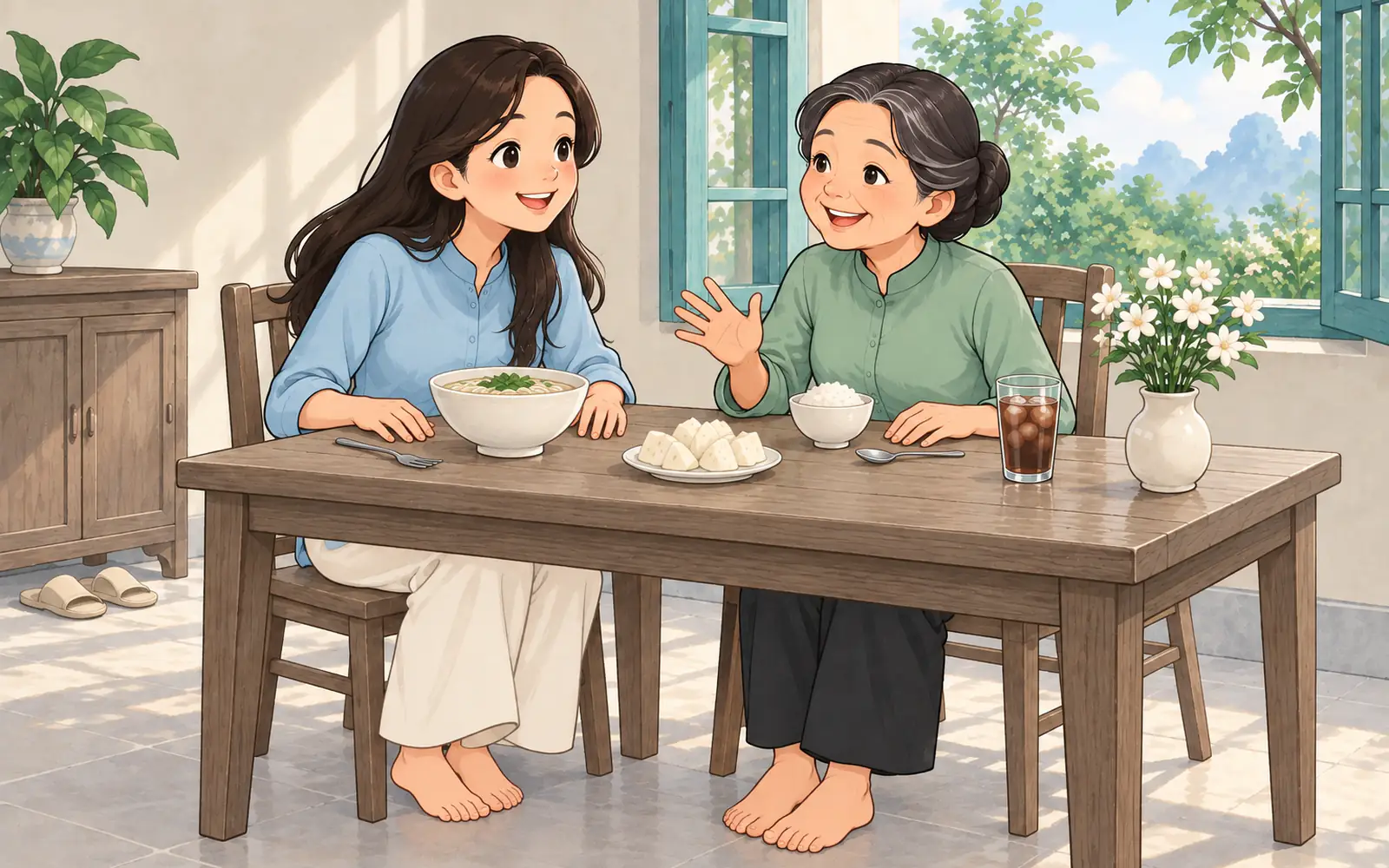
Key takeaway
Vietnamese regional words often share a meaning: father is bố in Hà Nội and ba in Huế and Sài Gòn, with tía as another Southern form. Mother is mẹ, mạ, or má, respectively. Choose one speaking base, recognize the other forms, and learn family words and pronouns in context.
Northern, Huế, and Southern Vietnamese often use different words for the same thing. Father is bố in Hà Nội and ba in Huế and Sài Gòn, with tía as another Southern form; mother is mẹ, mạ, or má, respectively. Choose a speaking base and learn the other forms for listening.
| Meaning | Hà Nội | Huế | Sài Gòn |
|---|---|---|---|
| Parents | bố, mẹ | ba, mạ | ba, má |
| Grandparents | ông, bà | ôn, mệ | ông, bà |
| Bowl, spoon, glass | bát, thìa, cốc | chén, muỗng, ly | chén, muỗng, ly |
| What? / Where? | gì / đâu | chi / mô | gì / đâu |
| Soft suggestion | nhé | hí (listening) | nha |
Why do Vietnamese dictionaries list several words for the same thing?

A dictionary may place bố, ba, and tía under one English heading: “father.” The translation matches, but the regional setting matters. This guide compares Hà Nội, Huế city, and Sài Gòn within the broader Vietnamese dialects. These are useful reference points, not boundaries around every family's vocabulary.
Use ba as the starting point for Huế and Sài Gòn. Recognize tía as an additional Southern family word rather than a replacement every Sài Gòn speaker uses. For mothers, compare Northern mẹ, Huế mạ, and Southern má. Huế ôn, mệ, and o mean grandfather, grandmother, and paternal aunt.
The differences extend beyond family words. Alves's study of Central grammatical vocabulary describes distinctive question and pointing words. Our Huế examples follow the course's Huế forms. Compare pronunciation in Northern vs. Southern Vietnamese, Northern vs. Huế Vietnamese, and Southern vs. Huế Vietnamese.
Which 50 everyday Vietnamese words should you compare by region?

Read across each row for the same meaning. Some words, such as anh and chị, are shared; the columns do not imply exclusive use. The main Northern–Southern pairs follow the SEAlang dictionary and Thompson's reference grammar; additional household references are linked in the table.
A dash means this guide does not specify a Huế equivalent. It does not mean Huế lacks the word. Quả and trái are fruit classifiers: compare quả dứa and trái thơm.
| English | Hà Nội | Huế | Sài Gòn |
|---|---|---|---|
| Family | |||
| Father | bố | ba | ba; tía (regional) |
| Mother | mẹ | mạ | má |
| Grandfather | ông | ôn | ông |
| Grandmother | bà | mệ | bà |
| Paternal aunt | cô | o | cô |
| Older brother | anh | anh | anh |
| Older sister | chị | chị | chị |
| I (peer) | tôi | tui / tôi | tui / tôi |
| He / she / it (familiar) | nó | hắn (listening) | nó |
| Group plural | chúng / bọn | tụi | tụi |
| Food and kitchen | |||
| Small bowl | bát | chén | chén |
| Large bowl | bát ô tô | tô | tô |
| Spoon | thìa | muỗng | muỗng |
| Fork | dĩa | — | nĩa |
| Plate | đĩa | dĩa | dĩa |
| Glass | cốc | ly | ly |
| Pork / pig | lợn | heo | heo |
| Fruit classifier | quả | trái | trái |
| Pineapple | quả dứa | — | trái thơm |
| Corn | ngô | — | bắp |
| MSG | mì chính | — | bột ngọt |
| Home | |||
| Flower | hoa | bông | bông |
| Thousand | nghìn | ngàn | ngàn |
| Socks | tất | — | vớ |
| Warm coat | áo ấm / áo rét | — | áo lạnh |
| Blanket | chăn | — | mền |
| Mosquito net | màn | — | mùng |
| Mirror | gương | — | kiếng |
| Upper floor | tầng | — | lầu |
| Alley | ngõ | — | hẻm |
| Questions and pointing words | |||
| What? | gì | chi | gì |
| Where? / Which? | đâu / nào | mô | đâu / nào |
| Why? / How? | sao / thế nào | răng | sao |
| Like that | thế | rứa | vậy |
| Like this | thế này | ri (như ri) | như vầy |
| This | này | ni | này |
| That | ấy / đấy | nớ | đó |
| Over there | kia | tê | kia |
| Now | bây giờ | chừ / bây chừ | bây giờ |
| Today | hôm nay | bữa ni | hôm nay / bữa nay |
| Common verbs and adjectives | |||
| To enter | vào | vô | vô |
| To do / work | làm | làm; mần (listening) | làm |
| To like | thích | ưng | thích / ưng |
| To call | gọi | kêu | kêu |
| To look | nhìn / xem | ngó / coi | ngó / coi |
| To pick someone up | đón | rước | rước |
| To fall | ngã | té | té |
| To be ill | ốm | đau | bệnh |
| Expensive | đắt | mắc | mắc |
| Real / true | thật | thiệt | thiệt |
Register matters: Huế hắn is for recognition only; do not use it as a polite “he” or “she.” The same listening-only rule applies to mi, tau, bây. With elders, use con/cháu for yourself. Practice làm in your own sentences and keep mần for listening.
One example per dialect for each group
1. Family: “Mom, Dad, we're going home to visit Grandma and Grandpa today.”
- N: Bố mẹ ơi, hôm nay chúng con về thăm ông bà ạ!
- H: Ba mạ ơi, bữa ni tụi con về thăm ôn mệ ạ!
- S: Ba má ơi, bữa nay tụi con về thăm ông bà!
2. Food and kitchen: “Auntie, may I have another small bowl, a spoon, and a glass of iced tea?” The speaker is younger than the aunt.
- N: Cô ơi, cho cháu thêm một cái bát, một cái thìa và một cốc trà đá ạ.
- H: Dạ, o cho con thêm một cái chén, một cái muỗng với một ly trà đá.
- S: Dạ, cô cho con thêm một cái chén, một cái muỗng với một ly trà đá.
3. Home: “Mom bought this vase of flowers for twenty thousand dong and brought it inside.”
- N: Mẹ mua bình hoa này hai mươi nghìn đồng rồi mang vào nhà.
- H: Mạ mua bình bông ni hai mươi ngàn đồng rồi đem vô nhà.
- S: Má mua bình bông này hai mươi ngàn đồng rồi đem vô nhà.
4. Questions and pointing: “Where are you going now? This one is so pretty!”
- N: Bây giờ chị đi đâu đấy? Cái này đẹp thế!
- H: Chừ chị đi mô rứa? Cái ni đẹp rứa!
- S: Bây giờ chị đi đâu vậy? Cái này đẹp quá!
5. Common verbs and adjectives: “Come inside and look. This shirt is really nice but a little expensive.”
- N: Mời anh vào nhà xem thử. Cái áo này đẹp thật nhưng hơi đắt.
- H: Mời anh vô nhà coi thử. Cái áo ni đẹp thiệt nhưng hơi mắc.
- S: Mời anh vô nhà coi thử. Cái áo này đẹp thiệt nhưng hơi mắc.
Which words change meaning, and how do everyday phrases change?
Check the meaning before swapping a familiar spelling into a sentence. For Huế, hí marks a soft suggestion or invitation; recognize it in the dialogue below. Hỉ seeks agreement, as in Ngon hỉ? (“Tasty, isn't it?”).
| Word or meaning | Hà Nội | Huế | Sài Gòn |
|---|---|---|---|
| dĩa | Fork; plate = đĩa | Plate | Plate; fork = nĩa |
| ốm | Ill | —; ill = đau | Thin; ill = bệnh |
| chè | Tea or sweet soup | Tea or sweet soup | Sweet soup; tea = trà |
| No problem | Không sao đâu. | Không răng mô. | Không sao đâu. |
| In that case | Thế thì... | Rứa thì... | Vậy thì... |
| When? | Khi nào? | Khi mô? | Khi nào? |
How do regional words sound in a conversation?

A younger relative visits a paternal aunt at lunchtime. The three versions keep the same meaning and relationship.
- 1. Younger relative: “Hello, Auntie! Where has Mom gone now?”
N: Cháu chào cô ạ! Bây giờ mẹ cháu đi đâu rồi ạ?
H: Dạ, con chào o! Chừ mạ con đi mô rồi ạ?
S: Dạ, con chào cô! Bây giờ má con đi đâu rồi cô? - 2. Aunt: “Your mom just went inside. Come look at this vase of flowers!”
N: Mẹ cháu vừa vào nhà. Cháu vào đây xem bình hoa này nhé!
H: Mạ con mới vô nhà. Con vô đây coi bình bông ni hí!
S: Má con mới vô nhà. Con vô đây coi bình bông này nha! - 3. Younger relative: “What are we eating today, Auntie?”
N: Hôm nay nhà mình ăn món gì thế cô?
H: Bữa ni nhà mình ăn món chi rứa o?
S: Bữa nay nhà mình ăn món gì vậy cô? - 4. Aunt: “Braised pork and fruit. Please get me the bowl, spoon, and glass!”
N: Có thịt lợn kho và hoa quả. Cháu lấy giúp cô cái bát, cái thìa và cái cốc nhé!
H: Có thịt heo kho với trái cây. Con lấy giùm o cái chén, cái muỗng với cái ly hí!
S: Có thịt heo kho với trái cây. Con lấy giùm cô cái chén, cái muỗng với cái ly nha!
For pronunciation practice, listen to these short vowel clips cut from the first unit of each course (Northern, Huế, Southern); all three speakers say the same six syllables. They are separate from the example dialogue.
Which regional words should you learn first?
Choose your speaking base around the people you talk with most. Our guide to which Vietnamese dialect to learn helps you choose. Then practice one category at a time.
Key takeaways for practice:
- Start with parents and tableware: Practice bố/mẹ/bát, ba/mạ/chén, or ba/má/chén in a complete sentence.
- Add a listening column: Cover your chosen dialect's column and identify the same meanings in the other two.
- Keep pronouns tied to relationships: Learn who is speaking to whom before repeating a line.
Practice with Vietlingo's Northern Vietnamese course (Unit 1), Huế (Central) Vietnamese course (Unit 1), or Everyday Southern Vietnamese course (Unit 1).
Frequently asked questions about Vietnamese words by region
What is the difference between bố, ba, and tía?
All mean “father.” Bố is the Northern starting point, and ba is the everyday Huế and Sài Gòn form. Tía is another Southern family word; use the form your family or conversation partner uses.
Does Huế use Northern or Southern words?
Huế shares words such as chén, muỗng, ly, and heo with Southern speech, alongside its own forms such as mạ, ôn, mệ, o, and mô. The Huế column follows Huế city usage rather than representing every Central variety.
Will speakers understand another region's vocabulary?
Vietnamese varieties are mutually intelligible, with differences in vocabulary and sounds, as Kirby's dialect-perception study explains. That does not make every unfamiliar word obvious. Learn common pairs in context, and ask for a repeat or paraphrase when needed.
Can dĩa mean both fork and plate?
Yes. Northern dĩa means “fork,” while the Northern plate spelling is đĩa. In Huế and Southern speech, dĩa means “plate”; Southern nĩa means “fork.” Keep the spelling and the table setting in mind.
Should beginners memorize all three versions at once?
You can begin with the words you need for one conversation. Practice those actively in your chosen dialect, then recognize the other columns. Shared words and familiar sentence frames give you a practical starting point for understanding regional alternatives.




Comments (0)
A new word, a question, or a different perspective? Share it with fellow learners.
Be the first to comment.