If you want to understand how Vietnamese people think, listen to what makes them laugh. Truyện cười (comic or humorous folk tales) are some of the shortest, sharpest stories in the entire tradition of Vietnamese folk literature. A good one is over in a minute, but the twist at the end can keep you smiling for the rest of the day. For learners, these tales are a gift: they are brief, full of everyday conversation, and built around a single clever punchline that rewards you for reading carefully. For teachers, they are a perfect classroom tool, because every story doubles as a tiny lesson in culture, grammar, and tone.
In this guide we will define the genre, retell three of the most beloved comic tales with their original Vietnamese lines, and show you how to use them to sharpen your own Vietnamese. By the end you will know why a fish shop with a blank signboard is one of the funniest images in Vietnamese culture.
What is a Vietnamese comic tale?
A truyện cười is a very short folk story whose whole purpose is to make you laugh, usually through a sudden twist at the end. Unlike a fairy tale (truyện cổ tích), which can be long and magical, a comic tale is lean and grounded in ordinary village life. There are no fairies or dragons here, just farmers, shopkeepers, scholars, and their very human flaws.
The genre lives close to the fable (truyện ngụ ngôn), since both teach a lesson. The difference is in the delivery. A fable instructs you gently; a comic tale teases you. Its main weapon is satire (châm biếm), and its favourite targets are the foibles everyone recognises: vanity, stupidity, stinginess, and above all the fake learning of people who pretend to be wiser than they are. Vietnamese audiences have always loved watching a self-important character dig his own hole, sentence by sentence, until he falls in.
Three features define the form. First, brevity: most tales are only a paragraph or two. Second, the twist: the humour lands in the final line, so the ending matters more than anything else. Third, the social bite: the laughter is never random. It corrects behaviour the community disapproves of, which is why these stories survived for centuries by word of mouth before anyone wrote them down.
The shopkeeper and the signboard
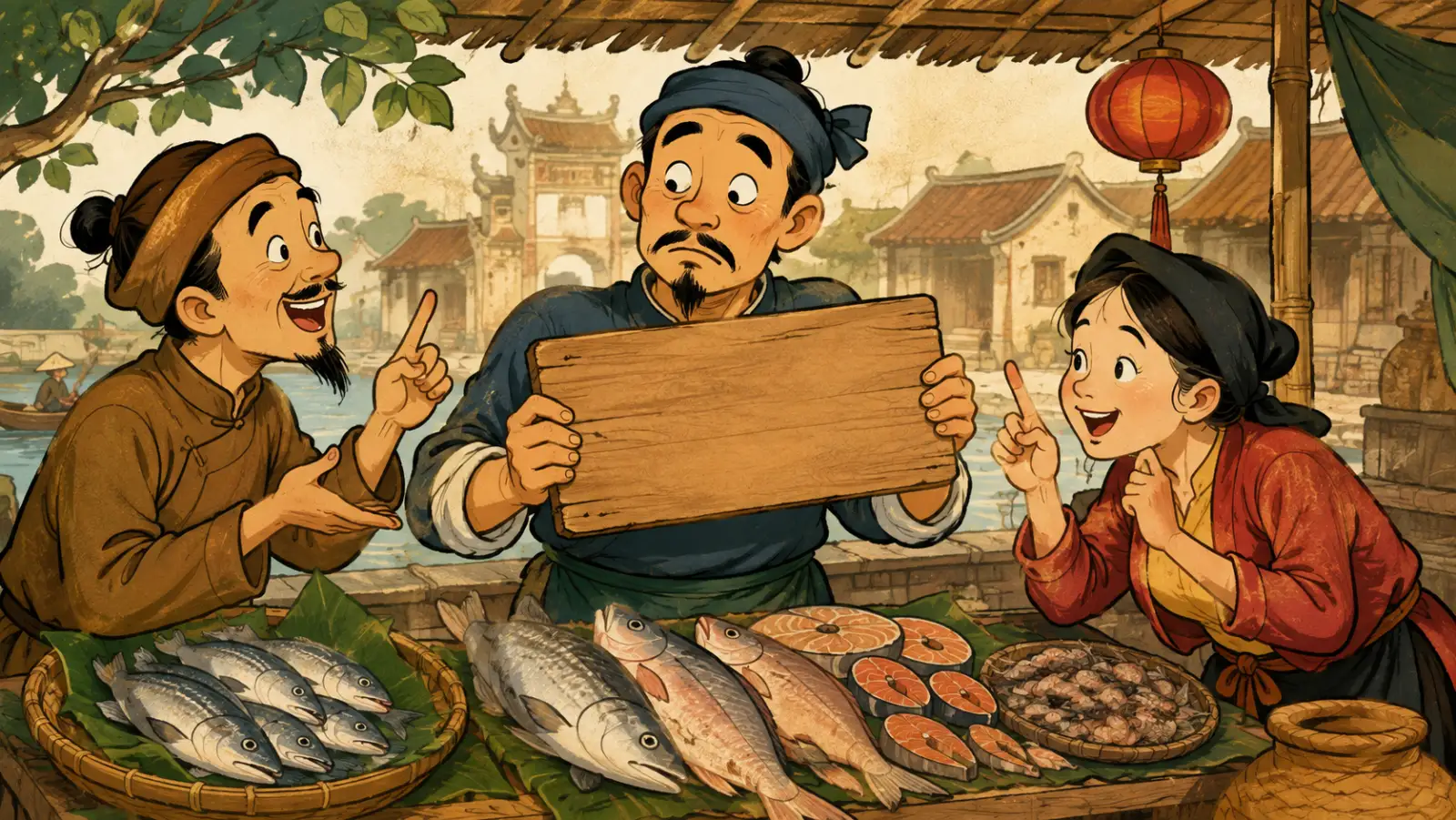
The most famous comic tale of all is Treo biển ("Hanging the signboard"). A man opens a fish shop and proudly hangs a wooden sign out front. It reads:
"Ở ĐÂY CÓ BÁN CÁ TƯƠI"
("Fresh fish sold here")
A passer-by stops, reads it, and laughs. "Why write here? Of course it is here. Are you selling fish somewhere else?" The owner thinks this is a fair point, so he paints out the first word. The sign now reads "Có bán cá tươi" ("Fresh fish sold").
Soon a second customer arrives. "Why say sold? This is a shop. Nobody thinks you are giving the fish away for free." The owner nods and removes that word too. The sign reads "Cá tươi" ("Fresh fish").
A third person frowns at it. "Why fresh? Surely you would never sell rotten fish. Everyone assumes it is fresh." Out goes that word. Now the board simply says "Cá" ("Fish").
Finally a neighbour walks past and chuckles. "Why write fish at all? I could smell your shop from the end of the street. Anyone can tell what you sell." Defeated, the owner stares at his blank board, then quietly takes the whole sign down and carries it inside.
The lesson is sharp and timeless. A person with no opinion of their own, who bends to every passing comment, ends up with nothing at all. In Vietnamese this kind of person is said to have no chính kiến (firm personal view). The story is a favourite in schools precisely because the structure is so clear: four comments, four cuts, one empty board. Read it aloud and you will feel the rhythm build toward that perfect, silent punchline.
The wedding pig and the new shirt
If Treo biển mocks indecision, Lợn cưới, áo mới ("The wedding pig and the new shirt") skewers pure vanity. It stars two men who are each, in their own way, ridiculous.
The first man has just bought a new shirt (áo mới). He is so eager to show it off that he stands in his doorway all day long, waiting for someone, anyone, to notice. Hours pass. Nobody comments. He grows more and more frustrated, because what is the point of a new shirt if no one admires it?
Then a second man comes running up in a panic. He has lost the pig meant for his wedding feast (lợn cưới) and is searching everywhere. But even in his distress he cannot resist bragging about the grand occasion, so he frames his question to brag about the wedding:
"Bác có thấy con lợn cưới của tôi chạy qua đây không?"
("Have you seen my wedding pig run past here?")
The man in the doorway sees his golden chance. Instead of simply answering, he flaps the front of his shirt and replies:
"Từ lúc tôi mặc cái áo mới này, tôi chẳng thấy con lợn nào chạy qua cả!"
("Since I put on this new shirt, I haven't seen any pig run by at all!")
Neither man can answer a simple question without dragging in the thing he is proud of. The pig is forgotten; the shirt goes unadmired; both look foolish. The tale gives the Vietnamese language one of its most useful phrases for everyday teasing: thói khoe khoang, the habit of showing off. To this day, if a friend brags too much, someone will smile and mutter "lợn cưới, áo mới" and everyone understands instantly.
The bluffing tutor
The third classic, Tam đại con gà ("Three generations of the rooster"), aims its satire at fake learning. A village hires a tutor (thầy đồ) to teach the local children to read Chinese characters, the mark of an educated man in old Vietnam. The trouble is that the tutor knows almost nothing himself.
One day a pupil points to the character 雞 (kê), which means "chicken" or "rooster". The tutor has no idea how to read it. Cornered, he mumbles a vague, made-up sound rather than admit he does not know. Worried that he might be wrong, he tells the children to read it very quietly so the answer cannot travel far. He even sneaks off to pray to the household altar for confirmation, treating a simple word as a matter for the spirits.
When the boy's father, who does know the character, questions him, the tutor refuses to back down. Instead he covers his ignorance with nonsense, inventing an absurd explanation that the strange word describes the rooster across "three generations" of the family. The more he talks, the deeper his foolishness shows. The title itself is the joke: a desperate scholar spinning an entire fake lineage out of one character he could not read.
The moral is captured in a phrase every Vietnamese learner should know: dốt hay nói chữ, literally "the ignorant love to use big words". The fool who hides his ignorance behind fancy talk only exposes it further. Honesty about what you do not know, the tale suggests, is far less embarrassing than a clever bluff that collapses.
Comic tales like these often grew into whole cycles. The most famous is Trạng Quỳnh, a series about a quick-witted trickster who uses clever wordplay to outsmart greedy officials and even the king. Where Tam đại con gà laughs at false cleverness, the Trạng Quỳnh stories celebrate the real thing: intelligence used by the small and powerless to puncture the pride of the powerful.
What Vietnamese humour reveals
Put these tales side by side and a pattern appears. Vietnamese comic stories almost never mock people for being poor, plain, or unlucky. They mock people for their attitude: for vanity, stubbornness, stinginess, and pretending to be something they are not. The humour is a quiet form of social correction, a way for a tight-knit village community to keep big egos in check without open conflict.
The style is gentle but pointed. There is rarely any cruelty, and the foolish character is usually left to expose himself through his own words rather than being punished. This reflects deeper Vietnamese values: humility (khiêm tốn), self-awareness, and the belief that you should know your place and not put on airs. Learning to laugh at the right things in these stories is a real step toward understanding the culture, not just the language.
There is also a warmth to it. These tales were told around dinner tables and rice fields, passed from grandparents to children. When you learn them, you are learning the same jokes Vietnamese people grew up with, which makes them a wonderful bridge in conversation with native speakers and a natural fit for any Vietnamese teacher building a culture-rich lesson.
Using comic tales to learn Vietnamese
Comic tales are arguably the single best folk genre for language practice, and here is why. They are short, so you can finish one in a sitting and feel a real sense of progress. They are conversational, full of natural questions and replies like the ones in Lợn cưới, áo mới, so the vocabulary transfers straight into real life. And because the humour depends on a precise punchline, they train you to read for meaning, not just to recognise individual words.
Here is a simple method you can try. First, read the tale slowly and look up any new words. Second, read it aloud, which is excellent for pronunciation and for hearing the rhythm of Vietnamese sentences. Third, retell the story in your own words, even if simply. If you can make a Vietnamese friend smile at your retelling of Treo biển, you have understood it far more deeply than any flashcard could prove.
Teachers can take this further. Use a comic tale as a warm-up reading, then have students spot the satirical target, act out the dialogue, or rewrite the punchline. The short format means you can cover a complete, satisfying text in one class. Because the tales are public-domain folklore, you can copy, translate, and adapt them freely, and learners remember a lesson that made them laugh long after they forget a grammar drill.
Bilingual glossary
| Vietnamese | English |
|---|---|
| truyện cười | comic / humorous folk tale |
| châm biếm | satire |
| treo biển | to hang a signboard |
| cá tươi | fresh fish |
| chính kiến | a firm personal opinion |
| áo mới | new shirt |
| lợn cưới | pig for a wedding feast |
| thói khoe khoang | the habit of showing off; vanity |
| thầy đồ | village tutor / scholar |
| dốt hay nói chữ | the ignorant love to use big words |
| khiêm tốn | humble; modest |
Tóm tắt bằng tiếng Việt
Truyện cười là những câu chuyện dân gian rất ngắn, có kết thúc bất ngờ, dùng tiếng cười để châm biếm thói hư tật xấu của con người. Bài viết kể lại ba truyện nổi tiếng nhất. Trong Treo biển, người bán cá nghe ai góp ý cũng nghe theo, xóa dần chữ trên biển rồi cất luôn tấm biển, ý nói người không có chính kiến sẽ chẳng còn gì. Lợn cưới, áo mới chê thói khoe khoang của hai anh chàng khoe của. Tam đại con gà cười ông thầy đồ dốt mà hay nói chữ. Những truyện này rất hợp để người học đọc to, luyện phát âm và hiểu thêm văn hóa Việt.
Learn Vietnamese with Vietlingo
Comic tales prove that learning Vietnamese can be genuinely fun. Take the next step with a free trial lesson, explore our structured Vietnamese courses, or get matched with one of our friendly Vietnamese teachers who can bring stories like these to life. Keep reading the culture too: dive into Vietnamese fairy tales, fables, and our full folk literature guide.

Comments (0)
A new word, a question, or a different perspective? Share it with fellow learners.
Be the first to comment.