Key takeaway
Vietnamese breakfasts often include savory dishes—such as phở, bánh cuốn, and xôi xéo in Hà Nội; bún bò Huế, cơm hến, and bánh canh in Huế; and cơm tấm, hủ tiếu, and bánh mì in Sài Gòn—ordered with regional words like Northern gọi, bát, đĩa, and chiếc versus Southern kêu, tô, dĩa, and ổ.
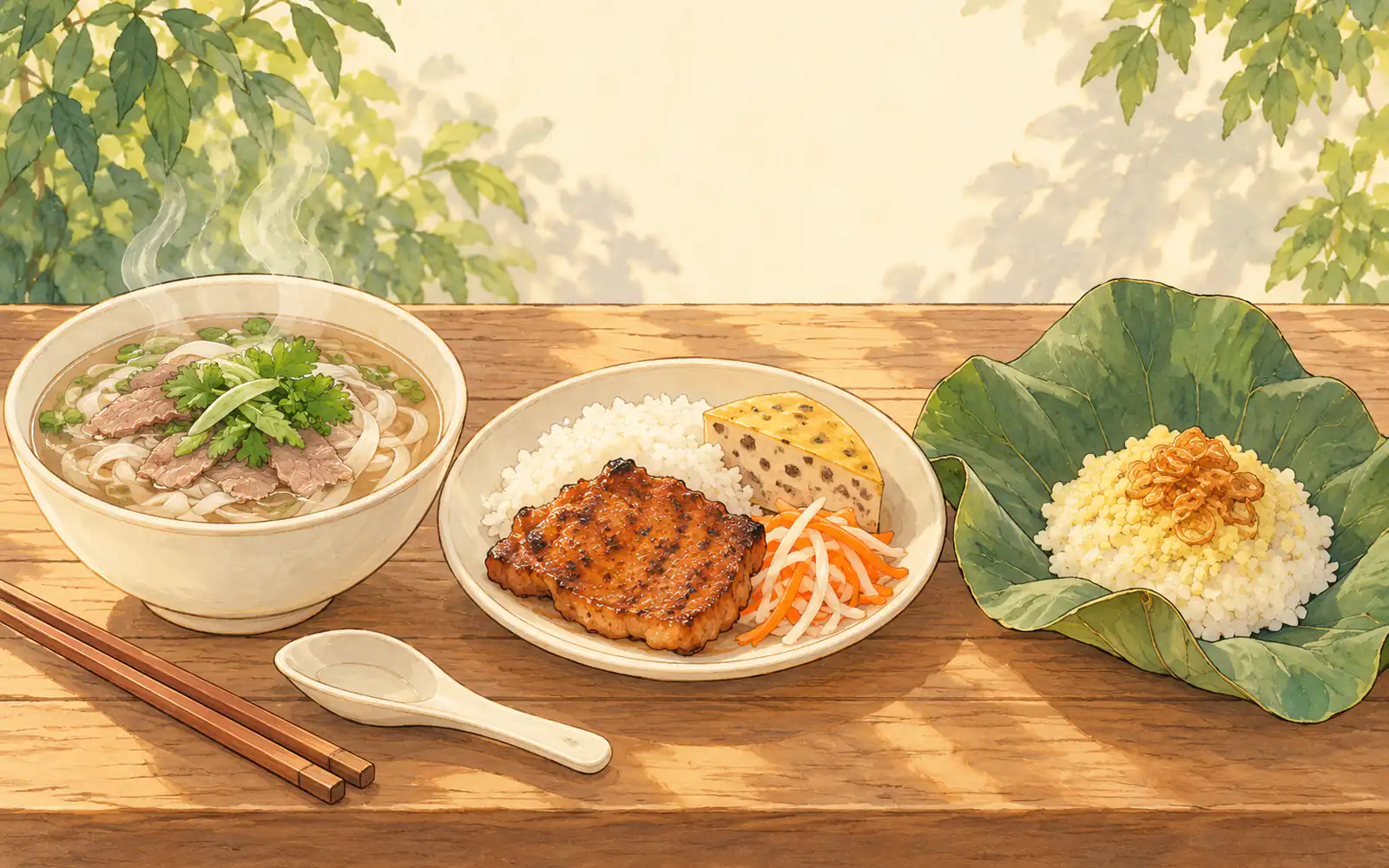
Vietnamese breakfasts often include savory dishes such as noodle soup, sticky rice, steamed rice rolls, and broken rice with grilled pork. In Hà Nội, phở, bánh cuốn, and xôi xéo are familiar morning choices; in Huế, bún bò Huế and cơm hến; and in Sài Gòn, cơm tấm, hủ tiếu, and bánh mì.
| City | Common breakfast dishes | What is in them | How they are usually eaten |
|---|---|---|---|
| Hà Nội | Phở, bánh cuốn, xôi xéo | Flat rice noodles in spiced beef bone broth; steamed rice-flour sheets with minced pork and wood ear mushrooms; glutinous rice with mung beans, fried onions, and liquid fat | Usually eaten hot at morning stalls; xôi xéo is served on a lotus leaf |
| Huế | Bún bò Huế, cơm hến, bánh canh | Rice vermicelli in lemongrass and shrimp-paste pork-and-beef broth with brisket and crab balls; rice with hến (baby mussels), herbs, peanuts, and pork skin; thick noodles with fish cakes, quail eggs, and pork skin | Bún bò Huế and bánh canh are served hot; cơm hến pairs rice with a side bowl of hot broth |
| Sài Gòn | Cơm tấm, hủ tiếu, bánh mì, xôi | Fractured rice with grilled pork, egg meatloaf, pickles, scallion oil, and cracklings; Southern noodle soup with fish or pork; stuffed baguette or skillet of eggs, sausage, and pâté; savory or sweet sticky rice | Cơm tấm is served at stalls morning, noon, and night; xôi is also eaten late at night or at dawn |
What do people eat for breakfast in Hà Nội?
In Hà Nội, thousands of residents start the morning with a steaming bowl of phở—flat rice noodles and meat in spiced beef bone broth with herbs. Phở is usually eaten for breakfast or late at night; see our guide on how phở differs between Hà Nội and Sài Gòn.
Another signature Hà Nội breakfast is bánh cuốn, made from thin steamed rice-flour sheets filled with minced pork and wood ear mushrooms. Early in the morning, many residents sit at roadside stalls to eat soft, freshly steamed bánh cuốn with dipping sauce.

Many Hanoians also eat xôi (steamed glutinous rice), a staple breakfast for centuries now also eaten as a late-night supper. A go-to morning variety is xôi xéo: glutinous rice stuffed in a small bowl, upended onto a lotus leaf, covered in ground mung beans, topped with crispy fried onions, and finished with liquid fat, as VnExpress International describes.
Bún chả—rice vermicelli with grilled pork meatballs, pork slices, herbs, and sweet-and-sour fish sauce—is mostly thought of as a lunch dish, but is eaten at other hours too, including breakfast and dinner. Meanwhile, bún thang (rice vermicelli in clear broth with shredded chicken, egg omelet strips, Vietnamese ham, mushrooms, and herbs) is not a typical breakfast: a Việt Nam News account suggests bún thang may once have been more of a home-cooked Tết specialty than a commercial dish; it is also sold during the day and evening.
What is a traditional breakfast in Huế?
In Huế, a local breakfast dish is bún bò Huế, a spicy central Vietnamese soup built on a pork and beef bone broth seasoned with lemongrass and fermented shrimp paste, served with rice vermicelli, sliced brisket, and crab balls, as VnExpress International outlines. Stalls across Huế serve it for breakfast, lunch, and dinner.
Another common local breakfast is cơm hến: rice mixed with hến (baby mussels), crispy pork skin, roasted peanuts, shredded taro trunk, and herbs, with a side bowl of hot broth. Huế street vendors sell cơm hến from 7 a.m. until noon, while restaurants near tourist sites serve it all day, according to VnExpress International.
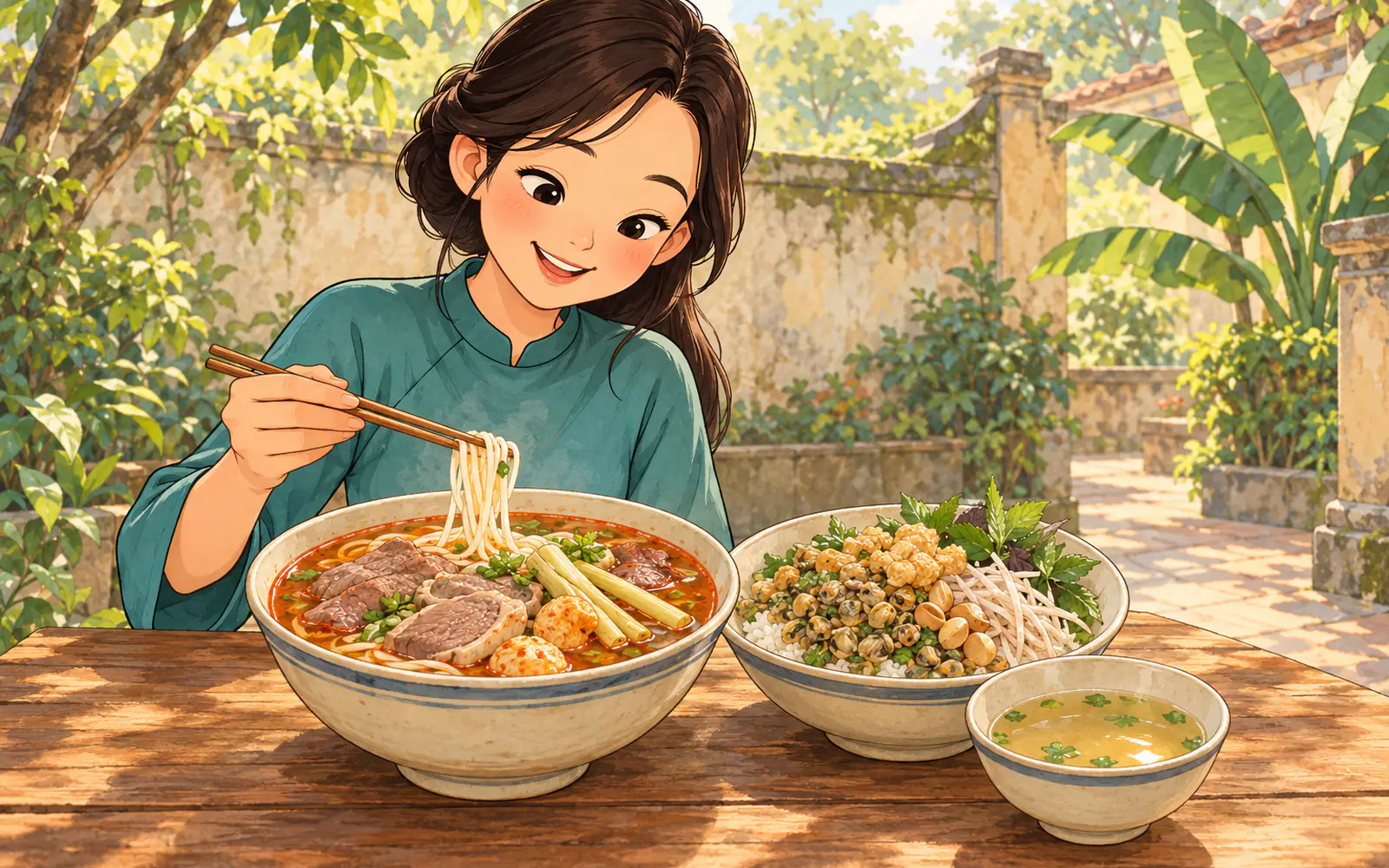
Huế residents also eat bánh canh: thick noodles in a fragrant broth with fish cakes, quail eggs, and pork skin. In Huế, bánh canh is sold in the morning, and on Hàn Thuyên Street, stalls serve it from early afternoon until late at night.
What do people eat for breakfast in Sài Gòn?
In Sài Gòn (Ho Chi Minh City), a classic breakfast is cơm tấm, made from fractured rice grains (tấm) and usually served with grilled pork, steamed egg-and-pork meatloaf, pickled vegetables, scallion oil, and crispy pork cracklings. Neighborhood stalls across Sài Gòn serve it morning, noon, and night, as The Guardian reports.
For noodle soup, many Southern diners eat hủ tiếu, a Southern noodle soup served in variations including fish or pork. A VnExpress International report describes regulars at one Sài Gòn hủ tiếu shop early in the morning.
In Sài Gòn, bánh mì can be a crispy baguette stuffed with cold cuts, pâté, mayonnaise, coriander, cucumber, and pickled carrots and daikon. A hot morning skillet of eggs, sausage, and pâté can also be served with a baguette, as VnExpress International highlights. Finally, xôi (steamed glutinous rice, in savory pork or chicken varieties and sweet varieties with coconut curd) is both a standard breakfast and a late-night or dawn meal.
How do you order breakfast in Northern and Southern Vietnamese?
When ordering breakfast in Hà Nội or Sài Gòn, some words for bowls, plates, loaves, and ordering differ by region. For broader food terms, see our Vietnamese food vocabulary guide.
A study of Vietnamese tableware vocabulary in idioms and folk songs lists paired nouns like bát and chén (bowl) and đĩa and dĩa (plate), while our comparison of Northern and Southern everyday words maps their regional use. Standard dictionaries, including Từ điển tiếng Việt and Từ điển Từ ngữ Nam Bộ, document tô for Northern bát ô tô (large soup bowl), ổ for Northern chiếc (loaf of bread), and kêu for standard gọi (to call or order).
| Meaning | Northern (Hà Nội) | Southern (Sài Gòn) | Example breakfast order |
|---|---|---|---|
| Small eating bowl | bát | chén | một bát xôi (N) / một chén súp (S) |
| Large soup bowl | bát / bát ô tô | tô | một bát phở (N) / một tô hủ tiếu (S) |
| Plate (for rice or rolls) | đĩa | dĩa | một đĩa bánh cuốn (N) / một dĩa cơm tấm (S) |
| Loaf classifier (for bánh mì) | chiếc | ổ | một chiếc bánh mì (N) / một ổ bánh mì (S) |
| To call / to order | gọi | kêu | gọi một đĩa bánh cuốn (N) / kêu một dĩa cơm tấm (S) |
Watch for one table mix-up: in Southern Vietnamese, dĩa means a plate (một dĩa cơm tấm), whereas in Northern Vietnamese, a plate is đĩa and dĩa means a fork. To compare how the accents sound, see our guide to Northern vs. Southern Vietnamese differences.
Short breakfast ordering dialogue in Northern and Southern Vietnamese
Here is how a morning order sounds using these pairs:
Northern (Hà Nội):
- N (Customer): Chị ơi, cho em một bát phở ạ. (Excuse me, could I have one bowl of phở, please?)
- N (Vendor): Vâng, một bát phở. (Yes, one bowl of phở.)
Southern (Sài Gòn):
- S (Customer): Chị ơi, cho em một tô hủ tiếu nha. (Excuse me, could I have one bowl of hủ tiếu, please?)
- S (Vendor): Dạ, một tô hủ tiếu. (Yes, one bowl of hủ tiếu.)
In these exchanges, dạ is the everyday polite opener in the South and is heard in the North too, where vâng and a closing ạ are common.
Key takeaways
- Vietnamese breakfasts often include savory dishes—noodle soups, sticky rice, steamed rice rolls, or broken rice with grilled pork.
- In Hà Nội, morning staples include phở, bánh cuốn, and xôi xéo; bún chả is mostly thought of as a lunch dish but is eaten at other hours too, and bún thang is not a typical breakfast.
- In Huế, locals often eat bún bò Huế, street stalls sell cơm hến from 7 a.m. to noon, and bánh canh is sold in the morning and on Hàn Thuyên Street from afternoon to night.
- In Sài Gòn, classic breakfasts include cơm tấm, hủ tiếu, bánh mì, and xôi.
- To order, Northern speakers usually use gọi, bát, đĩa, and chiếc, while Southern speakers often use kêu, chén or tô, dĩa, and ổ.
Practise Vietnamese through a breakfast order
A breakfast order gives you a concrete reason to practise a greeting, a dish name, and a polite request. For Southern speech, start with Everyday Southern Vietnamese, Level 00, an interactive textbook course following Ben in Sài Gòn through the tones, Southern final consonants, numbers 0 to 10, ordering drinks, and asking speakers to slow down, paired with Slow Vietnamese 01 - Southern, a beginner video course where conversations start slow before moving to normal speed.
For Northern speech, explore Everyday Northern Vietnamese, Level 01 (in Beta, still being tested with some parts such as audio being added), which follows Lucia in Hà Nội through workplace introductions with anh, chị, em, and bác, telling the time, and ordering at a café, alongside our Slow Vietnamese 01 - Northern video course. Still choosing a region? Read whether to learn Hà Nội or Sài Gòn Vietnamese, browse our tutors, or book a trial lesson.
Frequently asked questions
What do Vietnamese people usually eat for breakfast?
Vietnamese breakfasts often include savory dishes such as noodle soups (phở, bún bò Huế, hủ tiếu), steamed rice rolls (bánh cuốn), broken rice with grilled pork (cơm tấm), sticky rice (xôi), or stuffed baguettes (bánh mì).
Is bún chả eaten for breakfast in Hà Nội?
In Hà Nội, bún chả—rice vermicelli with grilled pork and herbs—is mostly thought of as a lunch dish, though locals eat it for breakfast and dinner too.
Are Vietnamese breakfast dishes served at other times of day?
Yes. While some vendors keep morning hours—like Huế street stalls selling cơm hến from 7 a.m. to noon—many dishes are sold later too. Phở and xôi are also eaten late at night, and Sài Gòn stalls serve cơm tấm morning, noon, and night; bánh mì is also a morning choice.
How do you order a bowl of noodles or a plate of rice in Northern vs. Southern Vietnamese?
Northern speakers usually use gọi to order, asking for a bát of soup, a đĩa for a plate, and a chiếc of bánh mì. Southern speakers often use kêu, asking for a tô of soup (or a small chén), a dĩa for a plate, and an ổ of bánh mì.




Comments (0)
A new word, a question, or a different perspective? Share it with fellow learners.
Be the first to comment.