If you ask people in Vietnam to name a hero from the old stories, many will smile and say Thạch Sanh. He is the poor, kind-hearted woodcutter who fights monsters, forgives his enemies, and — in the most famous scene of all — defeats an entire invading army with nothing but a tiny pot of rice. For learners of Vietnamese, this folktale (truyện cổ tích) is a perfect window into the language and the values it carries: courage, honesty, generosity, and a deep love of peace. This article retells the standard public-domain tale in English, quotes the most beloved Vietnamese lines with translations, and gives you a glossary so you can read along. Whether you are a learner building vocabulary or a teacher looking for a culturally rich lesson, Thạch Sanh has something for you.
Who is Thạch Sanh?
Thạch Sanh was born to a poor, elderly couple who longed for a child for many years. According to the tale, he was no ordinary boy: he was secretly a son of Heaven, sent down by the Jade Emperor (Ngọc Hoàng) to be born into a humble human family. His parents died while he was still young, leaving him an orphan (mồ côi) living alone under a banyan tree, with nothing but an axe to cut firewood and a heart full of kindness.
Though he had almost nothing, Thạch Sanh grew up strong — far stronger than any ordinary man. Heaven sent immortals to teach him martial arts and magic. He could split great logs, wrestle wild beasts, and carry loads no villager could lift. Yet he never used his strength to bully or to take what was not his. This combination — great power and a gentle, honest heart — is exactly why Vietnamese audiences have loved him for centuries. In a culture that prizes humility, the hero is not a proud prince but a barefoot woodcutter (chàng tiều phu nghèo) who shares whatever little he has.
Why does his poverty matter to the story?
Thạch Sanh's poverty is not a detail to skip over. It sets up the central contrast of the whole tale: the honest poor man versus the dishonest rich man. The story argues that virtue has nothing to do with wealth or status. A penniless orphan can be braver, kinder, and ultimately more powerful than anyone — and the man who exploits him will be the one who falls. Keep this contrast in mind, because it drives everything that follows.
How does Lý Thông betray Thạch Sanh?
One day a wine-seller named Lý Thông passed by Thạch Sanh's banyan tree. Lý Thông was clever, greedy, and always looking for someone to use. Seeing how strong and trusting the young man was, he pretended to be a kind elder brother and invited Thạch Sanh to live and work with him. Thạch Sanh, who had never known family warmth, happily agreed. He called Lý Thông "anh" (older brother) and served him loyally. This is the first of many betrayals.
At that time, the region was terrorized by a man-eating monster — a giant serpent-demon called chằn tinh (also written trăn tinh). To keep it from destroying the village, the people had to offer it a human sacrifice each year. When Lý Thông's name was drawn, he panicked. So he tricked Thạch Sanh into taking his place, claiming he simply needed someone to "guard a temple" overnight.
Đêm nay đến lượt anh đi canh miếu thờ, ngặt vì anh đang cất dở mẻ rượu, em chịu khó đi thay anh một đêm.
"Tonight it is my turn to guard the temple, but I'm in the middle of brewing wine — would you kindly go in my place for one night?"
Thạch Sanh agreed without suspicion. When the monster attacked, he fought it bravely and killed it, cutting off its head and seizing a magic bow it had guarded. He carried the head proudly back to his "brother." But Lý Thông, instead of being grateful, frightened him with a lie: he said the serpent was the king's beloved pet, and that Thạch Sanh would be executed for killing it. He urged the terrified woodcutter to flee back to his tree at once — and then Lý Thông carried the monster's head to the king himself and claimed the heroic deed. He was rewarded with high rank. This is the pattern of the tale: Thạch Sanh does the brave work; Lý Thông steals the credit.
What happens with the giant eagle and the princess?
The second betrayal is even darker. A giant eagle (đại bàng) swooped down and carried off the king's daughter, the princess (công chúa). The whole court was in despair. The king ordered Lý Thông — now a celebrated "hero" — to find and rescue her, but of course Lý Thông had no idea how. Desperate, he held a great festival to lure out the real strong man, and there he found Thạch Sanh again.
It happened that Thạch Sanh had already seen the eagle flying overhead with the princess in its claws. He had shot it with an arrow and followed the trail of blood to a deep cave (hang) in the mountains. Trusting his "brother" once more, he led Lý Thông to the spot and bravely climbed down into the cave alone. There he fought the wounded eagle, killed it, and freed the princess. He tied her to a rope so Lý Thông's men could pull her up to safety.
Then came the cruelest act of all. Once the princess was safe above ground, Lý Thông ordered his men to seal the mouth of the cave with great boulders, trapping Thạch Sanh inside to die so that no one could ever expose his lies. Buried alive, Thạch Sanh seemed lost. But deep in that same cave he discovered another prisoner: the son of the Sea King (Thái tử con vua Thủy Tề), also captured by the eagle. Thạch Sanh freed him too. In gratitude, the Sea King welcomed Thạch Sanh to his underwater palace and offered him treasure. The humble woodcutter refused gold and jewels, asking only for one simple thing: a lute (cây đàn thần, a magic stringed instrument). Some versions add a second gift here — a never-emptying rice pot (niêu cơm thần) — which becomes crucial later. With his magic lute, Thạch Sanh returned to the world above.
How does the magic lute speak the truth?
Back home, Thạch Sanh's troubles were not over. The vengeful spirits of the monster and the eagle framed him for theft, and he was thrown into the royal prison — wrongly imprisoned (bị bắt oan) for a crime he never committed. Meanwhile, the rescued princess had fallen completely silent. From the moment she returned, she could not speak a single word; no doctor or healer in the kingdom could cure her. The king was heartbroken.
Alone in his cell, sad and unjustly accused, Thạch Sanh took out his lute and began to play. And the lute did not play an ordinary song — it sang the truth of what had really happened in the cave:
Đàn kêu tích tịch tình tang,
Ai mang công chúa dưới hang trở về.
"The lute sings tich tich tinh tang — who was it that brought the princess back from the cave?"
The sound floated through the palace walls and reached the princess. The moment she heard it, she suddenly laughed and spoke for the first time. She begged the king to summon the prisoner whose music had healed her. When Thạch Sanh was brought before the court, the whole truth came out: he was the true hero who had slain the serpent and the eagle, and Lý Thông was the liar who had stolen his deeds and tried to murder him. The king set Thạch Sanh free, gave the princess to him in marriage, and let him judge his betrayer. Here the tale reveals Thạch Sanh's deepest virtue — his mercy. He chose to spare Lý Thông's life and simply send him home. But Heaven was not so forgiving: on the road back, Lý Thông and his mother were struck down by lightning and, in the most famous version, transformed into dung beetles (bọ hung) — a fitting end for a life of greed and deceit.
How did a rice pot defeat an army?
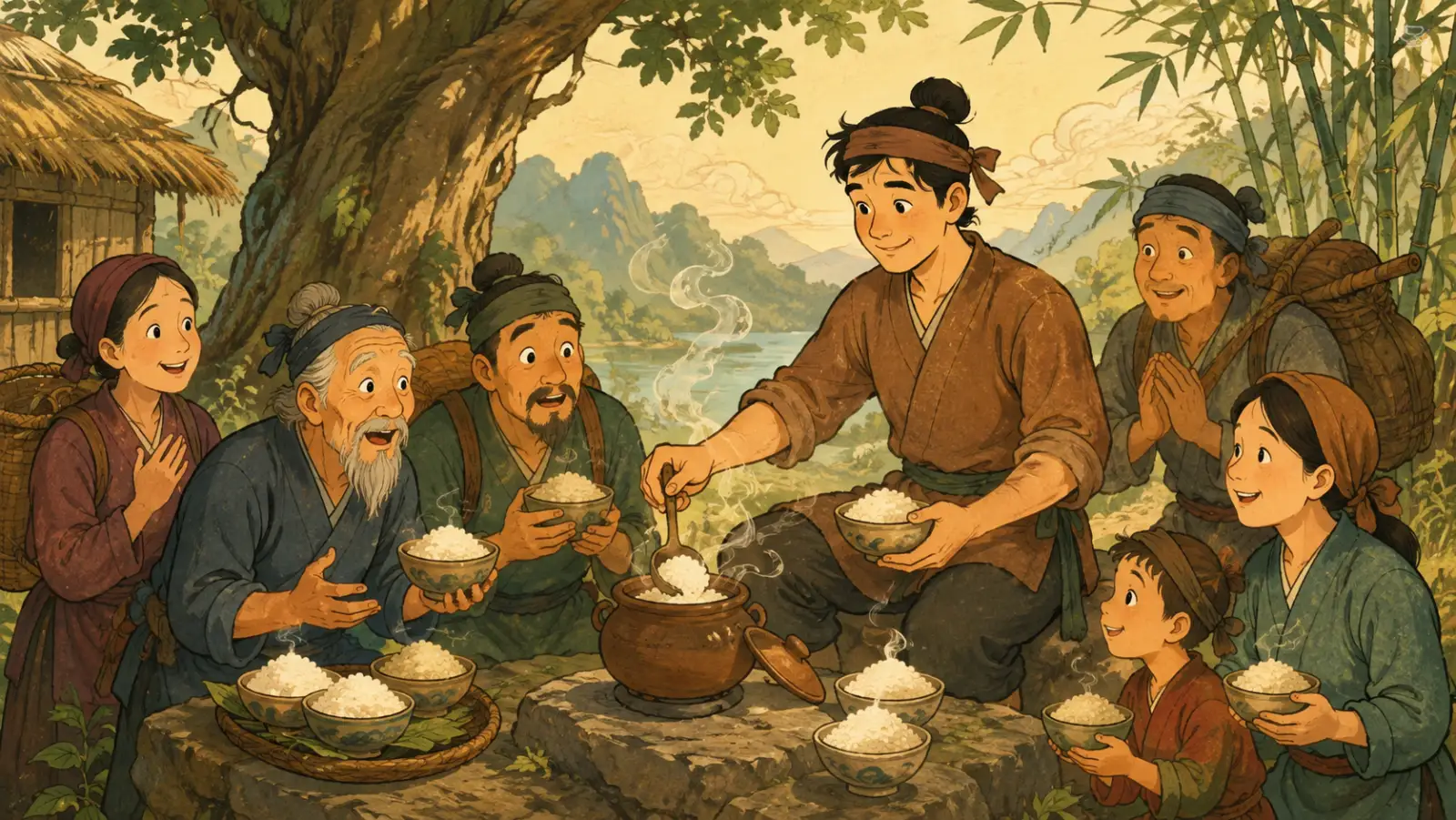
The grandest scene comes last. The princes of eighteen rival states (quân mười tám nước chư hầu) had also hoped to marry the princess. Furious that she had wed a lowly woodcutter, they joined their armies and marched on the kingdom to wage war. The royal court trembled. But Thạch Sanh did not call for soldiers, swords, or blood. Instead, he walked out alone to meet the eighteen armies, carrying his magic lute and his small rice pot (niêu cơm Thạch Sanh).
First he played the lute. Its sound was so sorrowful and so beautiful that the enemy soldiers lost all will to fight; their weapons fell from their hands and their hearts melted. Then Thạch Sanh made them an offer worthy of a riddle: if they could finish eating all the rice in his little pot, he would surrender and let them win. The generals laughed — how could a tiny pot feed an entire army? But the more they ate, the more rice appeared. The pot simply could not be emptied. Famished thousands ate their fill, and still the rice was full to the brim.
Amazed and humbled by such magic — and ashamed of marching to war over jealousy — the eighteen armies laid down their arms and bowed in surrender. No one was killed. Peace was won not by the sword, but by a bottomless bowl of rice shared with one's enemies. Thạch Sanh later inherited the throne and ruled with the same kindness he had always shown. This image is so powerful that in modern Vietnamese, the phrase niêu cơm Thạch Sanh ("Thạch Sanh's rice pot") means an inexhaustible, never-ending supply of something.
What does the tale of Thạch Sanh teach?
On the surface, Thạch Sanh follows a familiar folktale rhythm: good is rewarded, evil is punished (ở hiền gặp lành, ác giả ác báo). Thạch Sanh's kindness, courage, and honesty bring him a princess and a throne, while Lý Thông's greed brings him lightning and shame. But the tale carries values that feel strikingly deep for a children's story.
- Virtue over status. A barefoot orphan outshines rich, titled men. Worth is measured by character, not wealth.
- Honesty and loyalty. Thạch Sanh trusts and serves faithfully; the story condemns those who exploit trust for gain.
- Mercy toward enemies. When he finally has power over Lý Thông, Thạch Sanh forgives rather than takes revenge.
- An anti-war heart. This is what makes the tale unforgettable. Faced with eighteen invading armies, the hero refuses bloodshed. He wins with music and a shared meal. The deepest message is that generosity and peace are stronger than weapons — feed your enemy and you may turn him into a friend.
For a country that has known much war, the image of a humble man ending a conflict by sharing food rather than spilling blood resonates powerfully. Teachers can use this scene to spark wonderful classroom discussions about conflict, generosity, and what real strength looks like.
Why is this a great story for learners?
Because almost everyone in Vietnam knows it, mentioning Thạch Sanh instantly connects you with native speakers. The two idioms below appear in everyday conversation and writing, so learning them gives your Vietnamese a natural, cultured feel. The story is also short, vivid, and morally clear, which makes it ideal for reading practice. If you want a guided introduction to the wider tradition, see our companion article on Vietnamese folktales (truyện cổ tích), and the broader Vietnamese folk literature guide.
Words and idioms for learners
Here are the key expressions from the tale, with notes on how they are used today.
- niêu cơm Thạch Sanh — literally "Thạch Sanh's rice pot." Used to describe something that never runs out, an inexhaustible supply. Example: a small business that keeps generating money "like Thạch Sanh's rice pot."
- đàn kêu tích tịch tình tang — "the lute goes tich tich tinh tang." This is the onomatopoeic line of the magic lute. Tích tịch tình tang imitates the plucking of strings, and the whole phrase is now a playful, instantly recognizable cultural reference to the story.
- ở hiền gặp lành — "those who live kindly meet good fortune." The moral backbone of the tale and a very common Vietnamese proverb.
- mồ côi — "orphaned." Describes Thạch Sanh's situation and appears often in folktales.
If you enjoy this kind of story-based learning, you will also love the two most famous companion tales: the Cinderella-like Tấm Cám and the karmic Cây Khế (The Starfruit Tree). Together with Thạch Sanh, they form the heart of the Vietnamese folktale canon.
Bilingual glossary
| Vietnamese | English | Notes |
|---|---|---|
| Thạch Sanh | Thach Sanh (hero's name) | The poor, kind woodcutter hero |
| Lý Thông | Ly Thong (villain's name) | The greedy wine-seller who betrays him |
| tiều phu | woodcutter | One who cuts and sells firewood |
| mồ côi | orphan / orphaned | Common in folktales |
| Ngọc Hoàng | the Jade Emperor | Supreme ruler of Heaven; Thạch Sanh's heavenly father |
| chằn tinh / trăn tinh | man-eating serpent-demon | The first monster he slays |
| đại bàng | giant eagle | Kidnaps the princess |
| công chúa | princess | Falls mute, then healed by the lute |
| hang | cave | Where the princess is held |
| Thái tử con vua Thủy Tề | son of the Sea King | Fellow prisoner Thạch Sanh frees |
| cây đàn thần | magic lute | Speaks the truth and softens enemies |
| niêu cơm thần | magic rice pot | Never empties; feeds an army |
| quân mười tám nước chư hầu | armies of eighteen rival states | The invading force that surrenders |
| bọ hung | dung beetle | What Lý Thông becomes in many versions |
| ở hiền gặp lành | kindness meets good fortune | Core moral / proverb |
Tóm tắt bằng tiếng Việt
Thạch Sanh là chàng tiều phu nghèo, mồ côi, hiền lành nhưng có sức khỏe phi thường, vốn là con của Ngọc Hoàng. Gã bán rượu Lý Thông giả vờ kết nghĩa anh em rồi nhiều lần lừa dối chàng. Thạch Sanh giết chằn tinh, bắn đại bàng cứu công chúa và con vua Thủy Tề, nhận được cây đàn thần cùng niêu cơm thần. Bị bắt oan vào ngục, chàng gảy đàn "tích tịch tình tang", công chúa đang câm bỗng nói được, sự thật phơi bày. Khi quân mười tám nước chư hầu kéo sang, niêu cơm bé nhỏ ăn mãi không hết khiến chúng kinh ngạc xin hàng, đem lại hòa bình mà không đổ máu. Lý Thông bị trừng phạt. Truyện ca ngợi lòng nhân ái, sự dũng cảm và tinh thần yêu chuộng hòa bình.
Learn Vietnamese with Vietlingo
Folktales like Thạch Sanh are one of the most enjoyable ways to grow your Vietnamese — they teach you living idioms, real culture, and the values native speakers grew up with. At Vietlingo, you can turn this love of stories into real fluency. Start with a free trial lesson with a friendly Vietnamese teacher, browse our structured Vietnamese courses for every level, and meet the teachers who can read these classic tales aloud with you — diacritics, tones, and all. Like Thạch Sanh's rice pot, there is always more to discover.



Comments (0)
A new word, a question, or a different perspective? Share it with fellow learners.
Be the first to comment.