Key takeaway
Tấm Cám is Vietnam’s best-known folktale, often called the Vietnamese Cinderella: a kind orphan, a cruel stepmother, a talking fish, and a heroine who keeps coming back. This guide retells the full story in English, with its famous rhyming chants, a glossary, and a short Vietnamese summary for learners.
If you grew up with Cinderella, you already know the shape of Tấm Cám — but Vietnam's version is darker, stranger, and far more magical than the one with the glass slipper. It is a story of a kind orphan, a cruel stepmother, a talking fish, a fairy in disguise, and a heroine who simply refuses to stay dead. For learners, Tấm Cám is also one of the best windows into the Vietnamese imagination, because nearly everyone in Vietnam can recite at least one of its rhyming chants from memory. In this article we retell the classic public-domain tale faithfully in English, quote the famous Vietnamese verses with real diacritics and translations, and give you a bilingual glossary plus a Vietnamese summary so you can study the language while you enjoy the story.
Tấm Cám is part of Vietnam's rich oral tradition. If you want the bigger picture first, see our guides to Vietnamese folktales (truyện cổ tích) and Vietnamese folk literature. Then come back for the tale that Vietnamese children meet again and again, in storybooks, on stage, and in school.
Who are Tấm and Cám?
Tấm (whose name means broken rice, the cheaper, fragmented grains left after milling) is the heroine: a gentle, hardworking orphan. Her mother died when she was young, and her father remarried before he, too, passed away. That left Tấm in the house of her stepmother and her stepmother's own daughter, Cám (whose name means rice bran, the husk left behind). The two names sit side by side like a pair — broken rice and bran — and Vietnamese listeners hear the contrast immediately: both humble, but Tấm is the one you would actually keep.
From the start, Tấm is treated as a servant in her own home. She does the cooking, the washing, the rice-pounding, and the buffalo-herding, while Cám is pampered and idle. The stepmother loves her own daughter blindly and resents her stepdaughter at every turn. This unequal household — the kind, overworked child versus the spoiled favourite — is the engine of the whole story, and it is why Vietnamese readers root for Tấm so fiercely.
Why does this setup feel familiar?
The "mistreated good child plus cruel step-relative" pattern appears in folktales all over the world, which is exactly why Tấm Cám is so often called the Vietnamese Cinderella. But keep reading: once the magic fish and the reincarnation chain arrive, you will see that Tấm Cám goes to places the Western Cinderella never dreams of.
What happens with the magic fish and Bụt?
One day the stepmother sends both girls out to catch fish and shrimp, promising a beautiful red skirt (a yếm đỏ, a traditional red bodice) to whoever brings home a full basket. Tấm, used to hard work, fills her basket quickly. Lazy Cám catches nothing — so she tricks her stepsister. "Sister," she says sweetly, "your hair is muddy. Go and wash it in the deep water, or Mother will scold you." While the trusting Tấm bathes, Cám pours every fish and shrimp from Tấm's basket into her own and runs home to claim the prize. Tấm returns to an empty basket and bursts into tears.
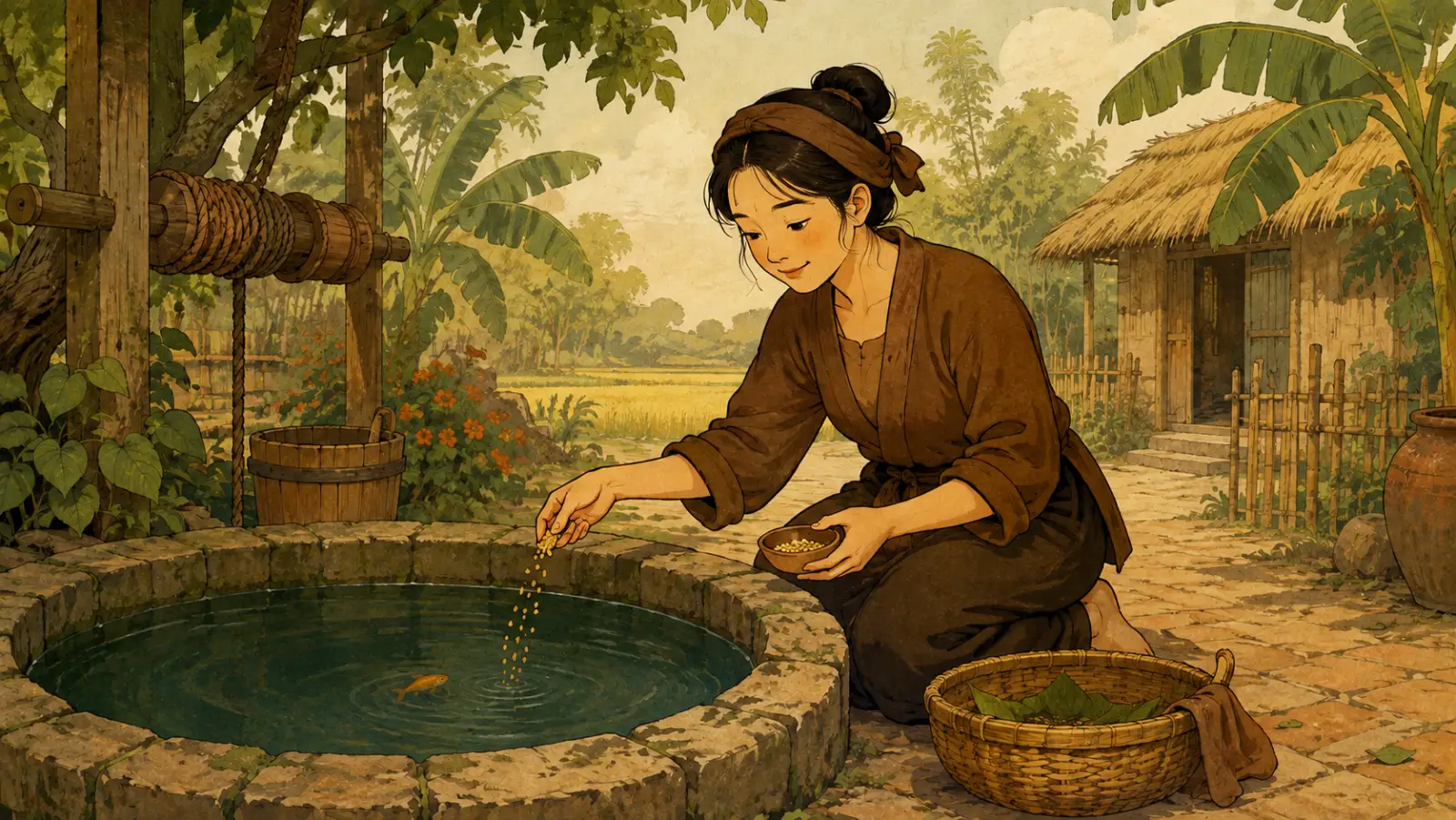
At this moment a kindly old figure appears: Bụt, a Buddha-like fairy who shows up whenever a good person weeps in despair. (In many Vietnamese tales it is Bụt, not a fairy godmother, who answers the suffering of the innocent.) Bụt tells Tấm to look again in her basket. There she finds a single tiny fish left behind — a little cá bống (a small goby). Bụt instructs her to take the fish home, keep it in the well, and feed it every day.
Tấm raises the little fish as a friend. Each day she saves part of her own meal and calls it up with a gentle chant:
Bống bống bang bang,
Lên ăn cơm vàng cơm bạc nhà ta,
Chớ ăn cơm hẩm cháo hoa nhà người.
Little bống, little bống, come up and eat our gold rice and silver rice; don't eat the stale rice and watery gruel of strangers.
The fish rises to the surface whenever it hears Tấm's voice. But the stepmother grows suspicious. She spies, learns the chant, and one day calls the fish up herself using Tấm's exact words. When the trusting little cá bống surfaces, the stepmother catches it, kills it, and cooks it for dinner. Tấm comes to the well, sings her chant, and only blood floats up. She weeps again.
Once more Bụt appears. He tells Tấm to gather the fish's bones, place them in four small jars, and bury them under the four legs of her bed. She obeys. This quiet act of love and faith is about to be repaid — because those buried bones hold the magic that will change Tấm's life.
How does the lost slipper change everything?
When the king announces a great festival, the stepmother is determined that Tấm shall not go. She mixes a basket of rice with a basket of husks and orders Tấm to separate them grain by grain before she may leave — an impossible task designed to keep her home. Tấm cries, and Bụt sends a flock of sparrows to sort the grains in moments. But Tấm still has nothing to wear.
Bụt tells her to dig up the four jars of fish bones. Inside she finds everything she needs: beautiful clothes, an embroidered dress, a fine pair of giày thêu (embroidered slippers), and even a tiny horse that grows into a real mount. Transformed, Tấm rides to the festival. But hurrying across a bridge, she drops one of her embroidered slippers into the water and cannot retrieve it.
The king's elephant later refuses to pass that spot. Servants search the water and bring up the lost chiếc hài — the single exquisite slipper. The king, struck by its beauty and tiny size, declares that whoever the slipper fits shall become his queen. Every woman at the festival tries it on; none succeed, including the smug Cám. At last shy Tấm slips her foot in. It fits perfectly. The king marries her, and the mistreated orphan becomes queen — the turning point that mirrors Cinderella most closely.
How is this different from Western Cinderella?
Up to the slipper, the two tales rhyme. After it, they part ways completely. In most Western versions the wedding is the happy ending. In Tấm Cám, the wedding is barely the halfway point — because the stepmother and Cám are not finished with Tấm, and Tấm is not finished with them.
Why does Tấm keep coming back?
The most distinctive part of Tấm Cám — the part with no Western equivalent — is the reincarnation chain, known in Vietnamese as hóa thân (transformation, taking a new bodily form). Tấm does not win once and live happily ever after. She is killed, and she returns again and again in new shapes, each one fighting back.
It begins when Tấm, now queen, returns home for her late father's death anniversary. Her stepmother asks her to climb an areca palm to pick nuts for the offering; while Tấm is at the top, the stepmother chops the trunk down, and Tấm falls to her death. The stepmother then dresses Cám in the queen's clothes and sends her to the palace to take Tấm's place. But Tấm's spirit will not rest.
- A golden oriole (chim vàng anh). Tấm is reborn as a bright golden bird that flies into the palace garden. When Cám hangs the king's robes out to dry carelessly, the oriole scolds her with a sharp little verse:
Phơi áo chồng tao, phơi lao phơi sào,
You're drying my husband's robe — dry it on the pole, on the rack; don't dry it on the hedge, you'll tear my husband's robe. The king grows fond of the clever bird and keeps it in a golden cage. Jealous Cám, on her mother's advice, kills and eats the oriole and throws the feathers in the garden.
Chớ phơi bờ rào, rách áo chồng tao. - A xoan đào tree. From the discarded feathers grows a pair of beautiful xoan đào trees (a kind of Persian lilac). The king loves to rest in their shade and hangs his hammock between them. Cám, suspecting Tấm again, has the trees cut down and turned into a weaving loom.
- A weaving loom (khung cửi). When Cám sits to weave, the loom clacks out a chilling threat:
Cót ca cót két,
Clack and clatter — you stole my husband, sister; I'll gouge your eyes out. Terrified, Cám burns the loom and scatters the ashes far from the palace.
Lấy tranh chồng chị,
Chị khoét mắt ra. - A golden thị fruit. Where the ashes fall, a single tree grows bearing one fragrant golden thị (a wood-apple or marmelos, prized for its sweet scent). A poor old woman passing by holds out her bag and says she only wants to smell it, not eat it — and the fruit drops into her bag. She takes it home and keeps it on a shelf for its perfume. Secretly, Tấm steps out of the fruit each day to clean the house and cook for the kind old woman. When the old woman discovers her and tears up the fruit's skin so Tấm can never hide back inside, Tấm stays — living happily as the old woman's adopted daughter.
This four-step chain — bird, tree, loom, fruit — is the heart of the tale, and Vietnamese children love reciting the loom's spooky warning most of all. Each transformation shows Tấm's spirit refusing injustice, getting a little closer each time to returning fully to the human world.
How is Tấm finally reunited with the king?
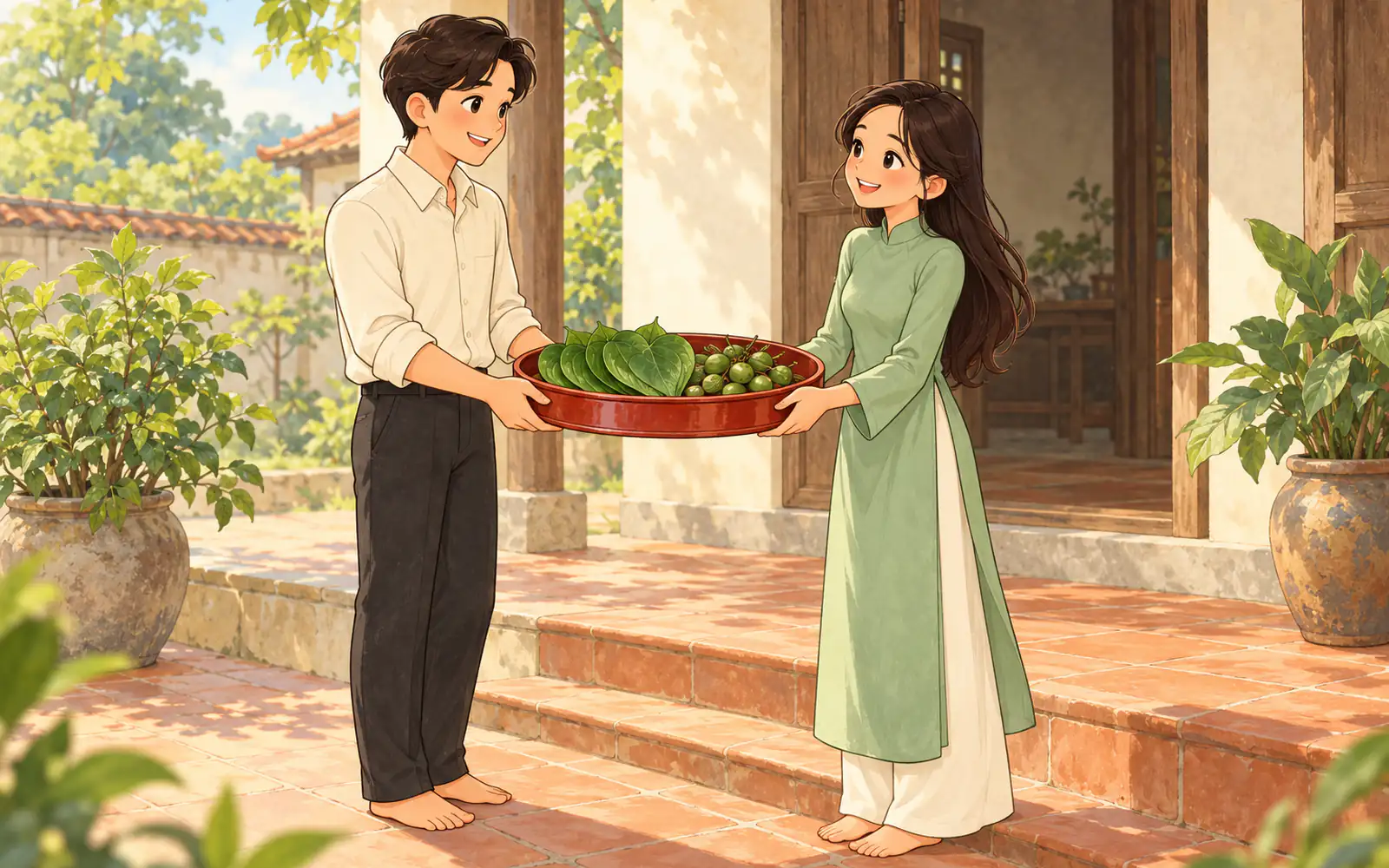
One day the king, traveling and tired, stops at the old woman's house for tea and betel. He notices that the betel quid is folded into a delicate phoenix-wing shape — exactly the way his lost queen used to fold it. He asks who made it, the old woman calls Tấm out, and husband and wife recognize each other at last. The king brings Tấm home to the palace as his queen once more. After death, transformation, and patient struggle, the orphan who was thrown away has come all the way back.
What does Tấm Cám teach?
On the surface, Tấm Cám rewards kindness and punishes cruelty — the classic moral of folktales everywhere. But Vietnamese readers also see deeper themes:
- Resilience (sự kiên cường). Tấm is wronged over and over, yet she never gives up. The reincarnation chain is essentially a metaphor for perseverance: knock her down, and she returns in a new form.
- Kindness rewarded (ở hiền gặp lành). This famous Vietnamese phrase — "live kindly and good things will come" — runs through the whole story. Tấm's care for a tiny fish and a poor old woman is what ultimately saves her.
- Reincarnation and transformation (hóa thân). The bird-tree-loom-fruit cycle reflects a worldview, shaped by Buddhist ideas, in which the soul persists and returns. This is what makes Tấm Cám feel so distinctly Vietnamese.
- Justice (công lý). Wrongdoing does not go unanswered. By the end, Cám and the stepmother are punished for what they did.
About that ending: the exact punishment of Cám and her mother varies a great deal between versions. Some older, harsher tellings end with a gruesome revenge; gentler, modern school editions soften it considerably, sometimes letting fate or the characters' own greed undo them. What stays constant across every version is the principle of poetic justice — the cruel are brought low, and the kind are restored. Because Tấm Cám is folklore passed down orally for centuries, you should expect this kind of variation, and it is part of what keeps the story alive.
For more heroes of the tradition, compare Tấm's quiet endurance with the brave woodcutter in Thạch Sanh, and see how folktales differ from the grander national myths in our guide to Vietnamese legends (truyền thuyết).
Why is Tấm Cám so important in Vietnam?
Tấm Cám is not just a bedtime story — it is a cornerstone of Vietnamese childhood and education. The tale is studied in Vietnamese literature classes in school, where students discuss its characters, its morals, and its language. It has been retold endlessly in picture books, comics, water-puppet shows, stage plays, and films, and the chants are quoted in everyday speech. If you mention Bụt, the cá bống, or the line about gouging out eyes to almost any Vietnamese person, they will smile in instant recognition. Knowing Tấm Cám gives a learner real cultural fluency — the kind that goes far beyond grammar drills.
Vietnamese learners: words and chants to know
The chants in Tấm Cám are written in simple, rhythmic Vietnamese, which makes them excellent listening and pronunciation practice. Try reading the fish chant aloud, paying attention to the rhyme between bang, vàng, and the flow of the line. Notice the repeated structure — cơm vàng cơm bạc (gold rice, silver rice) versus cơm hẩm cháo hoa (stale rice, watery gruel) — a neat lesson in how Vietnamese loves balanced, paired phrases.
A few cultural and grammar notes to deepen your reading:
- Bụt is a folk word for the Buddha, distinct from the more formal Phật. In folktales, Bụt is the gentle helper of the innocent.
- tao and chị in the chants are pronouns that carry attitude. Tao (I/me) is blunt and confrontational — the oriole and the loom use it to assert power over Cám. Chị (older sister) is used pointedly by the loom to remind Cám of the bond she betrayed.
- ở hiền gặp lành is a four-word idiom worth memorizing; it captures the whole moral of the tale in a single breath.
Reading folktales is one of the most enjoyable ways to build vocabulary, because the same words recur and the story carries you forward. A teacher can help you read the original Vietnamese line by line, explain the regional flavour of each word, and coach your tone marks on those tricky chants — find one on our Vietnamese teachers page.
Bilingual glossary
| Vietnamese | English | Notes |
|---|---|---|
| Tấm | broken rice (heroine's name) | The cheaper, fragmented grains; signals her humble status |
| Cám | rice bran (stepsister's name) | The husk; paired with Tấm as a contrasting name |
| mẹ kế | stepmother | The cruel antagonist of the tale |
| Bụt | Buddha / fairy helper | Folk word for the Buddha; appears to help the innocent |
| cá bống | little goby (small fish) | Tấm's beloved pet that she feeds with a chant |
| yếm đỏ | red bodice / red skirt | The prize the stepmother promises for a full basket |
| giày thêu / chiếc hài | embroidered slipper | The lost shoe the king uses to find Tấm |
| hóa thân | reincarnation / transformation | The core motif: Tấm returns in new forms |
| chim vàng anh | golden oriole | Tấm's first rebirth; scolds Cám in verse |
| xoan đào | Persian lilac tree | Tấm's second rebirth, grown from the bird's feathers |
| khung cửi | weaving loom | Tấm's third rebirth; threatens Cám as it clacks |
| thị | wood-apple / marmelos fruit | Tấm's final form; prized for its sweet fragrance |
| ở hiền gặp lành | kindness is rewarded | Four-word idiom summarizing the tale's moral |
| công lý | justice | The poetic justice delivered at the end |
Tóm tắt bằng tiếng Việt
Tấm là cô gái mồ côi hiền lành, sống cùng mẹ kế và em gái cùng cha khác mẹ tên Cám. Bị đối xử bất công, Tấm được Bụt giúp đỡ và nuôi một con cá bống làm bạn, gọi cá bằng câu hát quen thuộc. Mẹ kế giết cá, nhưng Bụt bảo Tấm chôn xương; nhờ đó cô có quần áo đẹp và giày thêu để đi hội. Nhà vua nhặt được chiếc hài và cưới Tấm làm hoàng hậu. Mẹ con Cám hại chết Tấm, nhưng Tấm hóa thân nhiều lần — thành chim vàng anh, cây xoan đào, khung cửi, rồi quả thị thơm. Cuối cùng, Tấm trở về đoàn tụ với nhà vua, còn kẻ ác bị trừng phạt. Câu chuyện đề cao lòng nhân hậu, sự kiên cường và lẽ công bằng "ở hiền gặp lành".
Keep going in the accent you chose: Everyday Southern Vietnamese, Everyday Northern Vietnamese, or Everyday Huế Vietnamese.
Prefer to learn from video? Start with the Northern Vietnamese Pronunciation Course or the Southern Complete Vietnamese Course (A1), and train your ear with Slow Vietnamese 01 (Northern) or Slow Vietnamese 01 (Southern).
Read next: Vietnamese folktales and Vietnamese myths.
Learn Vietnamese with Vietlingo
Folktales like Tấm Cám are a delightful doorway into the Vietnamese language and the values behind it. Want to read the original chants with confidence and understand every tone mark? Book a trial lesson on our trial page, browse structured lessons in our Vietnamese courses, or connect with a native-speaking guide through our Vietnamese teachers directory. Start your story with Vietlingo today.


Comments (0)
A new word, a question, or a different perspective? Share it with fellow learners.
Be the first to comment.