
Key takeaway
Southern and Huế Vietnamese both merge hỏi and ngã, giving five spoken tones, but their pitch levels and contours differ. Everyday question words, family terms, and sentence endings also distinguish them. Choose Southern for conversations centered on Sài Gòn or Southern-speaking relatives; choose Huế for life in Huế or a Huế-speaking family.
Southern and Huế Vietnamese both have five spoken tones because hỏi and ngã merge, but their pitch levels and contours still differ. They also differ in consonant patterns, everyday words, family terms, and sentence endings; choose a speaking model around the people you want to talk with.
| Feature | Sài Gòn (Southern) | Huế (Central) |
|---|---|---|
| Spoken tones | Five; hỏi and ngã merge | Five; hỏi and ngã merge |
| Where / what / like that | đâu / gì / vậy | mô / chi / rứa |
| Mother / father | má / ba | mạ / ba |
| Sentence endings to notice | nha | hỉ for agreement; hí and nghe in suggestions or leave-taking |
The five-tone counts are documented in Phạm and McLeod’s comparison of Vietnamese dialects. Here, Sài Gòn and Huế are city reference varieties: neither label describes every speaker across the South or Central Vietnam. For the wider picture, see our guide to Vietnamese dialects.
- Key takeaways: equal tone counts do not mean equal pronunciation.
- Learn Huế question words alongside their Southern equivalents.
- Use one main speaking model, then build recognition of the other.
Why do Sài Gòn and Huế sound different with five tones each?
A tone count tells you how many contrasts a listener distinguishes within a dialect. It does not tell you the height at which a tone starts, how it moves, or where it finishes. Two dialects can merge the same written categories while giving the resulting tone different sounds.
James Kirby’s pronunciation reference gives different tone patterns for Huế and Sài Gòn and notes that descriptions of Huế contours vary. For listening practice, compare the recordings below rather than trying to reproduce Huế tones from a fixed written contour.
- Starting pitch: listen to where the voice begins within each speaker’s range.
- Movement: follow the pitch through the whole syllable.
- Ending: notice where the voice finishes before you repeat.
The spelling keeps all six categories: ma, mà, má, mả, mã, mạ. A spoken merger does not make hỏi and ngã interchangeable in writing. Keep the correct marks even when the two categories sound alike in your chosen dialect.
First listen without repeating. On the next pass, follow how the pitch moves. Then repeat one short item from each recording separately. The exercise is to hear two models of the same written category, not to force them into one sound.
Consonant sounds to compare
Several consonant patterns overlap, so one shared sound cannot identify a speaker’s dialect. Start with initial consonants, then listen to whole words. Phạm and McLeod’s study documents regional consonant variation.
| Letters | Sài Gòn | Huế |
|---|---|---|
| d, gi | Commonly a y-like sound | Also a y-like sound |
| r | Several realizations occur | Kept apart from d and gi in the reference model |
| tr / ch | Distinct in careful speech; may merge casually | Distinct in the reference model |
| s / x | A distinction exists, but merging occurs in city speech | Distinct in the reference model |
Here, “y-like” means the opening sound of English “yes.” It is a listening cue, not a replacement spelling. Keep Vietnamese words written normally, including consonant letters that your speaking model may merge.
Practice one group at a time. Trying to copy every difference in a long sentence makes it difficult to tell what changed. If your first reference was Hà Nội, the Southern vs Northern Vietnamese comparison gives you another useful listening baseline.
Which everyday words change between Sài Gòn and Huế?

Short question words can make a familiar sentence suddenly difficult to follow. Learn them in pairs, then notice the words both dialects share. The table gives useful equivalents for the meanings shown, not automatic replacements in every expression.
| Sài Gòn | Huế | English |
|---|---|---|
| đâu | mô | where |
| gì | chi | what |
| sao | răng | why; how, depending on the question |
| vậy | rứa | like that; so |
| này | ni | this |
| đó | nớ | that; already mentioned or near the listener |
| kia | tê | that over there |
| bây giờ | chừ | now |
| ly | ly | glass; cup |
| chén | chén | bowl |
| muỗng | muỗng | spoon |
| ngàn | ngàn | thousand |
The question-word correspondences are documented in Alves’s study of Central Vietnamese grammatical vocabulary; the shared household words show why the comparison includes similarities as well as differences. Central vocabulary varies by locality, so use a Huế model when Huế is your goal.
For example, pair cái ni with “this one” and bên tê with “over there.” Learn each as a small phrase. Our Huế dialect guide develops the Central comparison further.
Family words for conversations at home
For a heritage learner, family words may matter before café vocabulary. Keep the relationship constant while learning its regional name. Start with the words your own relatives use.
| Relationship | Sài Gòn | Huế |
|---|---|---|
| Mother | má | mạ |
| Father | ba | ba |
| Grandmother | bà | mệ |
| Grandfather | ông | ôn |
| Father’s sister | cô | o |
The local cultural portal Visit Hue discusses mạ as a Huế word for mother. Notice the tone mark: Southern má and Huế mạ are different written words, not simply two pronunciations of one spelling.
Address depends on the relationship and situation. For polite practice in Huế, use con/cháu for self-reference with clearly older people and dạ in replies. Follow a relative’s introduction when meeting a family member. Do not assume that learning a regional family word tells you how to address every stranger.
How nha, nghe, and hỉ work in a sentence
Sentence endings help signal the speaker’s attitude. They are worth learning as part of a complete exchange, because an English gloss such as “okay?” cannot capture every use.
| Dialect | Ending | Learning cue |
|---|---|---|
| Sài Gòn | nha | A Southern counterpart of nhé; learn its meaning within a whole exchange |
| Huế | hỉ | Seek agreement, as in Ngon hỉ? — “Tasty, isn’t it?” |
| Huế | hí | Recognize suggestions and leave-taking; Mai gặp hí. — “See you tomorrow.” |
| Huế | nghe | Recognize sentence-final use similar to nhé; not a default substitution for learners |
A study of dialect contact in Ho Chi Minh City records nha among Southern variants corresponding to nhé. For Huế practice, use hỉ in agreement questions; recognize hí and sentence-final nghe first. Do not turn every Southern nha into hỉ. A suggestion and an agreement question do different jobs. Copy the whole line and its situation.
What does the same short dialogue look like in each dialect?
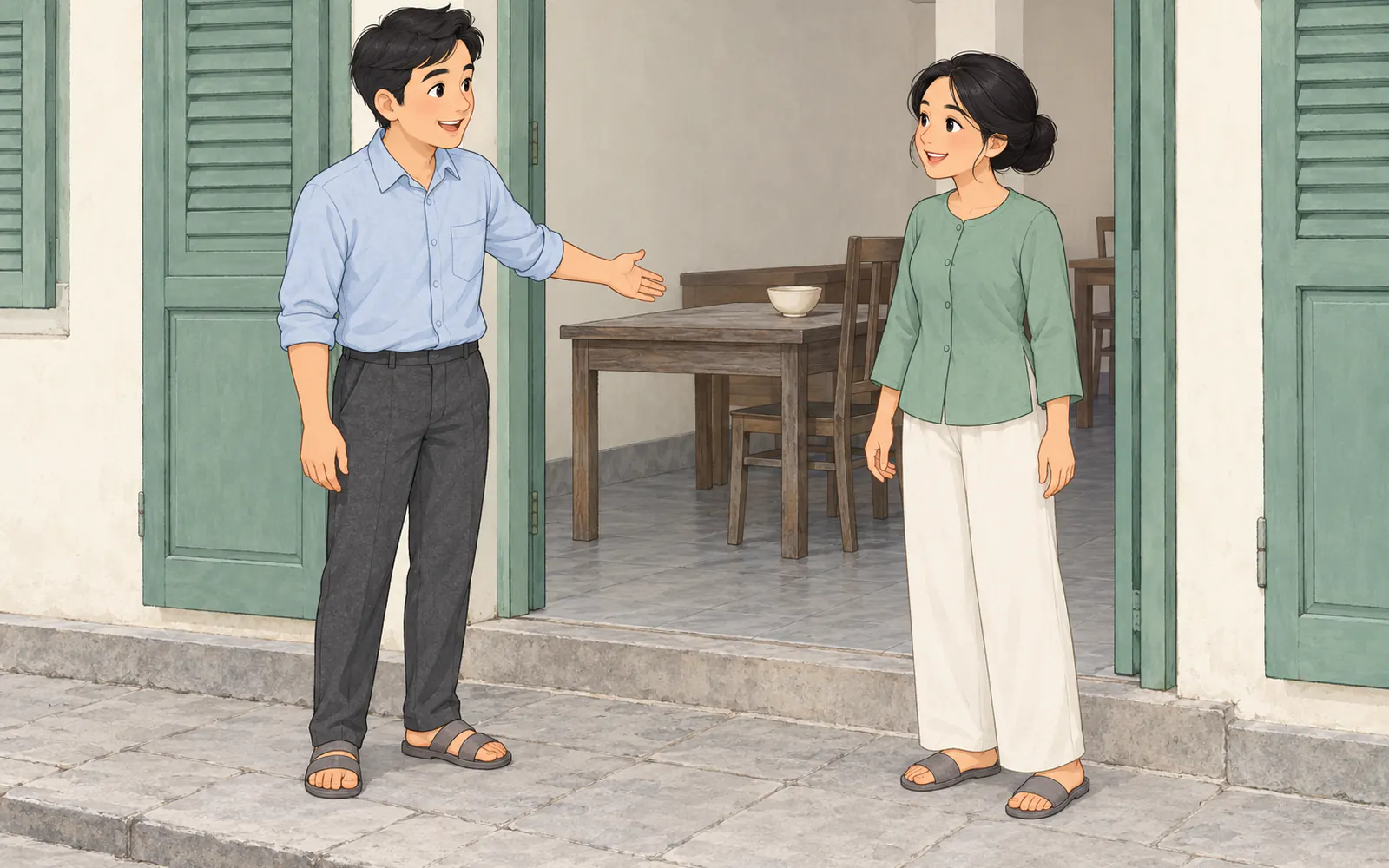
Two adult friends meet around lunchtime. One is heading out to eat; the other asks about the plan. Both use tui as casual self-reference. The question words change between the two versions.
Sài Gòn
Sài Gòn A: Bây giờ đi đâu?
Sài Gòn B: Tui đi ăn.
Sài Gòn A: Ăn gì?
Sài Gòn B: Ăn cơm.
Huế
Huế A: Chừ đi mô?
Huế B: Tui đi ăn.
Huế A: Ăn chi?
Huế B: Ăn cơm.
English: A: “Where are you going now?” B: “I’m going to eat.” A: “What are you having?” B: “A rice meal.” The opening question leaves its subject understood; the last answer refers to a rice meal in this context. Read one version through before switching, so you practice a connected exchange rather than isolated substitutions.
These written lines show vocabulary choices. They cannot reproduce the full accent: identical words such as ăn cơm still need a recording in the dialect you are learning.
Which should you learn: Southern or Huế Vietnamese?

| Your goal | Main speaking model | Useful next step |
|---|---|---|
| Daily life in Sài Gòn | Southern | Practice everyday exchanges with Southern recordings. |
| Daily life in Huế | Huế | Learn question words, family terms, and local pronunciation together. |
| Talking with relatives | Your family’s variety | Ask which words they use at home and record a short exchange with their permission. |
| Visiting both cities | Whichever you will use most | Keep a paired listening list for the other variety. |
A practical routine is to choose one exchange, listen, repeat, and record yourself. Check one feature at a time: the question word first, then the tone, then the ending. Add the other dialect after the first version feels familiar.
Neither five-tone system is automatically easier for every learner. Familiar voices and regular conversation give you a more useful starting point than tone count alone. If you also hear Hà Nội speech at home, compare our Northern vs Huế guide.
Everyday Southern Vietnamese is built on lessons from SVFF, Vietlingo’s sister school for Southern Vietnamese (since 2014). Vietlingo also has a Huế course, so you can choose a course around your main conversation goal.
Start with Everyday Southern Vietnamese or the Huế Vietnamese course. Try the free first units in Southern Vietnamese and Huế Vietnamese to hear both before choosing your main practice path.
Frequently asked questions
Do Southern and Huế Vietnamese both have five tones?
Yes, the reference varieties compared here merge hỏi and ngã into one spoken tone, giving five spoken categories. Vietnamese spelling still preserves all six tone categories, so keep the correct marks when writing.
Is the Sài Gòn accent the same as the Huế accent?
No. Sharing a tone count does not make their pitch contours identical. Consonant patterns, question words, family vocabulary, and sentence endings also contribute to the difference.
Does learning Southern Vietnamese prepare you for Huế?
It gives you useful shared vocabulary, but you still need Huế listening practice. Start by pairing đâu with mô, gì with chi, and vậy with rứa, then listen to whole exchanges in Huế speech.
Should I use nghe or hỉ instead of nha in Huế?
Learn the purpose of the sentence first. In the practice guidance here, hỉ seeks agreement; hí and sentence-final nghe are recognition-first forms associated with suggestions or leave-taking. They are not interchangeable replacements for nha.
Which dialect should I learn for a Huế family?
Start with the variety your relatives actually speak. Learn their family terms and repeat short exchanges they use at home. If other relatives speak Southern Vietnamese, build recognition of that variety alongside your main speaking model.




Comments (0)
A new word, a question, or a different perspective? Share it with fellow learners.
Be the first to comment.