Key takeaways
- Register is the gap between casual chat (Ê, sao rồi mày?) and formal writing (Kính gửi Quý anh/chị) — and in Vietnamese that gap is unusually wide and visible.
- Recognising the rule ("drop the particle in formal writing") is passive; the register-conversion drill forces active production every single time.
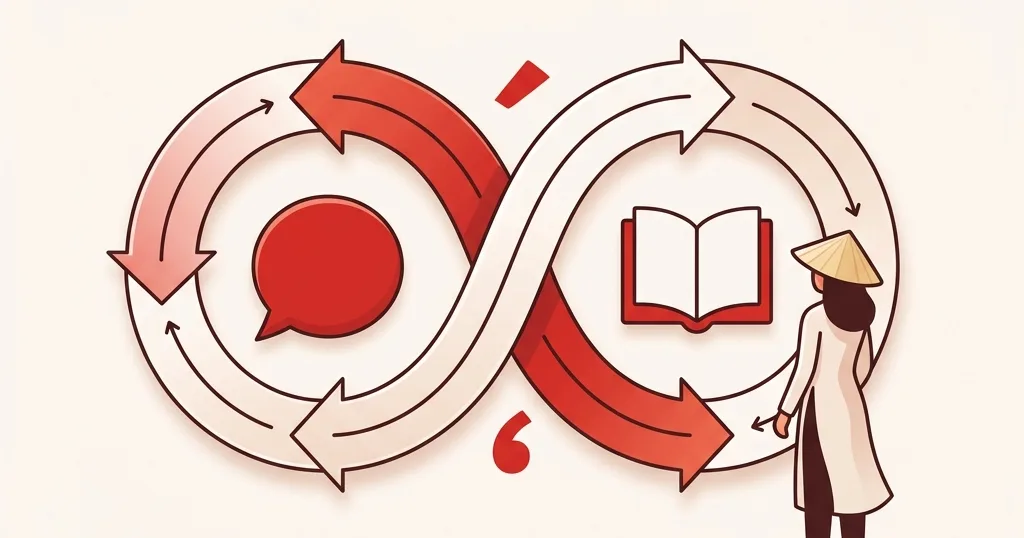
- The core mechanic runs in four directions: spoken to written, written to spoken, formal to casual, casual to formal.
- Spoken Vietnamese is warm, fast and full of particles like à, nha, nhé, đó, vậy; formal writing strips most of them out for tighter phrasing.
- A self-check rubric lets you run the loop endlessly without a teacher in the room.
Most learners can recite the difference between formal and casual Vietnamese in theory, and then freeze the moment they have to actually produce it. They know that vâng is polite and ừ is breezy, that a news report avoids sentence-final particles while a text message drowns in them — yet when they open their mouths, the wrong register tumbles out anyway. The gap is not knowledge. It is the absence of reps. What follows is a single exercise engine, borrowed from the bones of classic Vietnamese stylistics workbooks, that closes that gap by making the learner rebuild meaning in a new register over and over until the switch becomes automatic. One mechanic, infinite material, and a self-check you can run without a teacher in the room.
Why does transformation beat memorizing the rules?
Recognition and production are different muscles. When you memorize a rule — “drop the particle in formal writing” — you train recognition. You can spot a violation in someone else’s sentence. But spotting is passive. Production requires you to hold the meaning steady while you rebuild the form around it, choosing vocabulary, connectors, and particles on the fly. That is a fundamentally harder act, and it is the one real communication demands.
A transformation drill forces production every single time. You are handed a sentence in one register and told to deliver the same idea in another. There is nowhere to hide. You cannot recognize your way out; you have to reconstruct. This is the same reason translation practice outperforms vocabulary lists, and why athletes scrimmage instead of only watching film. The learner who has rewritten a hundred sentences from spoken to written Vietnamese has built a hundred tiny bridges between the two systems, and those bridges are what let them cross instantly under pressure.
There is a second, quieter benefit. Because the meaning is fixed and only the register moves, the drill isolates the variable you actually want to train. The learner is not also wrestling with new vocabulary or an unfamiliar topic. They already understand the sentence; the only puzzle is how would a different speaker, in a different setting, say this same thing? That isolation is what makes the practice efficient. Compare it to free composition, where the learner juggles ideas, grammar, vocabulary, and register all at once and usually drops register first. Constrain the task and you sharpen the skill.
A third benefit is that transformation is self-correcting in a way rote study never is. When you memorize a rule and misapply it, nothing pushes back until a teacher marks you wrong. When you transform a sentence and the result sounds off, your own ear — trained on real input — flinches. That flinch is data. The drill manufactures hundreds of those small moments of friction, and friction is where learning lives.
The core mechanic: four directions of conversion
Take any Vietnamese sentence and you can push it in four directions. Each direction trains a distinct sub-skill, and together they cover the full range of register control a learner needs. Master all four and you control not just whether you sound formal or casual, but how much feeling you carry and whether your voice stays consistent from the first word to the last.
1. Spoken to written
The learner takes a casual, conversational line and rewrites it as it would appear in a formal document, a report, or a polished email. This means trading colloquial vocabulary for neutral or literary equivalents, removing sentence-final particles, replacing loose connectors with precise ones, and often expanding contracted or elliptical structures into full clauses.
Mai tính nghỉ phép mấy bữa đi chơi đó mà. — I'm thinking of taking a few days off tomorrow to go have some fun, you know.
becomes
Tôi dự kiến xin nghỉ phép một số ngày để đi du lịch. — I plan to request several days of leave in order to travel.
Notice what changed: the casual verb tính (a breezy “reckon”) becomes the formal dự kiến, the trailing particle cluster đó mà vanishes entirely, the vague time-word mấy bữa tightens into một số ngày, and the childlike đi chơi upgrades to đi du lịch. The proposition — I want time off to enjoy myself — is untouched. Only the clothing changed.
2. Written to spoken
The reverse. The learner takes a stiff, bookish sentence and makes it sound like something a friend would actually say out loud. This is the direction most textbook-trained learners need most, because their Vietnamese often sounds like a printed announcement. They must add particles, contract phrases, swap formal vocabulary for everyday words, and let the rhythm loosen.
Chúng tôi trân trọng thông báo rằng sự kiện sẽ bị hoãn. — We respectfully announce that the event will be postponed.
becomes
Nghe nói sự kiện bị hoãn rồi đó! — I heard the event got postponed, you know!
Or, kept a touch fuller: Này, cái sự kiện đó bị hoãn rồi nha. — Hey, that event's been postponed, okay. Either rewrite is valid — part of the drill is recognizing that spoken language tolerates a range, where the written original was fixed. The formal trân trọng thông báo rằng dissolves into a casual nghe nói or simply disappears, and an everyday particle takes its place to do the social work the formal verb used to do.
3. Plain to emotionally charged
Here the register stays spoken, but the learner injects attitude through particles, intonation markers, and word choice. Vietnamese carries an enormous amount of feeling in its final particles — nha, đó, ấy, cơ, luôn, mà, đi, thôi — and learning to deploy them is the difference between sounding like a robot and sounding human.
Hôm nay trời mưa. — It's raining today.
becomes, with rising exasperation:
Trời ơi mưa gì mà mưa hoài vậy nè! — Good grief, why on earth does it keep raining like this!
or, with delight:
Mưa rồi kìa, thích ghê! — It's raining, look — how lovely!
The propositional content (“it is raining”) never moves. What the learner practices is layering emotion on top of a fixed fact, which is exactly what fluent speakers do without thinking. This direction is where the drill stops feeling like grammar homework and starts feeling like acting — and that is precisely why it sticks.
4. Mixed-register to consistent-register
This is the editor’s drill, and the most diagnostic of the four. The learner is given a sentence that clashes with itself — formal vocabulary wedged next to slang, a bookish connector trailing into a casual particle — and must smooth it into a single coherent voice, either fully formal or fully casual.
Do đó, tôi quyết định nghỉ chơi luôn cho khỏe nha. — Therefore, I have decided to just take the day off to relax, okay.
The formal Do đó and quyết định fight with the casual nghỉ chơi luôn and the particle nha. Resolved formally: Do đó, tôi quyết định nghỉ một ngày để nghỉ ngơi. — Therefore, I have decided to take a day off to rest. Resolved casually: Vậy nên thôi nghỉ một bữa cho khỏe nha. — So I'll just take a day off to relax, okay. This direction trains the learner’s ear for consistency, the single hardest thing for intermediate speakers who have absorbed both registers but cannot yet keep them apart.
How do you generate an endless supply of items?
The beauty of this engine is that the raw material is everywhere. Any sentence in Vietnamese is a candidate. Here is a template you can run on a news headline, a chat message, a textbook line, a song lyric, a road sign — anything.
- Step 1 — Capture one source sentence. Pull a single line from real Vietnamese. Keep it short at first: eight to fifteen words. A headline like Thành phố triển khai kế hoạch trồng cây xanh. — The city implements a green-tree-planting plan — is perfect.
- Step 2 — Identify its current register. Ask: where would I encounter this? A headline is formal-written. A line from a TV drama is casual-spoken. Naming the starting point keeps the conversion honest, because you cannot move away from a register you have not located.
- Step 3 — Pick a target direction. Choose one of the four. For the headline above, “written to spoken” is the obvious first move.
- Step 4 — Rewrite. Produce the converted sentence. Nghe nói thành phố sắp trồng nhiều cây xanh lắm đó. — I heard the city's about to plant lots of green trees, you know.
- Step 5 — Self-check against the rubric (below). This is non-negotiable; a rewrite you have not audited is a guess, not a rep.
- Step 6 — Reuse the same source for the other three directions. One headline yields four conversions. Then charge it emotionally, then mix and un-mix it. A single sentence can easily produce six to eight items.
Run this loop ten minutes a day and you will never run out of material. The internet refreshes your source pool every morning. That is what makes it a loop you can run forever — the supply is the entire living language, and it regenerates faster than you can ever consume it.
What does the self-check rubric look like?
Without a rubric, learners drift — they produce something that feels different and call it done. Three quick questions catch almost every error. Run them after every single rewrite, in order.
- Does it fit the target audience and setting? Read the sentence and picture who would say it and to whom. If your “casual” rewrite still sounds like a press release, you have not arrived. If your “formal” version would embarrass you in a report, the same. Imagine the actual room: an office, a coffee shop, a group chat.
- Is the vocabulary level consistent throughout? Scan word by word. Is every choice on the same shelf? A single formal word stranded in a casual sentence (or the reverse) breaks the spell. This is where most intermediate learners fail, because they fix the obvious words and miss the small ones.
- Are the particles and connectors appropriate? Formal Vietnamese leans on connectors like do đó, tuy nhiên, vì vậy, mặc dù and bans sentence-final emotional particles. Casual Vietnamese inverts this: particles like nha, đó, luôn, mà flourish, while heavy connectors give way to light ones like nên, mà, rồi. Check that yours match the target.
If all three answers are yes, the conversion is sound. If any is no, you have found exactly what to fix — which is itself a learning moment more valuable than a clean pass. A failed rubric check is not a failure of the drill; it is the drill working. The whole point is to surface the mismatch so your ear records it.
How should a tutor sequence the difficulty?
The drill scales smoothly from beginner to advanced, and a one-on-one tutor controls difficulty along several dials at once. Move through these stages as the learner stabilizes, and do not rush — a learner who is fluent at stage one is far more useful than one who is shaky at stage four.
Stage one: short, single-direction, spoken-to-written
Start with short casual sentences and only the spoken-to-written direction. It is the most rule-governed (remove particles, formalize vocabulary) and therefore the most forgiving for a nervous beginner. Give them sentences where the changes are mechanical and the wins are visible. Early confidence is fuel; spend it generously.
Stage two: reverse the arrow
Add written-to-spoken. This is harder because adding natural particles requires intuition, not rules. Model two or three acceptable rewrites yourself so the learner sees the range, then let them try. Resist correcting toward a single “right” answer — reward any version that a native would actually say. The lesson here is that spoken language is plural, and that loosening up is itself a skill.
Stage three: emotional charging
Introduce plain-to-charged. This is where lessons get fun, because emotion is personal. Hand the learner one neutral sentence and ask for three emotional versions: annoyed, delighted, worried. The same fact, three feelings. This builds the particle vocabulary that textbooks neglect and that no learner ever picks up from grammar tables alone.
Stage four: the consistency editor
Finally, mixed-to-consistent, and lengthen the sentences. This stage demands that the learner hold a whole sentence’s register in mind and audit it. It is the capstone because it tests everything at once: vocabulary awareness, particle control, and connector judgment. A learner who can clean up a clashing sentence can also catch themselves before they produce one.
Across all four stages, three independent dials let you fine-tune: length (short clauses up to multi-clause sentences), register distance (a small shift from neutral to slightly formal, versus a big leap from street slang to bureaucratic prose), and topic familiarity (everyday subjects before technical ones). Turn one dial at a time. If a learner stalls, shorten the sentence before you simplify anything else — length is usually the real culprit, not difficulty of register.
Which learner errors should you watch for?
Certain mistakes recur so reliably that you can pre-load corrections. Keep this list beside you and you will catch ninety percent of what goes wrong.
- Formal connectors left in casual rewrites. The classic. A learner converts to spoken but leaves do đó or tuy nhiên sitting at the front of the sentence. Tuy nhiên tao không muốn đi. — However, I don't want to go — is a jarring mismatch; the natural casual form is Mà tao không muốn đi. — But I don't want to go. Train the ear to flag bookish connectors first, because they are the loudest tell.
- Particle pile-up. Over-correcting into casual speech, learners stack three particles where one would do: đi nha luôn đó. One well-chosen particle beats a heap. Less is more, and a single nha usually carries the whole load.
- Wrong pronoun register. Vietnamese pronouns carry register too. A formal rewrite using tao/mày is broken no matter how clean the rest is; it should use tôi and an appropriate term for the listener. Conversely, a casual line stuck with tôi between close friends sounds cold and distant.
- Half-formalized vocabulary. The learner upgrades one word and forgets its neighbors, producing a sentence that is seventy percent formal and thirty percent slang. The rubric’s consistency check exists precisely to catch this; remind them to scan every word, not just the verb.
- Meaning drift. In the effort to change register, learners sometimes change the meaning — adding emphasis the original lacked, or dropping a qualifier. Remind them: only the register moves; the proposition is sacred.
- Tone-deaf emotional particles. Using a tender particle for an angry sentence, or vice versa. Emotional charging requires matching the particle to the feeling, not just adding any particle. The fix is to name the emotion out loud before choosing the particle.
Where do the best raw sentences come from?
Random internet text works, but it has a flaw: you cannot always trust that your rewrite matches how natives actually speak, and you have no easy way to hear it aloud. This is where pairing the drill with structured, verified material pays off. We recommend sourcing your raw sentences from VietLingo lesson transcripts and dialogues. They are already real Vietnamese, already leveled, and crucially they come with native audio — so after you charge a sentence with particles, you can check your instinct against how a fluent speaker would actually deliver it.
The workflow is tight. Pull a line from a dialogue. Run it through one or more of the four conversions. Then verify: use the platform’s audio to hear the source and your rewrite read in context, and use its translation tools to confirm your converted sentence still carries the original meaning. Now your self-check is not just “does this feel right” — it is anchored to native usage. That closes the loop between producing language and confirming it, which is the single biggest weakness of solo study. If you have not tried building a session this way, a trial lesson is enough to assemble a starter bank of fifty sentences in an afternoon.
Independent learners can run the same loop without a tutor. Keep a running document with three columns: the source sentence, your conversion, and a note on what the rubric flagged. Review the flags weekly and you will watch your own error patterns shrink in real time — a feedback loop most self-learners never set up. If you keep noticing the same flag (say, formal connectors in casual rewrites), spend a whole session attacking just that one pattern until it stops appearing.
Putting it together in a single session
A productive twenty-minute block looks like this. Spend two minutes harvesting five source sentences from a dialogue. Spend twelve minutes converting — aim for two directions per sentence, so ten rewrites. Spend four minutes running every rewrite through the three rubric questions and logging the flags. Spend the last two minutes listening to the native audio for the two or three sentences you were least sure about. Ten rewrites a day, six days a week, is two hundred and forty reps a month. No memorization session on earth produces that kind of active production volume.
For a tutor, the same structure becomes a lesson spine you never have to plan again. The learner brings the source sentences; you steer direction, length, and register distance; the rubric does the grading; the audio settles the arguments. You can teach register for a year with this one engine and never repeat an item. And because the learner is producing, not listening, you spend your contact hours on the hard part — judgment calls and edge cases — rather than on delivering rules they could have read in a book.
The loop that keeps giving
Register is not a fact you learn once. It is a reflex you build through reps, the same way you build any reflex — by doing the thing, correcting, and doing it again. The register-conversion drill turns the entire Vietnamese language into a bottomless supply of practice, because every sentence you encounter is one rewrite away from being an exercise. Start tomorrow with a single headline and four conversions. Keep the rubric beside you, watch for the formal connector that sneaks into your casual rewrites, and verify your instincts against real native audio. Do it long enough and the switch between spoken and written Vietnamese stops being a decision you make and becomes a thing your tongue already knows.




Comments (0)
A new word, a question, or a different perspective? Share it with fellow learners.
Be the first to comment.