Key takeaway
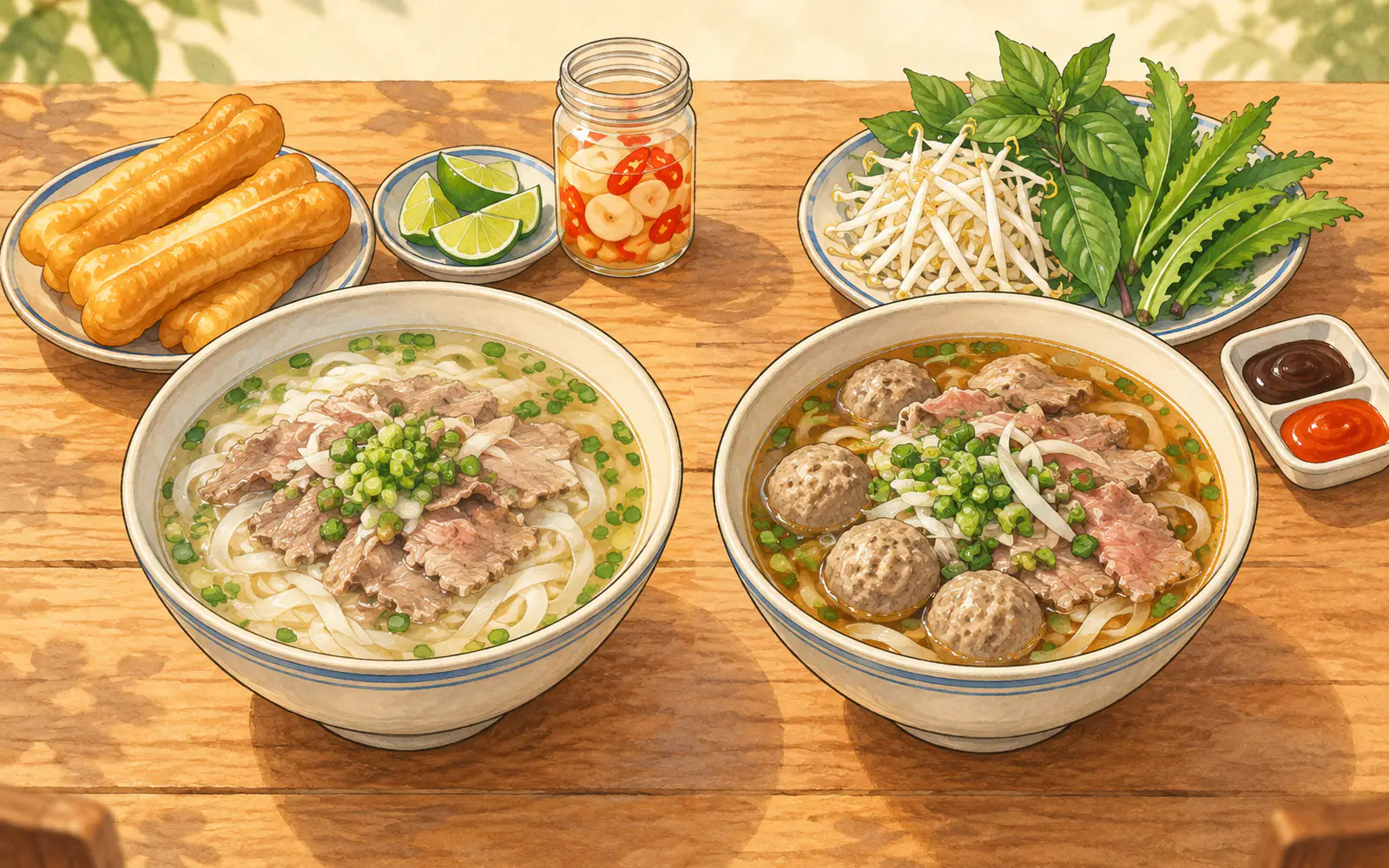
Hà Nội phở usually pairs a clear, salty broth with flat rice noodles, sliced meat, lime, garlic-chili vinegar, and fried dough sticks (bánh quẩy). Sài Gòn phở often uses a darker, sweeter broth made with rock sugar or daikon, served with bean sprouts, herbs, hoisin and chili sauces, and meatballs. Order một bát phở in Hà Nội and một tô phở in Sài Gòn.
Hà Nội phở usually centers on a clear, salty broth with flat rice noodles, sliced meat, and simple table additions like lime, garlic-chili vinegar, and fried dough sticks (bánh quẩy). Sài Gòn phở often features a darker, sweeter broth made with rock sugar or daikon, accompanied by fresh herbs, bean sprouts, hoisin sauce, and chili sauce.
| Feature | Hà Nội (Northern) | Sài Gòn (Southern) |
|---|---|---|
| Broth | Usually clear and salty, emphasizing purity of flavor | Often darker and sweeter, made with rock sugar or daikon |
| Noodles (bánh phở) | Flat rice noodles; sources differ on regional width and thickness | Flat rice noodles; descriptions of width and thickness vary |
| Herbs and sides | Rarely uses leafy herbs; commonly served with bánh quẩy | Typically served with bean sprouts, basil, and sawtooth coriander |
| Condiments | Often lime or garlic-chili vinegar; rarely hoisin sauce | Typically hoisin sauce and chili sauce |
| How you order | Ask for a bát with tái, chín, nạm, or gầu; meatballs are not typical in traditional Hà Nội phở | Ask for a tô with tái, chín, or nạm; beef meatballs are common |
Where phở comes from and how it moved south
According to a widely accepted account in National Geographic, phở originated at the end of the nineteenth century in Nam Định province, fifty miles from Hà Nội. When Nam Định workers traveled to Hà Nội to build the Long Biên Bridge, phở vendors followed, establishing the soup in the capital. Citing One Hundred Years of Vietnamese Pho (Trăm năm phở Việt), VnExpress International notes that Nam Định peddlers brought phở to Hà Nội in the early twentieth century, while chef Didier Corlou told Smithsonian Magazine that modern phở began around Hà Nội just over a century ago. In August 2024, Vietnam’s Ministry of Culture, Sports and Tourism inscribed both Phở of Hà Nội and Phở of Nam Định on the National Intangible Cultural Heritage list.
Its culinary roots and name remain debated. One theory attributed to Trịnh Khánh Linh says cooks in Nam Định boiled leftover beef bones and scraps as beef consumption rose in the late nineteenth century. Broader explanations are disputed among three hypotheses: a variation on French pot-au-feu, an heir to a Chinese beef noodle soup, or an evolution of a Vietnamese buffalo noodle dish. Competing theories in VnExpress International trace the word phở to French feu (“fire”) or Cantonese fàn (“cooked meal”), while a theory in The Guardian links it to coffre-feu, a portable stove.
The two styles grew apart after 1954, when many Northerners moved south.
How the bowl differs: broth, noodles, herbs, and condiments
Traditional restaurants in Hà Nội usually favor a saltier, minimalist combination of broth, meat, and noodles. Northern broth is usually clear and emphasizes purity, whereas southern broth in Sài Gòn often tends to be darker and sweeter, frequently sweetened with rock sugar or daikon.
Both styles use flat rice noodles (bánh phở), briefly blanched and strained. Sources differ on noodle size: National Geographic describes northern noodles as slightly wider than southern ones, while Tuổi Trẻ News states that northern phở normally uses flat noodles and southern phở uses slightly thicker noodles.
Sài Gòn phở typically comes with bean sprouts, basil, sawtooth coriander, hoisin sauce, and chili sauce. Hà Nội diners often add lime or garlic-chili vinegar and rarely use leafy herbs or hoisin sauce lest they blur the broth’s flavor, commonly dipping bánh quẩy (fried dough sticks) instead.
Beef cuts, meatballs, and chicken phở
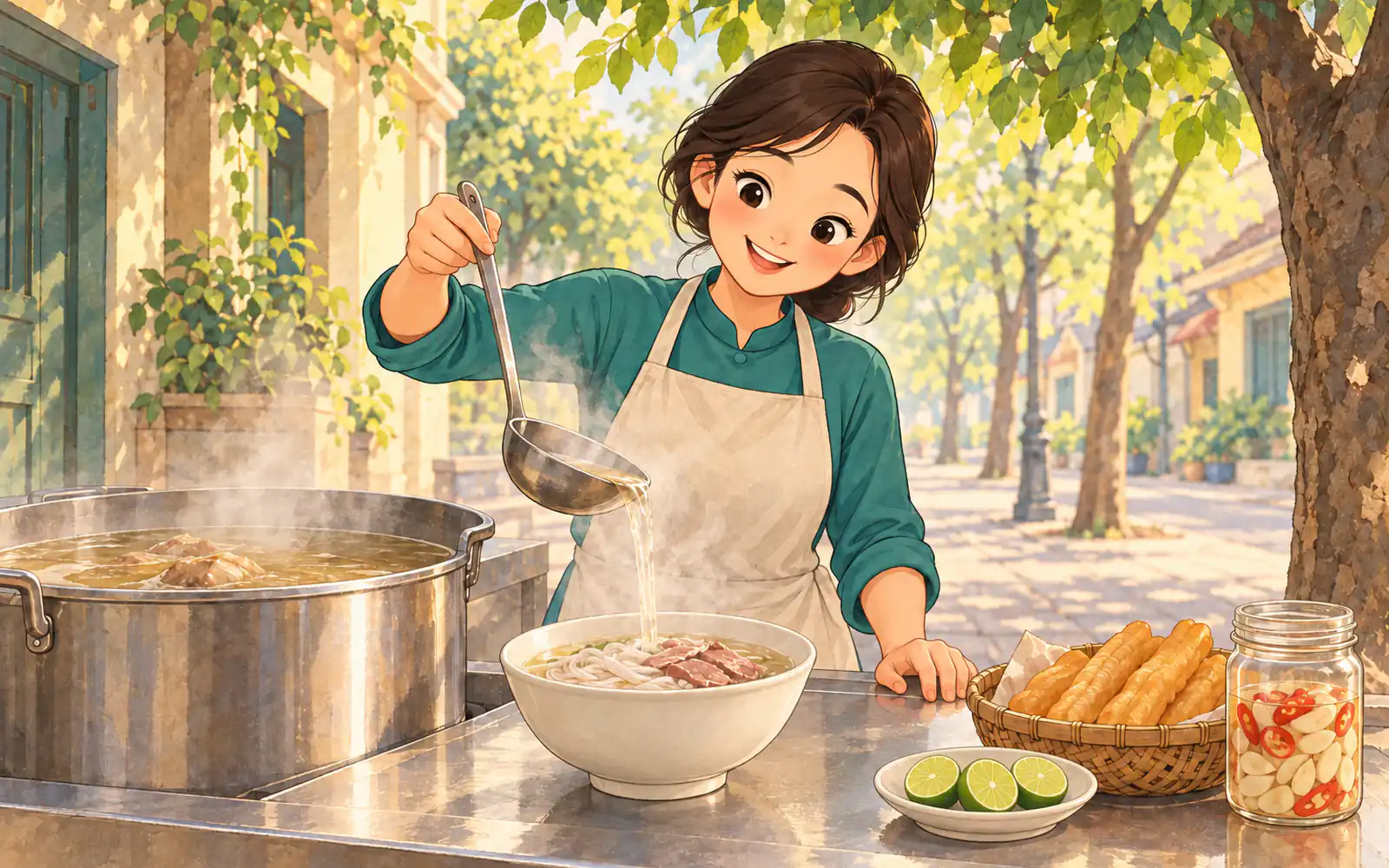
Both cities share standard terms for beef cuts in phở bò—see our Vietnamese food vocabulary guide for more dining words. Standard cuts include tái (rare steak), nạm (flank), and chín (lean beef). In traditional northern beef phở in Hà Nội, gầu (thinly sliced fatty brisket) and tái nạm are staples, while beef meatballs are common in Sài Gòn but traditionally absent from Hà Nội phở.
Phở gà (chicken phở), said to have originated in the 1930s when beef was scarce on certain market days, uses a clearer, milder broth made with ginger, shallots, and fish sauce, ordered with lean breast or mixed white and dark meat.
| Term | Meaning | Regional note |
|---|---|---|
| Tái / Chín / Nạm | Rare steak / lean beef / flank | Standard in both cities |
| Gầu | Thinly sliced fatty brisket | Traditional northern cut |
| Beef meatballs | Seasoned beef balls | Common in Sài Gòn; traditionally absent from Hà Nội phở |
| Phở gà / Bánh quẩy | Chicken phở / fried dough sticks | Milder chicken broth / dipped in northern phở |
How to order phở in Hà Nội and Sài Gòn: words and dialogue
While the beef cuts stay the same, everyday table words shift between Northern (N) and Southern (S) Vietnamese, as shown in our guide to Northern and Southern Vietnamese words. In Hà Nội, a small bowl is bát and a large bowl is bát ô tô (diners ask for một bát phở); in Sài Gòn, a small bowl is chén and a large bowl is tô (một tô phở). A spoon is thìa (N) versus muỗng (S), and iced tea (trà đá) uses the same cup words as when you order coffee in Hà Nội, Huế, and Sài Gòn: một cốc trà đá (N) versus một ly trà đá (S).
One tableware pair swaps meaning across regions, covered in Vietnamese words with different meanings in the North and South: in Hà Nội, đĩa is a plate and dĩa is a fork, whereas in Sài Gòn, dĩa is a plate and nĩa is a fork. Staff invite you in with vào (N) versus vô (S), you order with gọi (N) versus kêu (S), and MSG is mì chính (N) versus bột ngọt (S). You will also hear regional sound differences described in Phạm and McLeod’s dialect review: Hà Nội distinguishes six tones (keeping hỏi in phở separate from ngã), while Sài Gòn merges hỏi and ngã into five spoken tones and often pronounces initial v and d like English y.
| Meaning | Hà Nội (N) | Sài Gòn (S) | Example |
|---|---|---|---|
| Bowl in a phở order | bát (large: bát ô tô) | tô | một bát phở / một tô phở |
| Small bowl / Spoon | bát / thìa | chén / muỗng | cái thìa / cái muỗng |
| Plate / Fork | đĩa / dĩa | dĩa / nĩa | đĩa quẩy / dĩa rau |
| Glass / Enter / Order | cốc / vào / gọi | ly / vô / kêu | cốc trà đá / ly trà đá |
| MSG / Friendly particle | mì chính / nhé | bột ngọt / nha | một bát nhé / một tô nha |
Short ordering dialogue: Hà Nội vs Sài Gòn
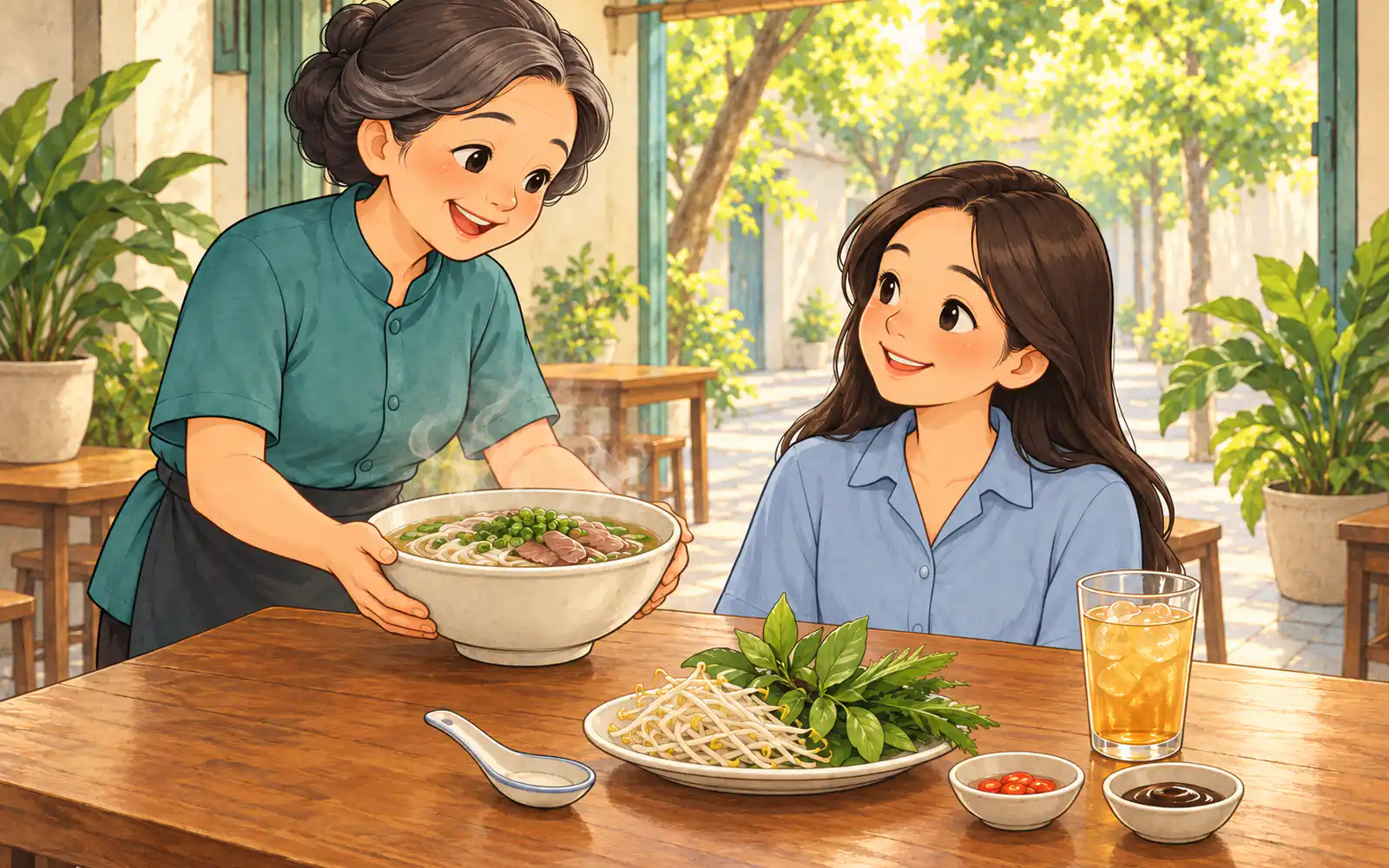
Here is how a younger diner orders from an older female server (cô) in each city:
In Hà Nội (N):
- Server (N): Mời cháu vào! Cháu ăn phở gì? (Please come in! What phở would you like?)
- Diner (N): Cô ơi, cho cháu một bát phở tái nạm và đĩa bánh quẩy nhé. (Auntie, please give me a bowl of rare and flank phở and a plate of fried dough sticks.)
- Server (N): Cháu uống gì không? (Would you like a drink?)
- Diner (N): Cho cháu một cốc trà đá và cái thìa ạ. (Please give me a glass of iced tea and a spoon.)
In Sài Gòn (S):
- Server (S): Mời con vô! Con ăn phở gì? (Please come in! What phở would you like?)
- Diner (S): Dạ, cô cho con một tô phở tái nạm nha. (Auntie, please give me a large bowl of rare and flank phở.)
- Server (S): Con uống gì không? (Would you like a drink?)
- Diner (S): Dạ, cho con một ly trà đá với cái muỗng nha cô. (Please give me a glass of iced tea and a spoon, Auntie.)
Choosing a city to learn for, not just a bowl to order? Read Hà Nội vs Sài Gòn: which city and dialect to learn for.
Key takeaways
- Origins: Phở is widely reported to have begun in late-nineteenth-century Nam Định before spreading to Hà Nội; its exact precursors and the etymology of phở remain debated.
- Broth and sides: Hà Nội phở usually pairs a clear, salty broth with lime, garlic-chili vinegar, and bánh quẩy; Sài Gòn phở often uses a darker, sweeter broth with bean sprouts, herbs, hoisin, and chili sauce.
- Ordering: Cuts like tái, chín, and nạm are shared, gầu is a traditional northern cut, while meatballs are common in southern phở. Order một bát phở in Hà Nội and một tô phở in Sài Gòn.
Start speaking the Vietnamese you hear at the table
Hearing một bát phở in Hà Nội versus một tô phở in Sài Gòn is a practical reason to learn the dialect that fits your goals. For the South, Everyday Southern Vietnamese, Level 00 is an interactive textbook course built on lessons from SVFF, Vietlingo’s partner school for Southern; following Ben in Sài Gòn, it covers the tones, Southern final consonants, greetings, address words, ordering drinks, numbers 0 to 10, and asking someone to repeat or speak slowly. For the capital, Everyday Northern Vietnamese, Level 01 follows Lucia in Hà Nội, covering workplace introductions with anh, chị, em, and bác, jobs, time, and café orders (in Beta, still being tested, with audio still being added).
To practice listening from slow to natural speed, try Slow Vietnamese 01 - Southern or Slow Vietnamese 01 - Northern. For live speaking practice, practice with tutors or book a trial lesson.
Frequently asked questions
Where did phở originate in Vietnam?
According to a widely accepted account, phở originated at the end of the nineteenth century in Nam Định province before vendors followed workers to Hà Nội during the construction of the Long Biên Bridge. Both Phở of Hà Nội and Phở of Nam Định joined Vietnam’s National Intangible Cultural Heritage list in August 2024.
Why is Sài Gòn phở broth sweeter than Hà Nội phở broth?
Cooks in Sài Gòn frequently sweeten the broth with rock sugar or daikon radish, whereas traditional Hà Nội restaurants usually keep it clear and saltier.
Do diners in Hà Nội and Sài Gòn add the same herbs and sauces?
Usually not. Sài Gòn phở typically comes with bean sprouts, basil, sawtooth coriander, hoisin sauce, and chili sauce, while Hà Nội diners often add lime or garlic-chili vinegar and rarely use leafy herbs or hoisin sauce.
Are beef meatballs served in both Hà Nội and Sài Gòn phở?
Beef meatballs are a common topping in Sài Gòn, but are traditionally absent in Hà Nội. Both cities serve cuts like tái (rare steak), nạm (flank), and chín (lean beef), while gầu (fatty brisket) is a classic northern cut.
How do you order a bowl of phở in Hà Nội versus Sài Gòn?
In Hà Nội, ask for một bát phở, use thìa (spoon) and cốc (glass), and end a friendly request with nhé; in Sài Gòn, ask for một tô phở, use muỗng and ly, and end with nha. For politeness, dạ is the everyday polite opener in the South and is heard in the North too, where vâng and a closing ạ are common.




Comments (0)
A new word, a question, or a different perspective? Share it with fellow learners.
Be the first to comment.