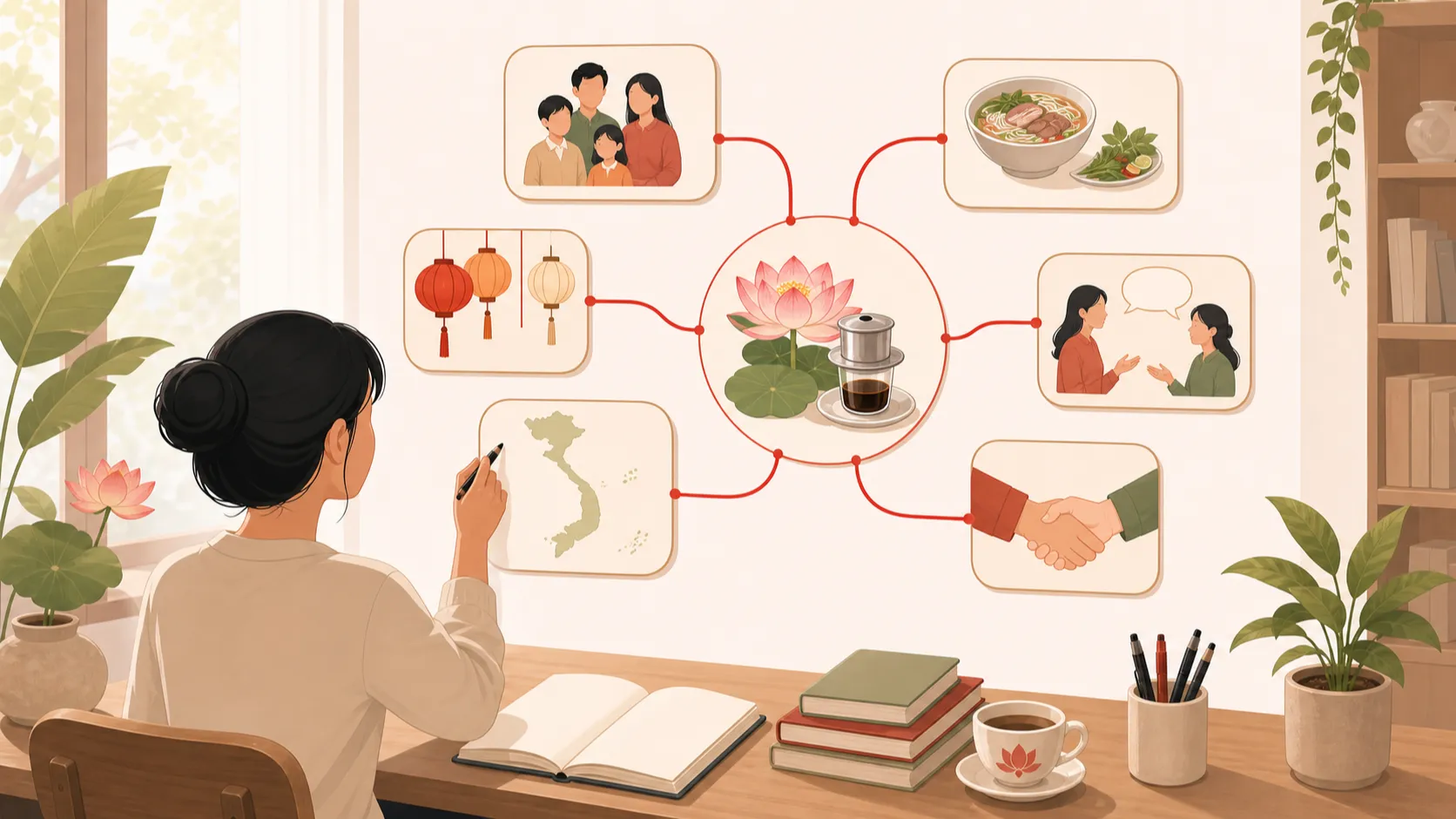
Key takeaways
- A big culture topic feels unmemorable because of its shape, not your memory: a wall of prose hides the structure your brain craves.
- Working memory juggles only a few items at once, so by the fifth idea in a paragraph the first has slipped, and prose hides how ideas relate.
- A graphic organizer (mind-map, tree, branch chart) chunks information into visual groups and draws the connections as explicit lines.
- This works through dual coding — storing an idea as both words and a spatial picture gives the brain two paths back to it.
- Build maps step by step, pair them with vocabulary lists, and follow habits that keep them from getting messy.
You sit down to learn about Vietnamese literature, or the value system behind centuries of resistance and resilience, and within ten minutes your brain has quietly surrendered. There are too many names, too many eras, too many abstract nouns ending in -ism. You reread the same paragraph three times. The problem is not your memory and it is not your intelligence — it is the shape of the information. A wall of prose hides structure, and your brain craves structure. The fastest fix is also one of the oldest study tricks in the world: stop reading in lines and start drawing in branches. A mind-map turns a flat, intimidating topic into a tree you can see, walk through, and rebuild from memory.
Why does a big topic feel impossible to remember?
When you read a dense article about, say, the functions of Vietnamese literature, the ideas arrive one after another in a single file. Your working memory can only juggle a handful of items at once, so by the time you reach the fifth idea, the first has already slipped away. Prose also hides the relationships between ideas. Is “nation-building literature” the opposite of “nation-defending literature,” a subset of it, or something running in parallel? In a paragraph you have to infer that. In a diagram you can simply look.
A graphic organizer — mind-map, tree diagram, branch chart, whatever you want to call it — solves both problems at once. It chunks information into small visual groups, and it makes the connections explicit by drawing them as lines. Cognitive scientists call this dual coding: when you store an idea as both words and a spatial picture, you give your brain two separate paths back to it. Forget the word and the picture might still pull it up. For language learners this is doubly powerful, because you are juggling new concepts and new vocabulary in the same breath.
There is also a deceptively simple Vietnamese word at the heart of this technique:
Sáng nay mình vỡ ra cách học mới. — This morning I figured out a new way to study. (Here vỡ ra means “to suddenly understand,” the click of a concept falling into place — exactly what a good diagram produces.)
What exactly is a graphic organizer for culture topics?
Picture a tree lying on its side, or a sun with rays, or an actual mind-map with a bubble in the center. In the middle you write your theme — the one big idea. From that center you draw a few thick branches, each one a category or sub-type of the theme. From each branch you draw thinner twigs, and at the very ends you hang leaves: concrete examples, names, dates, single sentences. The structure mirrors how knowledge is actually organized: general at the trunk, specific at the leaves.
The magic is in the hierarchy. You are not just listing facts; you are deciding what belongs under what. That act of sorting — “is this a type, a function, an example, or a cause?” — forces you to understand the material instead of just recognizing it. Recognition feels like learning but fades fast. Sorting builds the kind of memory that survives a test, a conversation, or a year of not thinking about the topic.
How do you build your own map, step by step?
You need nothing fancy. A blank page and a pen beat any app, because the slight friction of writing by hand is part of what makes it stick. If you prefer digital, a free tool with draggable bubbles works fine. Here is the sequence I give every self-study learner.
Step 1 — Choose one theme and write it in the center
Keep it focused. “Vietnamese culture” is far too big for one map; “The role of the family in Vietnamese culture” or “The functions of Vietnamese literature” is just right. Write it in the middle of the page and draw a circle around it. One map, one theme. If a topic feels too large, that is your signal to split it into two or three maps.
Step 2 — Branch the theme into types or functions
Ask one of two questions: What kinds of this are there? or What does this do? The first gives you a map of types; the second gives you a map of functions. Aim for two to five main branches — more than five and the map gets noisy, fewer than two and you probably do not need a map at all. Label each branch with a short noun phrase, not a full sentence.
Step 3 — Hang leaves: fill in real examples
Now the branches get specific. Under each one, add the examples that prove it: a work of literature, a historical figure, a proverb, a custom, a single illustrative sentence. This is where abstract ideas become real. An empty branch labeled “humanism” means nothing; the same branch with three concrete examples hanging off it suddenly makes sense and sticks.
Step 4 — Add the glue words on the lines
This is the step most people skip, and it is the most valuable. On each connecting line, write one word that explains the relationship: “causes,” “example of,” “contrasts with,” “leads to.” These glue words turn a static list into a network of meaning. They are also where the deep comprehension happens, because you cannot label a line you do not understand.
Step 5 — Review by rebuilding from memory
Here is the part that separates a pretty drawing from a powerful study tool. Put the finished map away. On a fresh sheet, try to redraw the whole thing from memory — center, branches, leaves, glue words. Then compare. The gaps you find are precisely the things you have not learned yet, and now you know exactly where to focus. Redrawing a map from memory is a form of active recall, the single most effective study technique we know of. Do it once today, once tomorrow, and once next week, and the topic is yours for good.
Worked example 1: the two functions of Vietnamese literature
Let us build a real one. Theme in the center: Functions of Vietnamese literature. Vietnamese literary tradition has long carried two great missions, so we draw two thick branches.
- Branch A — Nation-building. Literature that builds the country from within: that shapes character, teaches morality, preserves the language, and binds the community together. Leaves to hang here: folk songs and lullabies that pass values from mother to child; proverbs that compress ethics into a single line; love poetry that celebrates ordinary life and the land.
- Branch B — Nation-defending. Literature that defends the country against threats: the proclamation that rallies soldiers, the war poem that steels resolve, the patriotic essay that names an enemy and an ideal. Leaves to hang here: battlefield poetry, calls to arms, verses written from prison.
On the line between the two branches, write the glue word “complement.” That single word captures the whole insight: these are not rivals but two halves of one purpose — you build what you defend, and you defend what you build. A learner who can explain that line understands more than a learner who memorized a paragraph. Anchor the idea with a sentence you compose yourself:
Văn học vừa xây dựng đất nước, vừa bảo vệ đất nước. — Literature both builds the country and defends the country.
(If your editor mangles the diacritics there, that is your reminder to type Vietnamese with a proper input method — the tones are not decoration, they change the meaning.)
Worked example 2: the value system — patriotism, heroism, humanism
Here is a more abstract theme that terrifies learners: the core values that run through Vietnamese culture and art. Put Vietnamese values in the center and draw three branches.
- Patriotism (lòng yêu nước). Love of country and homeland. Leaves: attachment to the village and the ancestral land; pride in the language; the recurring image of rice fields and rivers standing in for the nation itself.
- Heroism (chủ nghĩa anh hùng). Courage and sacrifice for the common good. Leaves: the ordinary person who becomes extraordinary in crisis; the celebration of collective effort over individual glory; resilience in the face of overwhelming odds.
- Humanism (chủ nghĩa nhân đạo). Compassion for fellow human beings. Leaves: sympathy for the poor and the suffering; the belief that kindness outranks power; forgiveness even toward a defeated enemy.
Now draw the glue lines. From patriotism to heroism, write “motivates” — love of country drives the willingness to sacrifice. From heroism to humanism, write “balanced by” — courage in war is restrained by compassion for people. Suddenly three intimidating -isms are no longer a vocabulary list to cram; they are a small story with a clear logic. Pin it down with a sentence:
Yêu nước, dũng cảm và giàu lòng nhân ái là ba giá trị lớn. — Patriotism, courage, and a deep sense of compassion are three great values.
Worked example 3: a quick map of address terms
Mind-maps are not only for big cultural themes — they tame thorny grammar too. Vietnamese personal pronouns are really a system of relationship words, and learners drown in them precisely because they are taught as a flat list. Branch them instead. Center: How to say “you”. Branches by relationship:
- Older than you. Leaves: anh (older brother / older man), chị (older sister / older woman), cô, chú, bác.
- Younger than you. Leaf: em.
- Much older, grandparent age. Leaves: ông (grandfather / sir), bà (grandmother / madam).
Glue word on every line: “chosen by age & respect.” That one note encodes the rule that English speakers find so alien — that you pick the word based on the other person’s age and status relative to you. A short, honest example seals it:
Em chào anh, anh khỏe không? — Hello (to an older man), how are you? (The speaker calls themselves em and the listener anh — the pronouns themselves carry the relationship.)
How do you pair a map with vocabulary lists?
A diagram shows you structure, but a language learner still needs the words. The trick is to let the two feed each other instead of keeping them apart. Here is how to braid them together.
- Tag every leaf with its key word in Vietnamese. When you write “nation-defending” on a branch, write bảo vệ đất nước right beside it. Now the structure and the vocabulary live in the same spot, and recalling one drags the other along.
- Keep a running word list below the map, in branch order. Do not scatter new words alphabetically. List them in the same order they appear on your map — trunk first, then branch by branch. The list becomes a linear index of the picture, and reviewing one reinforces the other.
- Add the tone and a tiny example, not just a translation. A word list that says “anh hùng = hero” is weak. “anh hùng (hero) — một vị anh hùng dân tộc, a national hero” is far stronger, because it shows the word breathing in a phrase.
- Color-code by branch. Use one color per branch on both the map and the word list. Color is a free extra memory hook, and it makes the link between a word and its place on the tree instant.
- Turn leaves into flashcards. Each leaf plus its Vietnamese word is a ready-made card: picture-side the concept, flip-side the word and example. Because the cards were born from a structured map, you always know how they fit the bigger picture — no more memorizing floating words.
How do you know the map is actually working?
The honest test is not whether your diagram looks neat. It is whether you can do three things without looking: redraw the structure, explain every glue word out loud, and produce one correct Vietnamese sentence for each branch. If you can, the topic has moved from the page into your head. If you stumble, you have found tomorrow’s study target — which is exactly the information a passive reread never gives you.
This is also where a study partner earns its keep, and most self-study learners do not have one on call at 11 p.m. That is precisely what the VietLingo AI tutor is for. Once you have built a map, start a trial lesson and ask the tutor to quiz you on it: paste in your branches and leaves and request matching questions, multiple-choice items, and fill-in-the-blank sentences about the exact culture topic you mapped. Because the questions come from your structure, the quiz tests your real understanding instead of someone else’s syllabus — and the tutor will gently flag a wrong tone or a misused address term on the spot. It is the rebuild-from-memory step, automated and on demand.
You can push it further. Ask the tutor to interview you as if you were explaining the topic to a Vietnamese friend, branch by branch, in simple Vietnamese. Teaching a concept is the strongest test of whether you own it, and a patient AI partner lets you teach the same map a dozen times until it is effortless. When you are ready to connect the technique to real reading, our companion guide on active recall for Vietnamese vocabulary shows how to fold these maps into a weekly review rhythm.
A few habits that keep maps from getting messy
Mind-maps fail in predictable ways, so steer around the potholes. Do not cram a whole textbook chapter into one map — if you need more than five main branches, split it. Do not write full sentences on branches; use short noun phrases and save the sentences for your bilingual examples below. Do not skip the glue words — an unlabeled line is a missed chance to understand a relationship. And do not treat the first draft as final; the best maps get redrawn two or three times as your understanding sharpens, and each redraw is itself a review session in disguise.
Finally, be patient with the abstract topics. The first time you map “humanism in Vietnamese culture” it may feel forced and thin. That is normal. The structure is doing its job by exposing how much you do not yet know. Fill the gaps, redraw, and watch the same scary topic shrink into something you can sketch on a napkin and explain to a friend.
Big topics are not hard because they are big. They are hard because they arrive shapeless. Give them a shape — a center, a few honest branches, leaves you can point to, and glue words you can defend — and Vietnamese culture stops being a wall of facts and becomes a map you can walk. Draw one this week, rebuild it from memory, and let the AI tutor quiz you on it. You will be surprised how fast the fog lifts. Cố lên! — Keep going!




Comments (0)
A new word, a question, or a different perspective? Share it with fellow learners.
Be the first to comment.