Key takeaway
Before meeting your Vietnamese partner’s family, ask your partner how to address each person and which dialect the family speaks. Practise a greeting, a thank-you and a way to ask for help. Follow the household’s lead at meals; a few considerate words matter more than an impressive speech.
Ask your partner what to call each person, practise a short greeting and follow the family's lead when you arrive. You do not need a polished speech. A small amount of preparation gives you something to say while you settle into an unfamiliar room.
What should you ask your partner before the visit?
Start with practical questions: who will be there, what they prefer to be called and which dialect they speak. Ask whether anyone understands English and whether your partner can help when you miss a question. Those details are more useful than memorising a general rule about every Vietnamese family.
Ask about the shape of the visit too. A short introduction, a meal and an overnight stay need different preparation. Check what time to arrive, whether to bring anything and how much time the family expects you to spend together.
Family habits vary, so treat cultural advice as preparation for a conversation. Your partner knows the particular people you are meeting. If something feels unclear, ask them privately before assuming that a broad rule applies.
How should you greet and address the family?
Vietnamese forms of address show how people relate to each other. Age and family position matter, and your partner can help you choose suitable terms. Do not assume that the words your partner uses for their parents are automatically the ones you should use on a first visit.
The guide to kinship terms for addressing people explains the broader pattern. The article on family hierarchy and kinship terms gives more detail if the family has many relatives to meet.
Ask your partner to rehearse one greeting with you, including your words for yourself and the listener. Practise saying it at a comfortable pace. You can greet someone briefly and then let the conversation develop rather than continuing a memorised introduction.
What matters at the table and when bringing a gift?
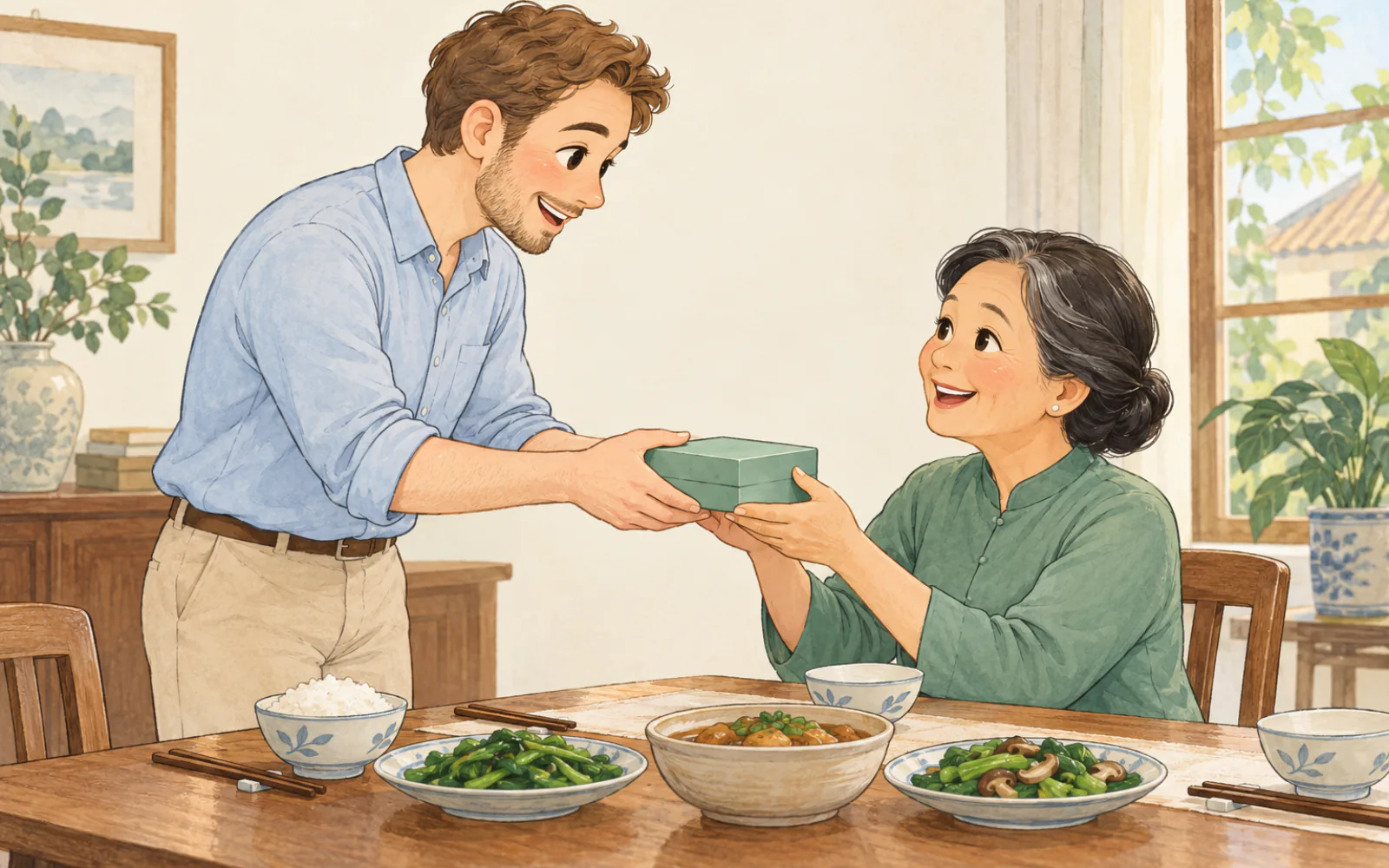
If you want to bring a gift, ask what the household would welcome. A familiar food may be suitable for one family and unsuitable for another because of preferences or dietary needs. Presenting it with both hands is a considerate option; follow your partner's guidance.
At the table, let the oldest people start. In many families the younger people first invite the elders to eat, a custom called mời cơm:
In the North: Cháu mời hai bác ăn cơm ạ. — Please, both of you, start eating.
In the South: Dạ, con mời cô chú ăn cơm. — Please, both of you, start eating.
Never leave your chopsticks standing upright in a bowl of rice: it looks like incense at an altar. Lay them across your bowl or on the rest instead. Beyond that, copy the household’s routine and ask your partner when you are unsure.
If you cannot eat something, explain it clearly and politely. Tell your partner about allergies or dietary needs before the visit so they can help communicate them accurately. A phrase book is not enough for a detail that someone needs to understand precisely.
What can you talk about without feeling put on the spot?
Begin with something in front of you: the food, the journey or a shared activity. Ask one small question and listen to the answer rather than rushing to the next prepared line. Your partner can help you understand enough to respond.
Ask which topics may feel personal in this household. Family plans, relationships, work and politics can carry different expectations for different people. You can give a brief answer, ask your partner for help or move gently towards a familiar topic.
When you do not understand, say so early. Nodding through a long exchange can leave both people confused. A warm expression and a clear request for help give the conversation a chance to continue.
Which ten phrases are useful to practise?
These are ten useful conversation jobs, with regional alternatives where the wording changes. The greeting examples assume your partner has confirmed those forms of address for these hosts. The other short lines work across regions, although pronunciation will differ.
1. Greet the hosts
In the North: Cháu chào hai bác ạ. — Hello to you both.
In the South: Dạ, con chào cô chú. — Hello to you both.
These are possible first-visit choices, not fixed labels for every household. Confirm them before using them.
2. Say you are pleased to meet everyone
Rất vui được gặp cả nhà. — It is lovely to meet everyone.
3. Thank the hosts for the invitation
In the North: Cháu cảm ơn hai bác đã mời cháu đến chơi ạ. — Thank you both for inviting me over.
In the South: Dạ, con cảm ơn cô chú đã mời con tới chơi. — Thank you both for inviting me over.
4. Explain your starting point
In the North: Tiếng Việt của cháu còn kém lắm ạ. — My Vietnamese is still quite weak.
In the South: Dạ, tiếng Việt của con còn dở lắm. — My Vietnamese is still quite weak.
5. Ask for a slower pace
In the North: Bác nói chậm một chút được không ạ? — Could you speak a little more slowly?
In the South: Cô nói chậm chút được không cô? — Could you speak a little more slowly?
6. Appreciate the food
Món này ngon quá. — This dish is delicious.
7. Ask about a dish
Món này tên là gì? — What is this dish called?
8. Say you like cooking
In the North: Cháu thích nấu ăn ạ. — I like cooking.
In the South: Con thích nấu ăn. — I like cooking.
9. Ask about a photograph
In the North: Ảnh này chụp ở đâu? — Where was this photo taken?
In the South: Hình này chụp ở đâu vậy cô? — Where was this photo taken?
10. Say goodbye
In the North: Cháu chào hai bác, cháu về ạ. — Goodbye to you both; I am heading home.
In the South: Dạ, con chào cô chú, con về. — Goodbye to you both; I am heading home.
Practise with your partner so the phrases fit the people you will meet. The Vietnamese greetings guide adds context for greetings beyond this visit.
Questions before meeting the family
What do I call my partner's parents?
Ask your partner what their parents would find comfortable on a first visit. The answer depends on the family's habits and your relationship. Rehearse a full greeting, including your word for yourself, rather than learning a single title and guessing how to use it.
Should I learn Northern or Southern Vietnamese?
Start with the dialect your partner's family speaks. If they speak Central Vietnamese, ask about their particular local wording too. You can use shared everyday sentences while learning their pronunciation, and your partner can check the family terms that matter for the first meeting.
Is it rude to speak English?
Using English when someone understands it can help you communicate clearly. Ask your partner how to include relatives who do not speak it, and use the Vietnamese greetings you have prepared. You can move between languages with help rather than pretending to understand everything.
Build on your first greetings
Explore the beginner course in your partner's dialect, choosing Southern or Northern Level 01 to match the family you want to speak with.




Comments (0)
A new word, a question, or a different perspective? Share it with fellow learners.
Be the first to comment.