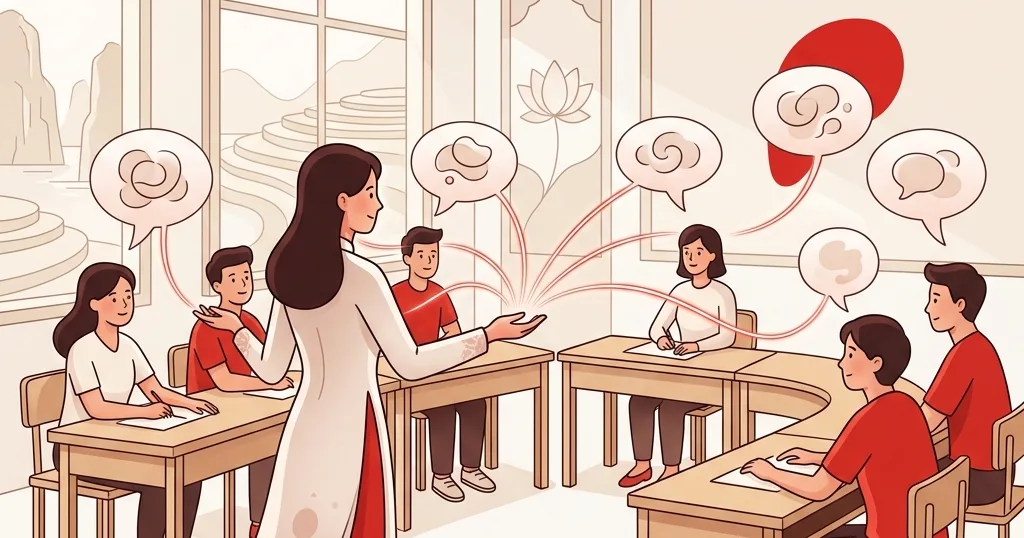
Key takeaways
- Language is learned by producing it, so when the same few eager students answer everything, they hoard the practice and everyone else stalls.
- Use whole-class questions to keep everyone mentally active and direct questions to pull in the quiet ones — each has its moment.
- Cold-calling works if you make it kind: warn the class, allow think time, and let students pass gracefully.
- About three seconds of silent wait time after a question is one of your best teaching tools, giving slower processors a real chance.
- Rotation strategies and a simple Tuesday routine keep quiet learners getting real speaking reps instead of watching.
Picture a Tuesday-evening Vietnamese class. You ask, “Cái này tiếng Việt là gì?” — “What is this in Vietnamese?” Within half a second the same three hands shoot up, the same three voices answer, and the other nine students exhale with relief because they are, once again, off the hook. The lesson feels lively. It even feels successful. But for most of the room, nothing happened. Three people practiced; nine people watched three people practice. If this is the rhythm of your class, the problem is not your material and it is not your students. It is the delivery of your questions — who gets them, when, and how.
Questioning is the single most frequent thing a language teacher does. We ask hundreds of questions a session without thinking about it. But the content of the question is only half the craft. The other half — the half that quietly decides whether everyone acquires Vietnamese or just a confident handful does — is distribution. This article is about that second half: how to spread questions around so that every learner, including the quiet ones and the nervous ones, stays cognitively switched on and gets real reps speaking.
Why does uneven questioning quietly sabotage acquisition?
Language is not learned by hearing it. It is learned by producing it, getting it slightly wrong, noticing the gap, and trying again. Every time a student forms a Vietnamese sentence out loud — even a clumsy one — they are doing the cognitive work that actually builds the language in their head. When a few eager students answer everything, they hoard that work. They get fluent fast. Everyone else stalls.
There is a subtler cost too. The moment a learner realizes they probably will not be called on, their brain downshifts. They stop pre-forming an answer. They stop testing whether they remember the word for “market” or which tone sits on quả. They become spectators, and spectators do not acquire. Uneven distribution does not just under-practice the quiet students — it actively teaches them that disengaging is safe and even rational.
Balanced participation flips this. When learners know a question could land on anyone at any time, everyone keeps a candidate answer warm. That state of low-grade readiness — mentally rehearsing just in case — is itself powerful practice, even for the students you never call on in a given minute. Fair distribution is not about politeness or classroom fairness for its own sake. It is a direct lever on how much language each brain in the room actually generates.
Whole-class questions versus direct questions: when to use each
There are two basic ways to put a question into the room, and most teachers lean far too hard on one of them.
A whole-class question is thrown to everyone: “Ai biết ‘ngày mai’ nghĩa là gì?” — “Who knows what ‘ngày mai’ means?” It is fast, it is low-pressure, and it is genuinely useful for warm-ups, choral repetition, and gauging the general mood of the room. But left alone it is a trap, because it is always answered by whoever is quickest and boldest. Whole-class questions reward speed and confidence, which are exactly the traits your strongest students already have. The shy beginner who needed four seconds to retrieve “tomorrow” never gets to finish the retrieval, because someone blurted it at second two.
A direct question is aimed at one named person: “Minh, hôm nay bạn ăn sáng chưa?” — “Minh, have you eaten breakfast today?” This guarantees that one specific learner produces language. It lets you target the right difficulty to the right person. And, crucially, it is the only reliable tool for reaching students who will never volunteer.
The skilled move is to blend the two. Use whole-class questions to generate energy and a wide pool of thinking, then convert that energy into individual production with a well-placed direct question. The bridge between them — the technique that does the converting — is the cold call.
The cold-call problem — and how to make it kind
“Cold-calling” means naming a student who did not raise their hand. Teachers often avoid it because it feels like an ambush, the kind of move that made us sweat in school. And done badly, it is exactly that: a public test designed to expose who was not paying attention. Used as a gotcha, it spikes anxiety, and anxiety is poison for language production — a frightened brain retrieves words badly.
But cold-calling does not have to mean “catch them out.” Reframed, it is simply the teacher taking responsibility for distribution instead of outsourcing it to whoever shouts first. The goal is a culture where being called on feels normal, expected, and safe — not a spotlight, just your turn. Here is how to get there.
Build a no-fault norm out loud. Early in a course, say it plainly: in this class everyone gets asked, “I don’t know yet” is a perfectly good answer, and we help each other. When a student stumbles, model warmth, not disappointment. The first time someone freezes and you respond with an easy “Không sao, từ từ.” — “No problem, take your time.” — you have just told the whole room that this is a safe place to be unfinished.
Calibrate the question to the person. Cold-calling is cruel only when the question is beyond the student. It is supportive when you hand each learner a question they have a real chance of answering. Ask your most hesitant beginner a yes/no or either/or question — “Lan, bạn thích cà phê hay trà?” — “Lan, do you like coffee or tea?” — while you save the open-ended “tại sao” (“why”) questions for learners ready to stretch. Same routine, different rung on the ladder.
Offer a graceful exit that still demands thinking. Let a stuck student “phone a friend” or ask for a hint, then come back to them to repeat the correct answer in a full sentence. The exit relieves the panic; the return ensures they still produce the language. Nobody escapes the rep; they just get a kinder path to it.
Why three seconds of silence is your best teaching tool
The most underused technique in language teaching costs nothing and requires no preparation: wait-time. After you ask a question, most teachers wait less than one second before they rephrase, answer it themselves, or call on the first hand. One second is not enough time for anyone to retrieve a word in a foreign language, let alone wrap a tone correctly around it.
Vietnamese makes this especially acute. A learner is not only recalling vocabulary and word order — they are also deciding which of six tones to land on, and a wrong tone makes a wrong word. Ma, má, mả, mã, mạ, mà are six different words. That extra computation takes time. If you cut the silence short, you are systematically excluding everyone who needed those few seconds — which is to say, most of your class.
Train yourself to wait three to five seconds after asking, before anyone answers. Count it silently. The silence will feel unbearable to you and completely normal to the students, who are busy using it. Then add a second, equally important pause: after a student answers, wait again before you react. That second pause invites them to add more, lets others process the answer, and signals that you value a thought-out response over a fast one.
A small structural trick protects wait-time: ask the question, pause, then name the person. If you say the name first — “Lan, cái này là gì?” — everyone except Lan instantly relaxes and stops thinking. If you ask first, hold the silence, and only then say “Lan,” the entire class spends those seconds forming an answer, because anyone could be next. One reordered sentence keeps twelve brains working instead of one.
Rotation strategies that keep the quiet ones active
Good intentions are not a system. If you rely on noticing who has not spoken, you will forget, drift back to the confident few, and the quiet students will once again slip through. You need mechanical strategies that distribute attention whether or not you are paying attention.
Name-after-question, on purpose
We met this above as a wait-time trick, but it is also your primary distribution tool. Because the name comes last, you choose who answers, freed from the tyranny of raised hands. Keep a light mental (or literal) tally of who has spoken and steer toward the silent. The class cannot predict your choice, so the class cannot tune out.
Randomization
Take the choice out of your hands entirely. Write each name on a craft stick in a cup, or use a random-name app, and let the draw decide. This does two things at once. It guarantees genuinely even coverage over time, and — because it is visibly impartial — it removes any suspicion that you are picking on someone. Nobody can resent the cup. A nice refinement: after a student answers, drop their stick back in rather than setting it aside, so no one can think “I’ve had my turn, I’m safe now” and switch off for the rest of the hour.
Think-pair-share
This is the most powerful equalizer of the three, because it makes everyone produce language before anyone is exposed. It runs in three beats. First, think: pose the question and give silent seconds for each learner to form an answer alone — “Hãy nghĩ xem cuối tuần bạn thường làm gì.” — “Think about what you usually do on the weekend.” Second, pair: students tell a partner, so every single person speaks Vietnamese out loud in a low-stakes, two-person setting. Third, share: now you cold-call, and it is gentle, because the student is not inventing on the spot — they are reporting what they already rehearsed, or even relaying their partner’s answer.
Think-pair-share solves the cold-call anxiety problem at its root. By the time you call on the shyest learner, they have already said the words once to one trusted person. The public version is a second attempt, not a first. For beginners especially, that rehearsal is the difference between a confident sentence and a panicked blank.
A step-by-step routine you can run on Tuesday
Here is a concrete sequence that braids these techniques into a single, repeatable lesson segment. Suppose today’s target is talking about daily routines — thức dậy (wake up), đi làm (go to work), ăn tối (eat dinner). Picture a class of about twelve.
Step 1 — Open wide, low stakes (2 minutes). Start with whole-class questions to wake everyone up and surface the vocabulary without pressure. “Buổi sáng, chúng ta làm gì đầu tiên?” — “In the morning, what do we do first?” Let answers come freely; the loud students are an asset here. You are filling the room with the day’s language and reading the general temperature.
Step 2 — Ask, pause, name (4 minutes). Now switch to direct questions and start distributing. Ask the question, hold a real three-second silence, then name someone — deliberately choosing students who stayed quiet in Step 1. Match difficulty to the person: an either/or for the hesitant, an open prompt for the ready. “Mấy giờ bạn thức dậy?” — “What time do you wake up?” If a learner freezes, offer the hint, take the partial answer, and circle back so they say a full sentence. Keep a quiet tally of who has spoken.
Step 3 — Think-pair-share the harder prompt (6 minutes). Pose a question that needs more than one word: “Hãy kể về một ngày bình thường của bạn.” — “Describe an ordinary day of yours.” Give thirty seconds of silent thinking, then two minutes of pair talk while you walk the room and listen. Then cold-call several pairs to share. Because everyone has rehearsed, you can safely land on anyone — this is where your quietest students produce their longest stretch of Vietnamese all evening.
Step 4 — Randomize the cool-down (3 minutes). Finish with the name cup for quick recall questions, returning each stick after it is drawn. “‘Đi ngủ’ tiếng Anh là gì?” — “What is ‘đi ngủ’ in English?” The randomness keeps everyone alert right to the end, and the visible fairness leaves the room feeling that today, genuinely, everyone got a turn.
Run this same four-step shape week after week and the techniques stop being effortful. They become the grain of your class, and the quiet students stop being quiet because silence is no longer an option the room offers them.
Practice between classes is where the reps add up
Balanced questioning solves the in-class half of the problem, but arithmetic is against you no matter how well you distribute. In a sixty-minute class with twelve learners, even perfectly even sharing gives each student only a few minutes of actual talking. That is not enough volume to build fluency on its own. The classroom is where you diagnose, correct, and stretch — but the raw repetitions, the hundreds of times a learner needs to say a sentence until it is automatic, have to come from somewhere else.
This is exactly where self-paced practice earns its place. Encourage your students to use VietLingo’s guided speaking practice between sessions, where each learner answers and speaks on their own, at their own pace, with no faster classmate to defer to. A nervous beginner who only managed three sentences in class can run through fifty at home, privately, until the tones feel natural. They arrive at the next lesson warmer, braver, and far more willing to be called on — which makes your in-class distribution work even better. The two halves reinforce each other: individual reps build the confidence; balanced questioning puts that confidence to work in real, spontaneous conversation.
If you want to go deeper on the kinds of questions worth asking once everyone is participating, pair this with our guide to asking better questions in the Vietnamese classroom. Delivery and design are two sides of the same skill.
The class that talks is the class that learns
The difference between a room where three students learn Vietnamese and a room where all twelve do is not talent, not curriculum, and not the teacher’s charisma. It is the simple, stubborn discipline of spreading the questions around — asking before you name, waiting longer than feels comfortable, calling on the quiet ones with a question they can win, and building routines that make participation the default instead of a volunteer activity. None of it is flashy. All of it works. Start with one technique this week — the three-second pause, perhaps — and watch how many more voices you hear. Every voice in the room is a brain building the language. Your job is simply to make sure they all get the chance.



Comments (0)
A new word, a question, or a different perspective? Share it with fellow learners.
Be the first to comment.