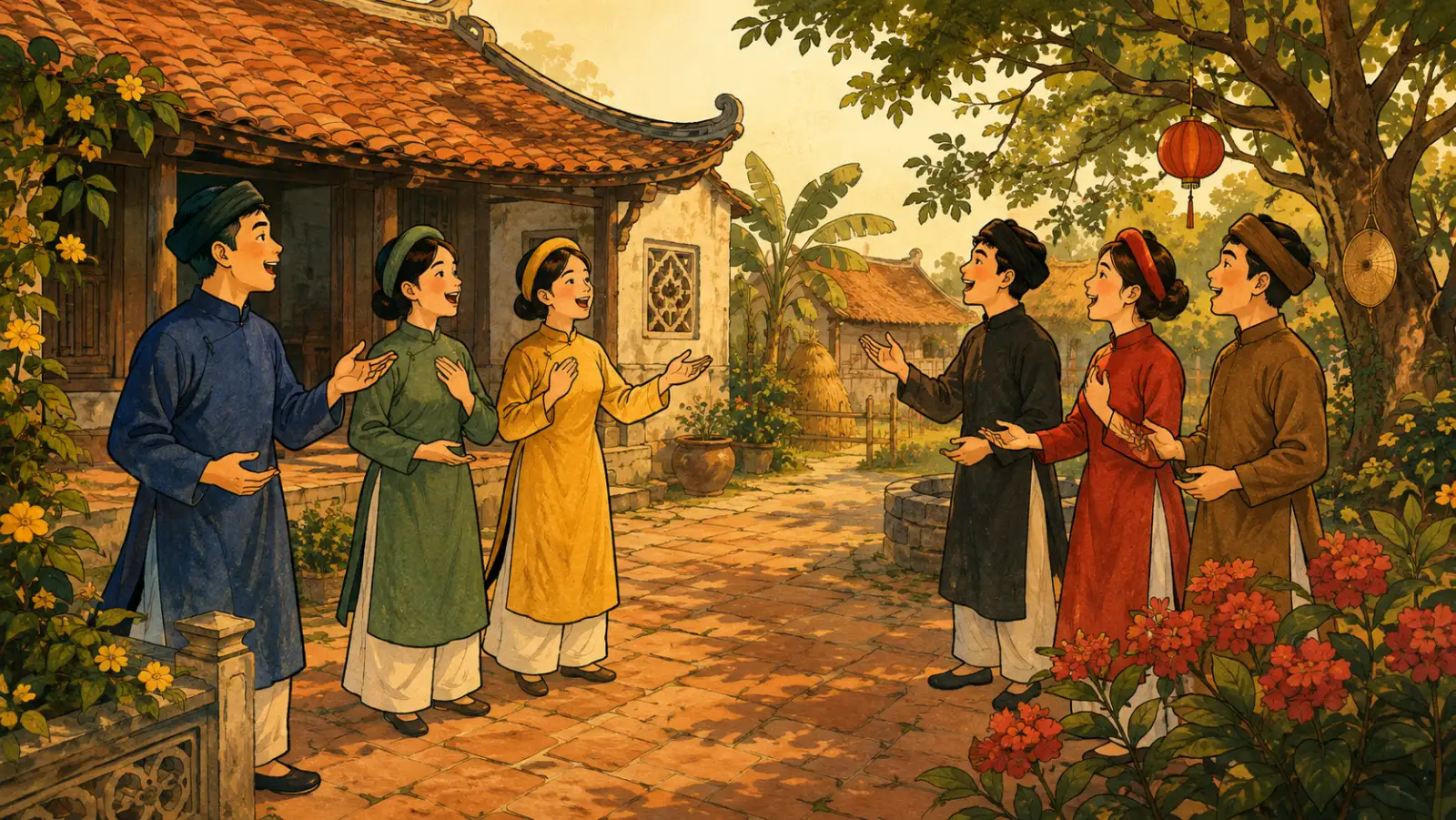
Read a Vietnamese folk verse on the page and you have only half of it. The other half is the voice that carries it: the swaying melody, the soft filler syllables, the gesture of a hand keeping time over a rice field. That sung, living half has a name of its own: dân ca (folk song). Where ca dao is the poem at rest, dân ca is the poem awake and singing. This bilingual guide shows English speakers and their teachers what dân ca is, how a bare verse blossoms into a tune, the families of folk song, and why the music is tied so tightly to dialect.
What is dân ca?
The term dân ca means simply "folk song" (dân, the people; ca, song). But the thing itself is richer than the translation. Scholars call it a nghệ thuật tổng hợp (synthetic art), because a true folk song is never just words on a line. In performance it weaves four strands together at once.
- The lyric (lời thơ): the poem, often ca dao.
- The filler and refrain syllables (tiếng đệm, tiếng láy, tiếng đưa hơi): the sounds that pad, decorate, and carry the breath.
- The music (nhạc): the regional melody that shapes the line.
- The gesture and movement (động tác, điệu bộ): the singer's body keeping time.
All four come alive only in diễn xướng (live performance). A folk song travels region by region, mouth to mouth, and saturated with lyric feeling. That is why two villages a river apart can sing "the same" song in two clearly different ways, and both are completely right.
How are ca dao and dân ca different?
This trips up almost every beginner, yet the answer is wonderfully simple. Ca dao is the lyric poem on the page; dân ca is that same poem brought to life in song. One is text, the other is performance. If you have read our guide to ca dao, Vietnamese folk poetry, you already know the words; dân ca is what happens when someone sings them.
There is no strict border between the two. Much ca dao grows into dân ca once a community puts a tune to it, yet not every verse makes that journey, and some folk songs add words the original poem never had. Think of it as a spectrum, not a wall: ca dao is the seed, and dân ca is one beautiful way the seed can flower. Both belong to the same folk-lyric family within Vietnamese folk literature.
From poem to song: the "Con cò" example
The clearest way to feel the difference is to watch one famous line expand before your eyes. Here is the bare ca dao, plain and tidy, in the classic lục bát (six-eight) metre.
Con cò bay lả bay la,
Bay từ ruộng lúa bay ra cánh đồng.
"The stork glides and floats along, flying from the rice paddy out across the open field."
Now listen to what happens when a singer turns it into the folk song Cò lả. The same words remain, but padded and stretched with filler syllables until they fill a melody:
Con cò cò bay lả lả bay la,
Bay từ là từ ruộng lúa, bay qua là qua cánh đồng.
Tình tính tang là tang tính tình,
Cô nàng rằng, cô nàng ơi,
Rằng có nhớ, nhớ anh chăng?
"The stork, the stork glides and floats along, flying from, yes from the rice paddy, flying over, yes over the field. Tinh tinh tang, oh tang tinh tinh; young lady, oh young lady, do you, do you still think of me?"
Notice three things. First, words double up for music: con cò becomes con cò cò, bay lả becomes bay lả lả. Second, the breath-carrying fillers là, là từ, and là qua slip into the gaps so the voice can ride the long notes. Third, a whole non-lexical refrain, tình tính tang là tang tính tình, appears from nowhere; it means nothing in the dictionary but everything to the rhythm. The same expansion drives courtship songs like the one opening "Ngựa ô anh thắng kiệu vàng…" ("I harness the black horse with a golden saddle…"). This padding is the engine of dân ca: it is how a quiet poem learns to sing.
What are the songs of work?
Vietnamese scholars sort dân ca by the part of life it belongs to. The first family is dân ca lao động (work songs), music tied directly to labour. Because hard work goes easier in rhythm, many are hò, call-and-response chants where one leader sets a line and the group answers. A classic example is the hò nện, sung while tamping earth to build a foundation, with a lead caller (Hô cái) and answering chorus (Hô con):
Hô cái: Mời bạn hò khoan này
Hô con: Hụ là khoan
Hô cái: A lá khoan hô khoan là
Hô con: Hụ là khoan…
"Lead: Come, friends, let us chant together. Chorus: Hu la khoan! Lead: A la khoan, ho khoan! Chorus: Hu la khoan!"
The caller's words barely matter as language; what matters is that every Hụ là khoan falls exactly as the rammers strike the ground together. Other work songs teach the year's labour through rhyme, following the farming calendar:
Tháng chạp là tháng trồng khoai,
Tháng giêng trồng đậu, tháng hai trồng cà.
Tháng ba cày vỡ ruộng ra,
Tháng tư làm mạ mưa sa đầy đồng.
"The twelfth month is the month for planting yams; in the first month plant beans, in the second plant eggplant. In the third month break the fields with the plough; in the fourth month raise the rice seedlings as the rain pours over the fields."
Here the song is also a calendar and a teaching tool. Sing it a few times and the rural year settles into memory, month by month, as farming families once learned it.
What are the songs of ritual?
The second family is dân ca nghi lễ (ritual songs), bound to belief and ceremony. When the harvest depended on the weather, communities sang their hopes straight up to the sky. The best-known is the rain-praying chant, short, urgent, and easy for a crowd to repeat:
Lạy trời mưa xuống,
Lấy nước tôi uống,
Lấy ruộng tôi cày,
Lấy đầy bát cơm.
"We pray to heaven, send the rain down: water for us to drink, fields for us to plough, and bowls filled full with rice."
Notice how the request grows step by step, from drinking water to ploughed fields to a full bowl of rice, the whole chain of survival in four lines. Coastal communities have their own ceremonial music too, the hát cầu ngư (fishing-prayer songs) for calm seas and a generous catch. Ritual dân ca shows the folk song at its most communal: a village voicing one shared wish.
What are the songs of home and social life?
The third and largest family is dân ca sinh hoạt (songs of everyday and social life). This is the music of the household and the courting season, and the warmest place for a learner to start.
Lullabies (hát ru)
Every Vietnamese childhood is rocked by hát ru. These cradle songs almost always open with the same soft, untranslatable cue meaning "sleep now":
À ơi… Con cò bay lả bay la,
Bay từ cửa phủ bay ra cánh đồng.
"A oi… the stork glides and floats along, flying from the mansion gate out across the field."
The drawn-out à ơi is pure breath and tenderness; it carries no dictionary meaning, yet it is the most recognisable sound in Vietnamese family life.
Children's rhymes (đồng dao)
For older children there is đồng dao, the chanted rhymes of games and play. Built from short, bouncing lines that fit a clapping or skipping rhythm, their logic is happily playful rather than strict, which makes them perfect tongue-trainers for new learners.
Courtship and lyric songs (bài ca trữ tình)
Finally come the lyric and courtship songs, the bài ca trữ tình that carry the feeling heart of dân ca. Here belong the gentle cò lả we met earlier, the many điệu lý tunes of the Centre and South (sweet melodies like Lý cây đa or Lý ngựa ô), and, most famous of all, the quan họ duets of Bắc Ninh. In quan họ, young men and young women answer each other song for song, trading verses of invitation and farewell. UNESCO recognises it as a treasure of world heritage, and one quan họ line shows the courteous, lingering tone:
Người ơi người ở đừng về.
"Oh dear one, please stay; do not go home yet."
Why is dân ca tied to dialect?
Here is where dân ca matters most for a learner. Because folk song lives in the voice, it carries the full regional colour of the place that sings it, and Vietnam's three regions each have their own melodies, filler syllables, and accent riding the tune.
- The North gives us the bright, formal quan họ of Bắc Ninh and the hát xoan of Phú Thọ, in the crisp tones of northern speech.
- The Centre sings the wistful hò Huế and the famous ví, giặm of Nghệ Tĩnh, in the deep, heavy central accent.
- The South offers the easy, gliding điệu lý and the hò of the Mekong rivers, in the soft southern voice.
Listen to a folk song and you are hearing a dialect in its most musical form. This is why dân ca is such a natural bridge to choosing how you will speak: the melody you love most is often a clue to the region you want to sound like. If you are still deciding, pair this guide with our overview of which Vietnamese dialect to learn, and let the songs help you choose.
A bilingual glossary of folk-song terms
Keep this table beside you as you listen. These are the words that unlock almost any Vietnamese conversation about folk song.
| Vietnamese | English | Notes |
|---|---|---|
| dân ca | folk song | A folk poem brought to life in melody. |
| ca dao | folk verse | The lyric poem on the page; the seed of dân ca. |
| lời thơ | lyric / words | The poem-text inside a song. |
| tiếng đệm | filler syllables | Padding sounds that fill out a line. |
| tiếng đưa hơi | breath-carrying sounds | Soft sounds that ride the long notes. |
| diễn xướng | live performance | Bringing the song to life aloud. |
| hò | work chant | Call-and-response labour song. |
| hát ru | lullaby | Cradle song, often opening with à ơi. |
| đồng dao | children's rhyme | Chanted rhymes for games and play. |
| điệu lý | short folk tune | Sweet melodies of the Centre and South. |
| quan họ | Quan Ho duets | Courtship song-exchange of Bắc Ninh. |
| cò lả | "Co La" folk song | The classic stork song shown above. |
How can folk songs help you learn Vietnamese?
A folk song is one of the most enjoyable study tools you have, because melody glues language to memory in a way flashcards rarely match. Here is how to put dân ca to work.
- Train your tones with melody. Vietnamese is tonal, and a folk tune already "sings" many of the tones for you, so matching the melody helps your pitch land in the right place.
- Let repetition do the work. The doubled words and refrains that make dân ca musical also make it stick; sing a verse twice and it stays.
- Choose by region. Pick songs from the dialect you are learning, so ear and accent grow in the same direction.
- Start with lullabies. Hát ru are slow, gentle, and forgiving, the perfect first songs for a beginner's mouth.
- Bring a verse to class. Sing one line to a teacher, let them correct your tones and tell you the story behind it; a real voice turns a song into a lesson.
To take a folk song from the page to real, confident speech, a live human teacher is the fastest way there. You can book a trial lesson, browse our Vietnamese courses that weave culture into everyday speaking, or meet the people who will guide you on our teachers page.
Tóm tắt bằng tiếng Việt
Dân ca là bài hát dân gian, một nghệ thuật tổng hợp kết hợp lời thơ, tiếng đệm, tiếng đưa hơi, nhạc và động tác trong diễn xướng. Khác với ca dao là phần lời trên trang giấy, dân ca là ca dao được cất lên thành tiếng hát; nhiều câu ca dao thành dân ca nhưng không phải câu nào cũng vậy. Khi hát, lời thơ được thêm tiếng đệm như "con cò cò", "tình tính tang" cho hợp giai điệu. Người ta chia dân ca thành dân ca lao động (hò nện, bài tháng chạp), dân ca nghi lễ (cầu mưa, cầu ngư) và dân ca sinh hoạt (hát ru, đồng dao, điệu lý, quan họ). Mỗi miền Bắc, Trung, Nam có làn điệu riêng, nên dân ca gắn chặt với phương ngữ và là cánh cửa quý cho người học tiếng Việt.
Learn Vietnamese with Vietlingo
From the soft à ơi of a lullaby to a lingering quan họ farewell, dân ca is the friendliest, most musical door into the Vietnamese language, and you need not step through it alone. Bring a verse, a refrain, or a whole folk song to a real teacher and watch your tones and your confidence grow together. Book your trial lesson today, or explore our Vietnamese courses that blend authentic culture with everyday speaking practice. Một làn điệu, một bài học mới — one folk tune, one new lesson at a time.


Comments (0)
A new word, a question, or a different perspective? Share it with fellow learners.
Be the first to comment.