Key takeaways
- Vietnamese 'we' is at least two words, and the choice encodes the clusivity distinction: is the listener inside the group you mean, or outside it?
- Chúng ta is inclusive 'we' = speaker + listener (Chúng ta đi ăn tối nhé invites the listener in); chúng tôi is exclusive 'we' = speaker + others but not the listener (Chúng tôi đi ăn tối đây leaves them out).
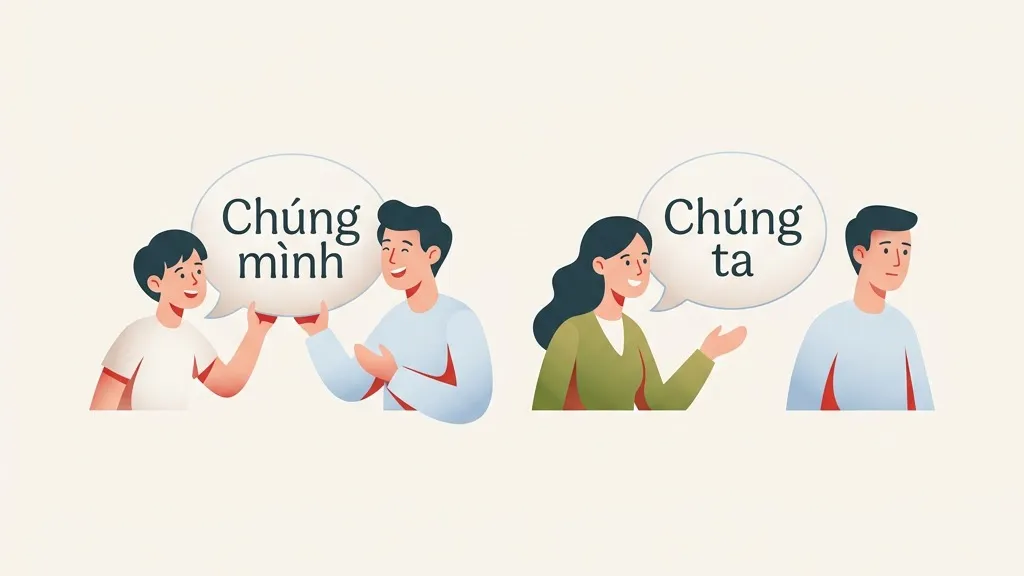
- Chúng mình is a warm inclusive 'we' that wraps the listener into the circle informally.
- English makes this hard to feel because its single word 'we' carries no warning, so learners pick the wrong one and accidentally exclude people.
- Train the reflex by noticing whether you are proposing (inclusive) or reporting (exclusive) before you speak.
You are standing in a friend's kitchen in Saigon, the rice is almost done, and you say what feels like the most natural sentence in the world: "We should eat now." You translate it on the fly, you reach for a word for we, and depending on which one your mouth lands on, you have either warmly invited your friend to sit down and eat together — or politely informed them that your group is about to eat and they are not part of it. English gave you one word and zero warnings. Vietnamese was keeping score the whole time.
This is one of the quietest, most consequential blind spots in learning Vietnamese, and almost nobody warns you about it early enough. The pronoun we is not one word in Vietnamese. It is at least two, and the choice between them encodes something English speakers never have to think about: is the person I am talking to inside the group I mean, or outside it?
What does "inclusive" and "exclusive" we even mean?
Linguists call this the clusivity distinction. Vietnamese, like dozens of languages across Asia and the Pacific, splits the idea of "we" into two clean categories:
- Inclusive "we" = the speaker + the listener (and possibly others). It means us, and that includes you.
- Exclusive "we" = the speaker + other people, but not the listener. It means us, but not you.
The cleanest pair to anchor this on is chúng ta versus chúng tôi.
Chúng ta is the classic inclusive "we." When you say chúng ta, you are explicitly wrapping the listener into the circle. The listener hears, without anyone spelling it out, "this includes me."
Chúng tôi is the classic exclusive "we." When you say chúng tôi, you are drawing a line that has the listener on the other side of it. You are talking about your side, your team, your group — and the person in front of you is the audience, not a member.
Put them next to each other and the difference is impossible to miss:
Chúng ta đi ăn nhé. — Let's go eat. (You and I, together — come on.)
Chúng tôi đi ăn đây. — We're going to eat now. (My group is heading off — not you.)
Same verb. Same meal. Two completely different social messages. The first is an invitation; the second is an announcement, maybe even a goodbye. If you wanted to invite your friend and you reached for chúng tôi, you didn't just pick the wrong word — you closed a door in their face without realizing your hand was on the handle.
So where does chúng mình fit in?
Here is where it gets warmer, and where a lot of everyday conversation actually lives. Chúng mình (often shortened to mình on its own, or heard as tụi mình / bọn mình in casual speech) is an inclusive "we" — but it carries a tone that chúng ta doesn't.
Where chúng ta can sound a little formal, broad, or even speech-like — the "we" of teachers, leaders, and announcements — chúng mình is intimate. It's the "we" of friends, couples, small groups of people who feel close. It still includes the listener (that's the key point), but it does so with an arm-around-the-shoulder warmth rather than a podium.
Compare the temperature of these two:
Chúng ta cần bảo vệ môi trường. — We need to protect the environment. (Broad, civic, almost a slogan — all of us, society.)
Chúng mình đi xem phim cuối tuần này nhé? — Shall we go see a movie this weekend? (Just us — you and me, close and casual.)
Both are inclusive. Both fold the listener in. But you would sound strange proposing a cozy movie date with chúng ta, and you would sound oddly intimate giving a public environmental appeal with chúng mình. The clusivity is the same; the register is not.
So the mental map you actually need has two axes, not one:
- Does it include the listener? — chúng ta, chúng mình, tụi mình, bọn mình all say yes. chúng tôi, tụi tôi, bọn tôi all say no.
- How close/formal is it? — chúng ta leans formal/broad; chúng mình and the tụi/bọn family lean casual/intimate.
Why does English make this so hard to feel?
The reason this trips up learners isn't that the rule is complicated. It's that English flattens the entire distinction into one syllable: we. English "we" is gloriously, uselessly ambiguous. When an English speaker says "we're having a party," the listener has to infer from context, tone, and a follow-up sentence whether they're invited or merely being told. The grammar gives them nothing.
Because of that, English speakers never develop the reflex of asking, mid-sentence, "wait — is the person I'm talking to part of this 'we' or not?" The question simply never comes up in their native grammar. So when they switch to Vietnamese, they keep operating on autopilot, picking whichever "we" they learned first — often chúng tôi, because it shows up early in textbooks as "we" — and they accidentally exclude people for months without anyone correcting them, because the sentences are still grammatical. They're just socially wrong.
That's the dangerous part. A grammar mistake gets corrected. A clusivity mistake just quietly makes you sound a little cold, a little distant, a little like an outsider — and most native speakers are far too polite to point it out.
The same scene, four ways
Let's run a single situation through all the variants so you can feel the dial turning. Imagine you've just finished a project with a colleague, and your boss walks over and asks how it went.
Chúng tôi đã hoàn thành dự án rồi ạ. — We've finished the project. (Said to the boss about you-and-your-colleague. The boss is outside this "we" — correct, because the boss didn't do the work. Chúng tôi is exactly right here.)
Now imagine instead you're talking to that same colleague, rallying them for the final push:
Chúng mình cố lên, sắp xong rồi! — Let's push on, we're almost done! (Said to your teammate. They are inside this "we" — you're in it together. Exclusive chúng tôi would be bizarre here; it would mean "my group, not you," while standing next to the very person you're encouraging.)
Now zoom out. You're giving a short speech to the whole company about what the team accomplished:
Chúng ta đã cùng nhau làm nên điều này. — We achieved this together. (Said to a room that includes everyone. Inclusive and broad — chúng ta reaches out and gathers the whole audience into the "we.")
And finally, you're reporting your team's result to a partner company that wasn't involved:
Bên chúng tôi đã xử lý xong phần kỹ thuật. — Our side has handled the technical part. (Said to outsiders — chúng tôi, plus bên ("side"), draws a crisp line between us and them.)
Notice the pattern: the moment the listener becomes someone who did the work with you or someone you're inviting along, you swing to inclusive. The moment you're reporting your side to someone, you swing to exclusive. Same project. Same person, even. The pronoun tracks the relationship in real time.
The trap of "reporting" vs "proposing"
If you want one rule of thumb that catches most real-world mistakes, it's this distinction between proposing and reporting.
When you propose doing something together — let's go, shall we, why don't we — the listener is almost always meant to be in the group. You want inclusive: chúng ta or, more casually, chúng mình.
When you report on your own side — we did, we have, we're going to (without them) — the listener is usually outside the group. You want exclusive: chúng tôi.
Watch how badly it breaks if you swap them:
Chúng tôi đi cà phê không? — ❌ Sounds like: "Shall my group (not you) go for coffee?" — which is nonsense as an invitation. You meant chúng mình đi cà phê không? ("Shall we — you and I — go for coffee?")
Chúng mình đã nộp báo cáo cho sếp anh rồi. — ❌ Said to someone from another team, this oddly pulls them into the group that submitted the report. You meant chúng tôi đã nộp báo cáo rồi ("we — my team, not you — already submitted the report").
Once you start hearing sentences through this proposing-vs-reporting filter, a huge chunk of the confusion dissolves.
A few honest complications
Vietnamese is rich, and a good learner deserves the truth rather than an oversimplified rule. Two things worth knowing:
1. Pairs, closeness, and casual texture. When it's literally just you and one other person, chúng mình can shade toward "the two of us," and couples especially use mình and chúng mình as terms of closeness. Among friends you'll also constantly hear tụi mình and bọn mình — same inclusive meaning, just the everyday spoken texture.
2. The ending is what counts. In colloquial forms like tụi tôi, tụi mình, bọn tôi, bọn mình, the tụi/bọn part is just a casual pluralizer; clusivity lives in the tôi (exclusive) versus mình (inclusive) at the end. Train your ear on that final piece. And note that chúng ta can act as a soft inclusive nudge — even a teacher saying chúng ta cùng làm bài này nhé ("let's do this exercise together") to turn a command into teamwork.
One trap to flag before we move on: the words ta and mình also exist on their own, and there they often aren't plural "we" at all. Bare mình can mean "I/me" softly, or "you" between intimate partners — so shortening chúng mình to mình can flip you from "we" to "I" and quietly drop your listener out of the sentence. Mình đi trước nhé means "I'll go ahead" (alone), while chúng mình đi nhé means "let's go" (together). When you mean an inclusive "we," keep the chúng.
There's a listening payoff here too. Once your ear is tuned to clusivity, you start catching information you used to miss: the moment someone says chúng tôi, you instantly know you're not in that group — which tells you who did what, who's invited, and where the social lines fall in a conversation. The distinction isn't only something you produce; it's something you can finally hear.
How do I actually train this reflex?
You can't fix a clusivity blind spot by memorizing a table once. The fix is building a tiny mental checkpoint that fires before the pronoun leaves your mouth. Here's a concrete way to drill it.
- Step 1 — Freeze before "we." Whenever you're about to say "we" in Vietnamese, pause for half a second and ask one question: Is the person I'm talking to inside this group, or outside it? That single question is 90% of the skill.
- Step 2 — Pick the axis. If inside → inclusive (chúng ta for broad/formal, chúng mình/tụi mình for close/casual). If outside → exclusive (chúng tôi/tụi tôi).
- Step 3 — Sanity-check with the swap test. Mentally say the opposite form. If the opposite would change who's invited or who did the thing, you'll feel instantly which one is right.
- Step 4 — Shadow real dialogue. When you watch Vietnamese videos or listen to conversations, flag every "we" you hear and guess inclusive vs exclusive before context confirms it. This turns passive listening into targeted reps.
- Step 5 — Rewrite your own sentences. Take five "we" sentences you'd actually say this week and write each one twice — once including the listener, once excluding them — and note how the social meaning flips.
This is exactly the kind of micro-skill that a focused drill nails far faster than passive exposure. You can practice real situations — an invitation here, a report to your boss there — in conversation with the Vietlingo AI tutor, which gently corrects the form you choose. Even better, after you answer you can ask the Vietlingo AI tutor a single, powerful question: "Does the form I picked include or exclude the person I'm talking to?" The tutor will tell you exactly who your "we" let in and who it left out — which is the one piece of feedback no English-trained ear can give you on its own.
If you want to go deeper on how Vietnamese pronouns shift with relationship and respect, it pairs naturally with what you already know about choosing the right forms of address like anh, chị, and em — clusivity is really just the plural cousin of that same instinct: always know where the other person stands relative to you.
The one-line takeaway
English lets you say "we" without deciding who you mean. Vietnamese makes you decide every single time — and that's not a burden, it's a feature. Built into the grammar is a small daily act of social awareness: am I drawing this person in, or am I speaking only for my side? Get it right and you sound warm, precise, and genuinely fluent. Get it wrong and you sound, ever so slightly, like you're talking at people instead of with them.
So before your next "we," take that half-second. Decide who's in the circle. Then pick the word that matches — and watch how much closer people lean in when the language itself tells them they belong.




Comments (0)
A new word, a question, or a different perspective? Share it with fellow learners.
Be the first to comment.