Few stories are as deeply woven into the Vietnamese imagination as Cây Khế, "The Starfruit Tree." Ask almost any Vietnamese person, young or old, about the magical bird who promised to "eat one fruit and repay with a lump of gold," and you will see a smile of recognition. This gentle, slightly mischievous tale is a cornerstone of Vietnamese folktales (truyện cổ tích), and it carries one of the culture's most enduring moral lessons: greed never pays, while honesty and contentment are quietly rewarded. For anyone learning the language, the story is also a treasure chest of everyday vocabulary, kinship terms, and a famous rhyme worth memorizing.
In this article we retell the classic public-domain version of the tale, quote the bird's celebrated line in Vietnamese with a translation, and finish with a learner's glossary and a Vietnamese-language summary. Whether you are a student building your reading skills or a teacher looking for authentic material, Cây Khế rewards a careful read.
Who were the two brothers?
Long ago in a quiet village lived two brothers. Their parents were hardworking farmers who, over a lifetime, had built up a comfortable estate: a fine house, fertile rice fields, gardens, and savings. When the parents grew old and passed away, the family property was supposed to be shared between the two sons, as custom required.
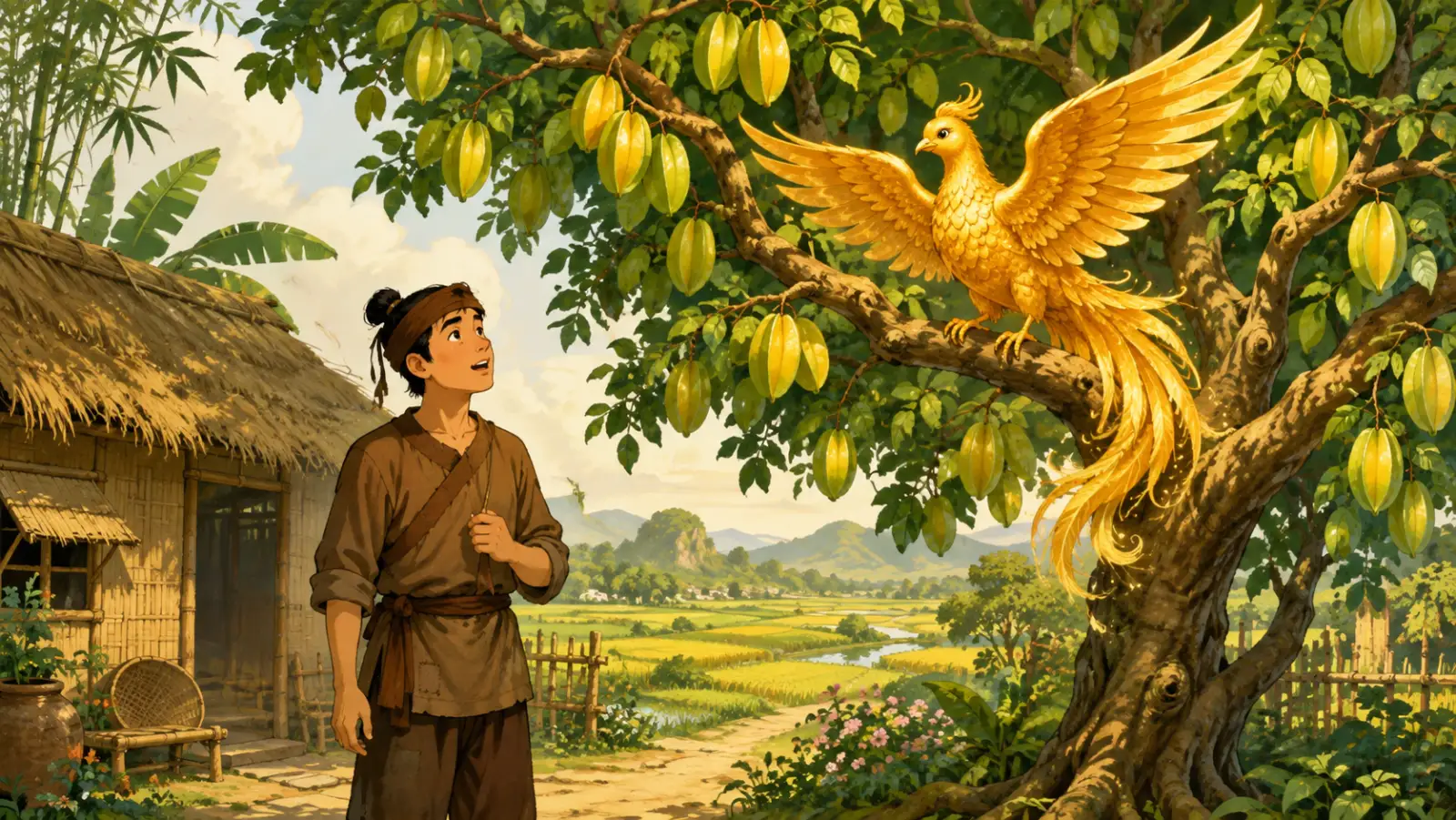
But the elder brother (người anh) was greedy and cunning. The younger brother (người em) was honest, gentle, and trusting. Taking advantage of his brother's good nature, the elder brother claimed nearly everything for himself. He kept the house, the rice fields, the buffalo, and the money. To the younger brother he gave only a small thatched hut and, at the very edge of the garden, a single starfruit tree (cây khế).
The younger brother did not argue or complain. He accepted his meager share without bitterness, moved into the little hut with his wife, and resolved to make an honest living. Each day he worked for others in the fields, and in his spare moments he tended his one possession of value: the starfruit tree. He watered it, cleared the weeds around its roots, and cared for it as if it were a member of the family. In time, the tree grew strong and heavy with bright, ripe, star-shaped fruit.
What did the magical bird want with the starfruit tree?
The starfruit ripened beautifully, and the young couple looked forward to selling the fruit at market — for it was nearly their only source of income. But one morning, an enormous and magnificent bird appeared. In most tellings it is a phoenix (chim phượng hoàng); in others, a giant eagle. Whatever its name, it was a creature of obvious magic, with vast wings and gleaming feathers.
The great bird settled in the branches and began to eat the ripe star-fruit, one after another, with no sign of stopping. The young man hurried out and, instead of shouting or throwing stones, spoke to the bird politely and sorrowfully. He explained that the tree was the only thing he owned, that he and his wife depended on the fruit to survive, and that if the bird ate it all, they would have nothing.
To his astonishment, the bird answered him in human speech. It spoke the lines that nearly every Vietnamese child can recite to this day:
Ăn một quả, trả một cục vàng,
May túi ba gang, mang đi mà đựng.
In English: "Eat one fruit, repay with a lump of gold; sew a bag three spans wide, and bring it to carry the gold." A "span" (gang) is the distance across an outstretched hand — an old, very human unit of measurement. The bird was promising to make good on every fruit it ate, and it told the young man exactly how to prepare.
Why did the bird say "sew a bag three spans wide"?
The young man and his wife could hardly believe their ears, but they did exactly as the bird instructed. They sewed a small cloth bag, precisely three spans wide (túi ba gang) — modest, sensible, and no larger than the bird had suggested.
The next morning the bird returned, lowered itself to the ground, and told the man to climb onto its back with his three-span bag. Then it rose into the sky and flew far out over the sea, until it reached a remote island that glittered in the sun. The whole island was heaped with treasure: gold, silver, diamonds, pearls, and precious stones of every color, more wealth than the young man had ever imagined.
The bird told him to take what he needed. But the honest younger brother did not stuff his pockets or grab armfuls of jewels. He calmly filled only his small three-span bag with gold — exactly what he had been told to bring, and no more. Then he climbed back onto the bird, which carried him safely home. With that single bag of gold, the young couple became comfortably wealthy. They bought fields and a proper house, but they remained kind and generous, sharing with their neighbors and never forgetting how they had once lived.
How did greed sink the elder brother?
News of the younger brother's sudden fortune soon reached the elder brother. Consumed by envy, he came to ask how it had happened. The honest younger brother, hiding nothing, told him the whole story of the magical bird and the starfruit tree.
At once the elder brother proposed a trade. He offered to swap all his wealth — the big house, the rice fields, everything — in exchange for the little hut and the starfruit tree. The younger brother, who had no desire to cheat anyone, agreed. So the greedy elder brother moved into the small hut and waited eagerly beneath the tree.
Sure enough, when the fruit ripened, the great bird returned and began to eat. The elder brother rushed out and made the same complaint his brother had made. The bird gave the very same reply:
Ăn một quả, trả một cục vàng,
May túi ba gang, mang đi mà đựng.
But where his brother had been content, the elder brother was ruled by greed (lòng tham). Instead of a modest three-span bag, he sewed an enormous sack — six spans wide in some versions, even twelve in others. When the bird carried him to the island of treasure, he behaved like a man possessed. He crammed his giant bag full of gold, then filled his pockets, his sleeves, and his belt; some tellings say he even tied lumps of gold all over his body.
When at last he climbed onto the bird, the creature could barely lift off, so heavy was its passenger. Straining, it flew back across the sea. Halfway home, exhausted and dragged down by the impossible weight, the bird could carry him no longer. It tilted its wings — and the greedy elder brother, together with his overstuffed sack of gold, tumbled down into the deep water and drowned. His greed had carried him to his own ruin.
What is the moral: greed versus contentment?
The lesson of Cây Khế is direct and unmistakable, and it lives on in everyday Vietnamese speech. The honest, contented younger brother — who took only what he was offered, exactly the size of his three-span bag — was rewarded with a happy, prosperous life. The greedy elder brother, who could never have enough, lost everything, including his life.
Vietnamese has a perfect proverb for this outcome: "Tham thì thâm" — roughly, "Greed brings loss," or "The greedy end up worse off." The story itself has given the language a memorable set phrase, "Ăn khế trả vàng" ("eat starfruit, repay with gold"), used to describe a fair, generous exchange. Above all, the tale celebrates the virtue of không tham lam — not being greedy — and the quiet dignity of being satisfied with an honest share. These same values run through many of the country's best-loved stories; you can explore more of them in our guide to Vietnamese folk literature and in the heroic tale of Thạch Sanh.
What vocabulary can learners take from this tale?
One reason Cây Khế is such useful material for learners is that it is built from words you will hear constantly in daily life. Here are a few worth noticing as you read or listen to the story.
- Kinship terms. Vietnamese does not use a neutral word for "brother." Anh means an older brother (or older male), and em means a younger sibling. These same words shape everyday conversation, where you address people by their relative age.
- Khế (starfruit). The fruit at the heart of the tale is a real, common Southeast Asian fruit, tart and star-shaped when sliced. Knowing fruit names is essential at any market.
- Vàng (gold). A high-frequency word that also appears in colors and in many set phrases about value and loyalty.
- Gang (span) and túi (bag). The bird's instruction to sew a "túi ba gang" introduces both a classifier-friendly noun and an old hand-based unit of measure.
- Tham (greedy). The moral hinges on this single adjective. Pair it with lòng tham (greed, literally "greedy heart") and the proverb tham thì thâm.
The famous rhyming couplet is also wonderful for pronunciation practice, because its rhythm helps fix the tones in your memory. Try reading it aloud slowly, paying attention to the rise and fall of each syllable. Folktales pair naturally with proverbs, so once you know this story, dip into our collection of Vietnamese proverbs (tục ngữ) to see how its lesson echoes across the language.
Glossary: key words from the story
| Vietnamese | English |
|---|---|
| cây khế | starfruit tree |
| khế | starfruit |
| người anh | the elder brother |
| người em | the younger brother |
| chim phượng hoàng | phoenix (magical bird) |
| vàng | gold |
| cục vàng | a lump of gold |
| túi ba gang | a bag three spans wide |
| gang | span (a hand's width) |
| tham / lòng tham | greedy / greed |
| không tham lam | not greedy, unselfish |
| biển | sea |
| hòn đảo | island |
| Tham thì thâm | Greed brings loss (proverb) |
Tóm tắt bằng tiếng Việt
Truyện Cây Khế kể về hai anh em. Sau khi cha mẹ qua đời, người anh tham lam chiếm hết gia tài, chỉ chia cho người em một túp lều nhỏ và một cây khế. Người em hiền lành chăm sóc cây khế thật chu đáo. Khi khế chín, một con chim phượng hoàng khổng lồ đến ăn và hứa: "Ăn một quả, trả một cục vàng, may túi ba gang, mang đi mà đựng." Người em may túi ba gang, được chim chở ra đảo vàng và chỉ lấy vừa đủ nên trở nên giàu có. Người anh nghe chuyện liền đổi nhà để lấy cây khế, rồi may túi quá to, lấy quá nhiều vàng. Chim chở nặng quá, hất anh ta xuống biển chết. Bài học: tham thì thâm, sống hiền lành và biết đủ mới được đền đáp.
Learn Vietnamese with Vietlingo
Folktales like Cây Khế are a delightful way into the Vietnamese language and the values it carries. Ready to go further? Start a trial lesson with a real instructor, browse our structured Vietnamese courses, or meet the friendly Vietnamese teachers who can guide you from your first words to confident conversation.


Comments (0)
A new word, a question, or a different perspective? Share it with fellow learners.
Be the first to comment.