Key takeaways
- Causation ('X made Y do it') looks universal but splinters into three grammatical strategies across language families, and English, Japanese, and Vietnamese each represent one.
- English uses lexical causatives — the cause is baked into the verb or the choice between verbs (melt, let, get someone to).
- Japanese uses morphological causatives — a verb ending or verb pair adds the causer, often combined with giving verbs.
- Vietnamese is overwhelmingly analytic: it uses separate standalone function words next to the main verb, and you pick the right one based on how much pressure was applied, who benefits, and politeness.
- Teaching this contrastively (surface, contrast, drill) heads off the transfer-trap errors learners make when carrying their first-language pattern across.
Ask a learner to translate “The teacher made the students stay late” into Vietnamese, and watch what happens. The English speaker reaches for a single verb that carries the whole idea of force. The Japanese speaker hunts for a verb ending that does the same job morphologically. Both arrive at Vietnamese and hesitate — because Vietnamese hands them not one tool but a small toolbox of separate words, and expects them to pick the right one based on how much pressure was applied, who benefits, and how polite they want to sound. Causation looks like one universal concept, but the moment you cross language families it splinters into three completely different grammatical strategies. For teachers, that splintering is exactly where the most predictable, most fixable errors live.
What does it actually mean for a language to “encode causation”?
Causation is the relationship where one participant brings about an action or state in another. The heat melted the ice. The boss let me leave. She got her brother to apologize. Every human language can express this, but they differ in where they put the grammatical work. Linguists usually sort the strategies into three buckets, and English, Japanese, and Vietnamese happen to be near-perfect representatives of each.
- Lexical causatives bake the cause into the meaning of a verb or into a choice between verbs. English leans heavily here.
- Morphological causatives attach an affix or change the verb's shape to add a causer. Japanese is a textbook case.
- Analytic (periphrastic) causatives use a separate standalone function word next to the main verb. Vietnamese is overwhelmingly analytic.
None of these is more “advanced” than another — they are just different engineering solutions to the same problem. The trouble is that learners do not arrive as blank slates. They arrive carrying the solution their first language drilled into them, and they try to map it directly onto Vietnamese. That mapping fails in specific, teachable ways.
How does English say it? Verbs that carry force
English mostly handles causation by choosing the right causative verb, then arranging the participants by word order. The core set every learner already knows is make, have, get, let, and force — and crucially, these verbs encode different degrees of pressure and different complement patterns.
- make + bare infinitive — strong, often involuntary: The film made me cry.
- force + to-infinitive — explicit coercion: They forced him to sign.
- have + bare infinitive — arranged or expected, low drama: I had the plumber fix the leak.
- get + to-infinitive — persuasion, effort, sometimes manipulation: She got the kids to eat their vegetables.
- let + bare infinitive — permission, the opposite pole: He let her borrow the car.
Notice that English buries a lot of meaning inside the verb itself. The difference between coercion and permission is not a particle or an ending — it is a completely different lexical item. English speakers therefore expect Vietnamese to also have a tidy menu of force-laden verbs. As we will see, Vietnamese does distinguish force, but it does so with separate words that behave more like grammatical operators than like rich verbs, and the register rules attached to them are stricter than anything in English.
How does Japanese say it? Endings, verb pairs, and giving
Japanese is the most structurally distant of the three, and that distance is precisely why Japanese-speaking learners of Vietnamese stumble in fascinating ways. Japanese spreads causation across several grammatical systems at once.
The morphological causative
Japanese has a dedicated causative conjugation — the -saseru / -aseru endings. The verb itself changes shape to add a causer, and a case particle marks whether the causee was coerced or merely permitted. A single suffix can mean both “make someone do” and “let someone do,” with the particle disambiguating. For a learner, the causation lives inside the verb morphology, not in a separate word.
Intransitive / transitive verb pairs
Japanese also has many lexical pairs where one verb is “something happens by itself” and its partner is “someone causes it to happen” — think of the difference between “the door opens” and “I open the door” being two distinct verbs you must memorize, not one verb used two ways. This trains Japanese speakers to expect that the spontaneous event and the caused event will be marked differently at the word level.
The giving-verb construction and the causative-passive
On top of that, Japanese routinely expresses “do something for someone’s benefit” with auxiliary giving verbs, and it has a notorious causative-passive (“to be made to do something”) that fuses coercion and victimhood into one heavily inflected form. The upshot: Japanese encodes not just who caused what, but who benefited and who suffered, all through morphology and auxiliary verbs.
So the Japanese speaker arrives at Vietnamese primed to look for verb endings and special paired verbs. Vietnamese has neither. Every grammatical distinction the Japanese learner is used to expressing by reshaping a verb must now be expressed by adding a separate word and getting the word order right. That is a profound reorientation, and it is invisible unless the teacher makes it explicit.
How does Vietnamese say it? Standalone function words
Vietnamese is strongly analytic and isolating: words generally do not change shape, and grammar is built by stringing free-standing morphemes together in a fixed order. Causation is no exception. Instead of inflecting the verb, Vietnamese inserts a causative function word between the causer and the caused event. The main words to teach are a small, learnable set, and each sits at a different point on the force-and-register scale.
- làm — the broad, often unintentional causer, very common with emotions and states (literally also “to do/make”).
- khiến — causes a state or reaction, slightly more formal or literary, frequent in writing and with feelings.
- bắt — strong coercion, “to force/compel”; carries real pressure and usually a power imbalance.
- cho phép / cho — permission, “to let / allow”; the permissive pole.
- nhờ — getting help by asking a favor, polite request causation, “to ask someone to (kindly) do.”
Here is the same family of ideas rendered in Vietnamese so the analytic pattern is visible. Notice that the verb after the function word never changes form — only the function word swaps out.
Bộ phim này làm tôi khóc. — This film made me cry. (broad, involuntary → làm)
Tin này khiến mọi người lo lắng. — This news made everyone worried. (state/reaction, a touch more formal → khiến)
Giáo viên bắt học sinh ở lại muộn. — The teacher made the students stay late. (real coercion → bắt)
Mẹ cho tôi mượn xe. — Mom let me borrow the (motor)bike. (permission → cho)
Tôi nhờ anh thợ sửa vòi nước. — I had the repairman fix the tap. (polite favor → nhờ)
Read those five aloud and the design principle jumps out: English changed the verb (cry, worry, stay, borrow, fix each pair with a different causative verb), Japanese would change the ending, but Vietnamese keeps the inner verb totally stable and only swaps the little operator in front of it. The grammatical labor moves out of the word and into word choice plus word order.
Why do learners confuse these patterns? The transfer trap
Once you lay the three systems side by side, the errors stop looking random and start looking inevitable. Here are the predictable failure modes, sorted by source language.
The English speaker over-lexicalizes
English learners expect a one-to-one verb swap and tend to default to làm for everything because it conveniently also means “do/make.” They will say làm when the situation clearly demands the coercive bắt or the polite nhờ. The result is grammatical but tone-deaf: imagine using “make” in English for every causation, including “I made my friend help me move” when you actually asked them a favor. The force level is wrong, and in Vietnamese a wrong force level can sound rude or absurd.
The Japanese speaker looks for morphology that is not there
Japanese learners instinctively try to compress causation into the verb, sometimes producing odd verb stacks or omitting the causative word entirely because their instinct says the conjugation already carries it. They also import the benefactive instinct — the deeply ingrained habit of marking who the action is for — and look for a Vietnamese equivalent of the giving-auxiliary, which leads them to overuse cho in places where Vietnamese would simply not mark benefit at all. And the causative-passive (“I was made to do it”) has no single Vietnamese form, so they need to learn to build it analytically with bắt plus context, which feels uncomfortably loose to a speaker used to one tidy inflected form.
Everyone underestimates register and pragmatics
This is the deepest trap and it is shared across both source languages. In English, choosing “make” vs. “have” vs. “get” is mostly about degree of force and is fairly low-stakes socially. In Vietnamese, the causative word you choose is entangled with the social relationship and the politeness system. Using bắt toward someone you should be deferent to is jarring; using nhờ when you actually have authority can sound oddly soft or even sarcastic. The word does not just measure force — it negotiates the relationship. Learners who treat causative choice as a purely logical force calculation will keep producing sentences that are technically correct and socially off.
Why teach this contrastively instead of just presenting the Vietnamese forms?
A lot of curricula introduce làm, khiến, and bắt as a tidy list and move on, assuming the mismatch with the learner's first language will sort itself out. It does not. The whole reason these errors are predictable is that they originate in the structure of the learner's first language, and a structural problem needs a structural intervention. If you never name the mismatch — “English packs force into the verb; Japanese packs it into the ending; Vietnamese uses a separate word and weighs politeness” — the learner keeps silently running their old algorithm and keeps producing the same off-key output.
Contrastive teaching makes the invisible visible. When a learner can see, in one glance, that their first language solves causation one way and Vietnamese solves it another, the error stops being a mysterious recurring mistake and becomes a known boundary they can monitor. This is the difference between a learner who eventually self-corrects and one who fossilizes a clumsy làm-for-everything habit for years.
A lesson sequence: surface, contrast, drill
Here is a three-stage sequence you can run in a single lesson or stretch across two. It is deliberately built around the three encoding strategies rather than around a vocabulary list.
Stage 1 — Surface the first-language pattern
Before showing any Vietnamese, get learners to notice how their own language does causation. Give English speakers four scenarios (a strong force, an arranged service, a persuaded action, a granted permission) and ask them to write the English sentence and underline the causative verb. Japanese speakers do the same and circle the causative ending or the giving-auxiliary. The goal is metalinguistic awareness: “Look — you already make these force distinctions; you just make them with a verb or an ending.” This takes five minutes and pays off for the rest of the unit because learners now have a labeled mental model to map from.
Stage 2 — Contrast the encoding explicitly
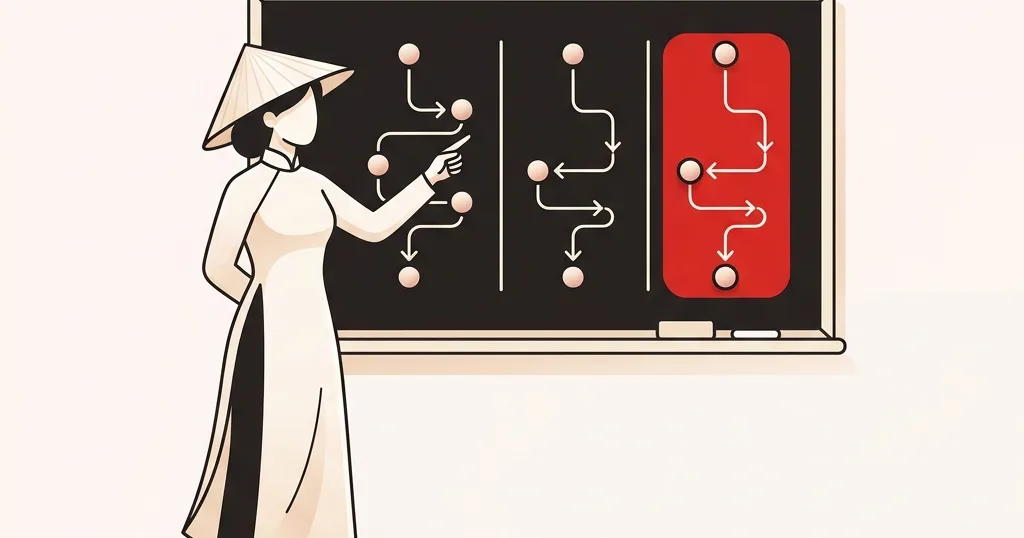
Put a simple three-column comparison on the board: Lexical (English) — Morphological (Japanese) — Analytic (Vietnamese). Walk one meaning across all three columns so the structural shift is undeniable. Use a clear pair like force vs. permission:
Giáo viên bắt học sinh làm bài. — The teacher made the students do the assignment. (coercion)
Giáo viên cho phép học sinh nghỉ. — The teacher let the students take a break. (permission)
Now state the takeaway in one sentence learners can copy down: “In Vietnamese, the inner verb stays the same; you change the little word in front of it, and that word also signals how polite or forceful you are.” Make the politeness axis explicit here, not later — show that swapping bắt for nhờ changes not just force but the whole social relationship between the people.
Stage 3 — Drill the three Vietnamese axes
Now drill, but drill the decision, not just the form. Vietnamese causative choice turns on three axes, and your exercises should isolate each one:
- Force: Give a situation and ask learners to choose between làm / khiến (low, often emotional), bắt (high coercion), and cho (permission). Example prompt: “Your boss orders everyone to work Saturday.” → expected bắt.
- Register: Same propositional content, two social settings. “Ask a close friend to take a photo for you” vs. “a formal request to a senior colleague.” Learners must justify why nhờ fits and why bắt would offend.
- Pragmatics: Give a short dialogue and ask “was this rude?” Have learners repair an over-forceful sentence into a polite one — for instance turning a blunt bắt request among equals into a softer nhờ request — then explain the social effect of the change.
Finish with a tiny production task: each learner writes three causative sentences from their own life — one coercive, one emotional, one polite-favor — and a partner checks whether the chosen function word matches the intended force and politeness. That single task exercises all three axes and surfaces residual first-language transfer immediately.
Generating fresh contrastive material without burning out
The bottleneck for contrastive lessons is examples. You need parallel sentences — the same scenario across force levels and registers — and you need them in clean, correctly toned Vietnamese, ideally in a dialect that matches your learners' target. This is exactly where Vietlingo earns its keep in lesson prep. Between lessons, learners can practice these causative patterns in conversation with the AI tutor, which corrects them gently and shows the right version. Flip the dialect toggle to see how a Southern phrasing differs from a Northern one, so learners hear the causative words in the variety they will actually encounter rather than a flattened textbook standard.
Treat the generated sentences as raw clay, not finished product: you are the teacher, so you decide which examples land, which to cut, and how to sequence them across the surface-contrast-drill arc above. A good workflow is to generate a dozen candidates, keep the six that cleanly separate force and register, and drop them straight into a Stage 3 sorting activity. If you want a companion piece for learners, point them to your platform's grammar explainers so they can review the function words at their own pace before class.
The bigger lesson hiding inside a small word
Causation is a perfect miniature of why language learning is hard in the interesting way. The idea — X made Y do it — is universal and trivially clear. What is not universal is the machinery: a verb in English, an ending in Japanese, a free-standing operator in Vietnamese, each dragging its own rules about force, benefit, and politeness. When you teach Vietnamese causatives as if they were a vocabulary list, you ask learners to memorize the answers to a question they have not been told they are asking. When you teach them contrastively, you hand learners the question itself — where does my language put causation, and where does Vietnamese put it? — and from there the answers start to organize themselves. Surface the old pattern, contrast it honestly, drill the three Vietnamese axes, and your students will stop translating force and start choosing it. That shift, from translating to choosing, is what fluency actually feels like.




Comments (0)
A new word, a question, or a different perspective? Share it with fellow learners.
Be the first to comment.