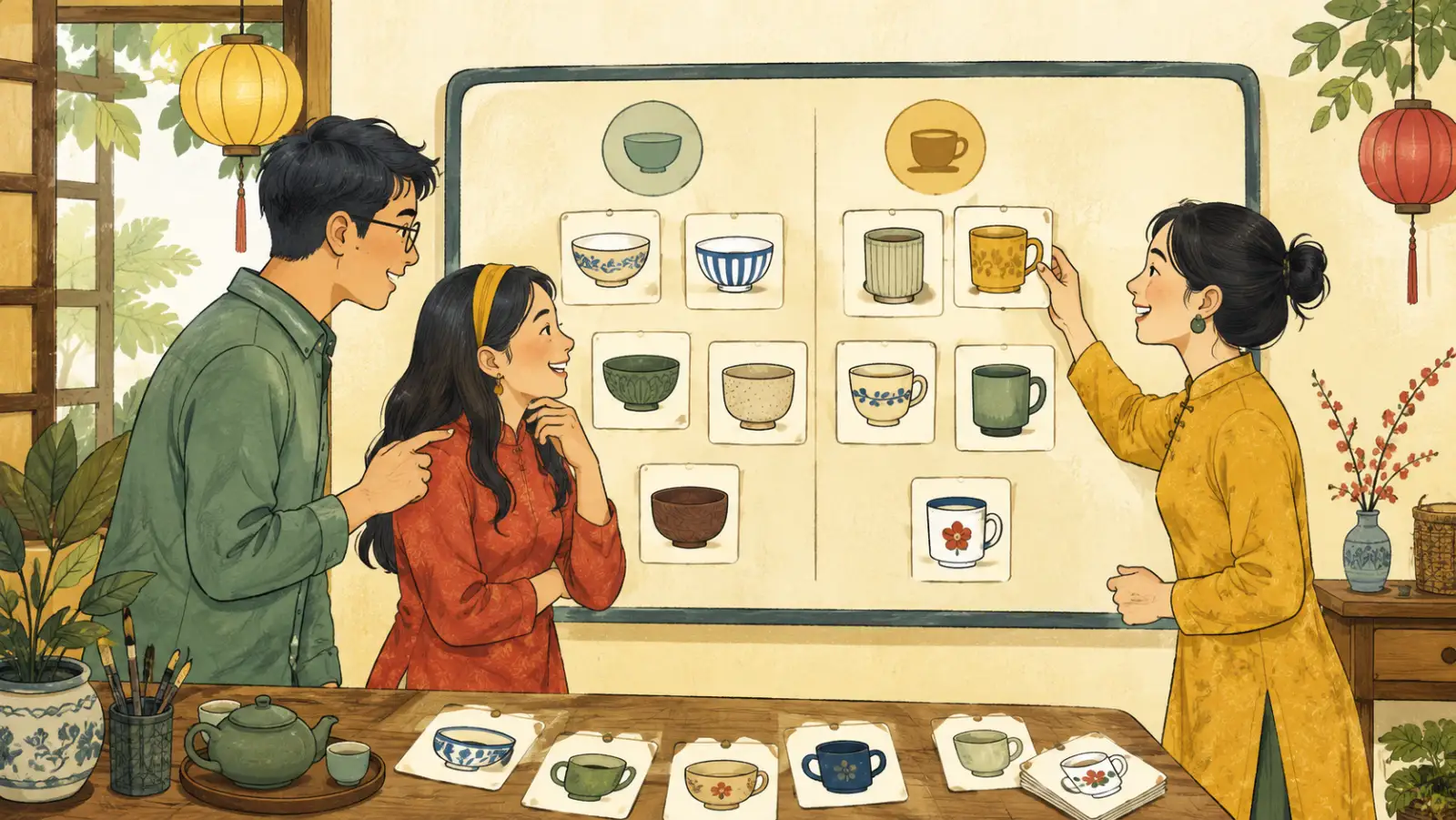
Hand a learner a card that reads má (mother, southern) and ask a single question: is this word northern or southern? Suddenly they cannot stay passive. They have to look, decide, walk to the board, and pin the card under a heading where the whole class can challenge them. That small act of committing to a choice and then defending it is the engine of the card-sort method, known in Vietnamese pedagogy as phương pháp sàng lọc (the sorting or filtering method). This article shows you how to set it up, run it, and lead the discussion that makes it work when you teach Vietnamese to English speakers.
What is the card-sort (sorting) method?
The card-sort method is a teaching technique in which learners classify prepared cards into two opposing categories, then explain and defend where each card belongs. You can use it three ways: to review a previous lesson, to assess what learners already know, or to deliver brand-new content. The teacher writes a clear topic and a sorting criterion on the board, presents a stack of cards that deliberately mixes both types, and invites learners to sort them into the right columns.
The criterion is always a pair of opposites. Common choices include Right and Wrong (Đúng – Sai), Should and Should-not (Nên – Không nên), Advantages and Difficulties (Thuận lợi – Khó khăn), or Pros and Cons (Ưu điểm – Nhược điểm). For a Vietnamese class, the most useful opposites are usually correct versus incorrect, or one regional or register category versus another. The method belongs to the same family of learner-centred techniques covered in our guide to active learning for teaching Vietnamese, and it pairs especially well with brainstorming on the board.
Why does sorting work so well for language learning?
Most classroom activities let a learner hide. They nod along, copy the board, and never reveal whether they understood. A card sort removes that hiding place, because every card forces two things in sequence: a decision and a justification. The learner first chooses a column, committing publicly to a judgement, then explains why, putting their reasoning into words. For language learning, that combination is unusually powerful.
It forces a decision
Deciding whether chén means "bowl" in the south or "cup" in the north is not something a learner can fudge. The card goes in one column or the other. That binary choice surfaces hesitation and half-knowledge that a lecture would never expose, and it does so for every learner at once rather than just the one who happens to be called on.
It forces a justification
The richer half is the explanation. When a learner says "I put bố under southern because that is what my host family in Saigon called their father," they are retrieving, organising, and articulating knowledge, which is exactly the cognitive work that builds lasting memory. The method's source notes the payoff plainly: learners observe, brainstorm, present, and counter-argue, the content gets explored deeply, and they remember it quickly and for longer. As a bonus, watching learners defend their cards lets you gauge the class's level in minutes.
The distinctive value of the card-sort method is not the sorting itself but the discussion that follows it. Skip the discussion and you have a guessing game; keep it and you have real learning.
How do you set up a Vietnamese card sort?
Good preparation is the whole job. The activity is simple to run but takes care to build, and the book is honest that this is its main limitation: you need time, coloured paper, markers, pins, and tape to make a good set. Once built, though, a set is reusable for years.
Choose a clear, accurate criterion
State your topic and your sorting criterion on the board so everyone can see them. The criterion must be clear and genuinely accurate, suited to the content, and within your learners' ability. If the line between the two columns is fuzzy, the sort collapses into argument with no resolution. "Northern word versus Southern word" is crisp; "old-fashioned versus modern" is too vague for most classes.
Prepare cards that mix both types
Write your cards on A4 paper, large and legible, in lowercase so they read cleanly from the back row. The essential trick is that one stack must contain both opposing types, jumbled together. If you are sorting northern versus southern vocabulary, the same pile holds northern words and southern words shuffled out of order. Keep the text carefully judged, not too hard, so the challenge is the classification rather than deciphering the card.
Lay out the board in two halves
Divide the board into two zones. On one half, write the topic and the two criterion headings. On the other half, pin the unsorted cards in a jumbled order as you read each one aloud. Arrange them neatly. The visual of a messy pile of cards waiting to be organised is itself a prompt, and reading each card aloud as you pin it makes sure every learner can access the content before the thinking starts.
| Before the sort: unsorted pile (read aloud, pinned jumbled) | After the sort: organised into columns |
|---|---|
| bố (dad), bát (bowl), má (mum), chuối (banana, mixed), cái chén (bowl/cup) | Two clear columns with headings Northern and Southern, every card pinned under the correct one |
How do you run the sort?
Once the topic, criterion, and jumbled cards are on the board, give learners genuine think time. Let them study the pile and form opinions before anyone moves. Then choose how the sorting itself happens; the method offers two options, and your class size and energy decide which fits.
Option A: whole-class, card by card
A learner holds up each card in turn and the class calls out which column it belongs in. This is fast, keeps the whole room involved, and works beautifully for opening a lesson or for smaller groups. You stay at the board, pin according to the class's verdict, and pause whenever a card sparks disagreement.
Option B: split into groups
Divide the class into groups and hand each group a share of the cards. The groups discuss among themselves, then send a representative to pin their cards in the right positions. This option suits larger classes and rewards quieter learners, because the real thinking happens in the small group before anyone faces the whole room. It is one of the reasons card sorts scale so well to big classes, a point we make in our piece on active learning for teaching Vietnamese: every learner is handling cards at the same time, regardless of headcount.
The step everyone skips: the discussion
Here is where most teachers cut the activity short, and where the learning actually lives. After the cards are sorted, do not simply confirm the answers and move on. Comment on the content of the cards together, teacher and learners side by side. Walk through the board and clarify each card, drawing out why it sits where it sits.
Let learners defend the disputed cards
The cards that caused argument are gold. Ask the learners who placed them to justify their choice briefly, then conclude on a sound basis. Your job is not to win the argument but to nudge the chosen options toward the correct answer, supplying the reasoning that settles it. A disputed card about whether cảm ơn (thank you) needs a politeness particle is far more memorable after two learners have argued it than after you asserted the rule.
Always wrap up and anchor
Close with a clear final conclusion. Lock in the main content, consolidate what the sort revealed, and lead into the next part of the lesson. This wrap-up is non-negotiable; without it, the activity feels like noise rather than mastery. The same principle of anchoring every activity runs through our five principles of a great Vietnamese lesson, and it is the difference between a fun game and a lesson learners retain. The questions you ask during the discussion matter too; our guide to questioning techniques for the Vietnamese classroom shows how to pull out reasoning rather than one-word answers.
Ready-to-use Vietnamese card sorts
The method works to open a lesson, to teach a single point, or to anchor material at the end, and it fits every class type. Below are five sorts you can build today. Each one uses a clean two-column criterion and a deliberately mixed pile of cards. Start with whichever matches your current unit, and remember that the discussion after the sort is where you earn the preparation time.
1. Northern versus Southern vocabulary
One of the most useful sorts for any learner heading to Vietnam. Mix regional word pairs into a single pile and have learners sort by region. This sort pairs naturally with our deeper look at Southern versus Northern Vietnamese, which you can assign as follow-up reading.
| Northern (Miền Bắc) | Southern (Miền Nam) |
|---|---|
| bát (bowl) | chén (bowl) |
| cốc (cup/glass) | ly (cup/glass) |
| bố / cha (father) | ba / tía (father) |
| mẹ (mother) | má (mother) |
| dứa (pineapple) | thơm / khóm (pineapple) |
2. Correct versus incorrect tone marks
Write the same syllable several ways, some with correct diacritics and some deliberately wrong, and have learners sort into Correct (Đúng) and Incorrect (Sai). For example, show that "thank you" is correctly written cảm ơn and challenge learners to reject a card that drops the hook tone. This sort exposes the tone confusions that English speakers carry, and the discussion is where you explain why the wrong ones change the meaning.
3. Formal versus informal pronouns
Vietnamese pronoun choice is a constant hurdle for English speakers, who are used to a single "you." Sort cards into pronouns suited to a formal setting versus a casual one, then discuss who each pronoun is actually used with. Mix in anh (older brother), chị (older sister), em (younger sibling), bác (respectful, older than your parent), and casual forms, and let learners justify their placements against real situations such as greeting a teacher versus a friend. Pronouns are a kind of grammatical companion to classifiers; if your class needs the latter, our guide to teaching Vietnamese classifiers uses the same sort-and-justify logic.
4. Which noun does the classifier go with?
Classifiers are perfect sorting material because every one pairs with a specific class of nouns. Take a single classifier such as con (used for animals) or cái (used for inanimate objects) and have learners sort a pile of nouns into "takes this classifier" versus "does not." For a more advanced sort, label two columns with two classifiers and have learners decide which noun belongs under each, defending the choice out loud.
5. Politeness particle needed versus not
The particle ạ (a marker of politeness and respect) appears in some utterances and not others. Give learners short spoken lines on cards and have them sort into "needs ạ" versus "does not need it," depending on who is speaking to whom. Answering an elder's question calls for it; chatting with a peer does not. The defence stage here teaches register far more vividly than a rule on the board ever could.
How to run any of these well
- Keep criteria sharp. Two clean opposites, written on the board, beat any clever-but-fuzzy category.
- Mix the pile honestly. Both types must be jumbled together so the sort is a real judgement, not a sequence.
- Protect the discussion. Budget more time for explaining the cards than for placing them.
- Reuse your sets. Laminate the cards once and the preparation cost pays off across many classes.
- Combine with the board. Capture the conclusions as a brainstorm beside the sorted columns.
When should you reach for a card sort?
Because it opens, teaches, and anchors equally well, the card sort is one of the most flexible tools you can carry. Use it at the start of a lesson to wake the room and surface prior knowledge, in the middle to teach a tricky distinction such as regional vocabulary, or at the end to consolidate what stuck. It draws learners in to observe, brainstorm, present, and counter-argue, and it gives you a fast, honest read on where the class stands.
- Pick one distinction your learners struggle with. Regional words, tone marks, or pronoun choice are reliable starting points.
- Write two opposing headings and ten to fifteen mixed cards. Large, lowercase, legible from the back.
- Give think time, then sort by whole class or by groups. Match the option to your class size.
- Run the discussion and let learners defend disputed cards. Conclude each one on a sound basis.
- Anchor the conclusion on the board. Make it the class's shared achievement before moving on.
If you want to feel this method from the learner's side first, take a trial lesson or browse the Vietlingo courses to see how active sequencing plays out across a full syllabus. You can also study how experienced instructors structure their sessions on the Vietlingo teachers page, and pair this technique with role-play for teaching spoken Vietnamese for a lesson that moves from sorting to speaking.
Start teaching Vietnamese with Vietlingo
The card-sort method turns a quiet, passive classroom into a room where every learner has to decide, defend, and remember. It costs a little coloured paper and an afternoon of preparation, and repays you with deeper engagement and faster insight than almost any lecture can offer. If you are ready to teach Vietnamese this way, Vietlingo gives you the platform, the learners, and the support to do it well. Apply to become a Vietlingo teacher and join the community of instructors on the Vietlingo teachers page. Bring your cards, your clear criteria, and your willingness to let learners do the sorting, and watch your classroom come alive.




Comments (0)
A new word, a question, or a different perspective? Share it with fellow learners.
Be the first to comment.